A battery caulking gun is designed to make sealant and adhesive dispensing easier, cleaner, and more consistent. Instead of relying on hand pressure like a manual caulk gun, it uses a rechargeable battery and motor to push material out of a cartridge or sausage pack.
For contractors, installers, and maintenance teams, that means less hand fatigue and better bead control during long sealing jobs. For distributors, wholesalers, and OEM buyers, it means one more thing: you need to understand how the tool actually works before choosing models for your product line.
This guide explains how a cordless caulking gun works, how it compares with corded and pneumatic options, and what B2B buyers should check before placing an order.
How a Battery Caulking Gun Works
A battery caulking gun uses a motor-driven push rod to apply pressure to the back of a cartridge, sausage pack, or adhesive tube. When the operator pulls the trigger, the motor moves the push rod forward through the barrel. This pressure forces sealant or adhesive out through the nozzle.
Unlike pneumatic models, a battery-powered caulking gun does not need an air compressor. Unlike corded electric models, it does not need to stay plugged into a power outlet. The rechargeable battery provides the power, which makes the tool practical for job sites, renovation work, outdoor sealing, and mobile installation teams.
Most professional models use lithium-ion battery packs, similar to those used in cordless drills and impact drivers. Battery life depends on several factors, including battery capacity, motor efficiency, material viscosity, and how continuously the tool is used. A thin silicone sealant is much easier to dispense than a thick construction adhesive, so runtime can vary from one application to another.
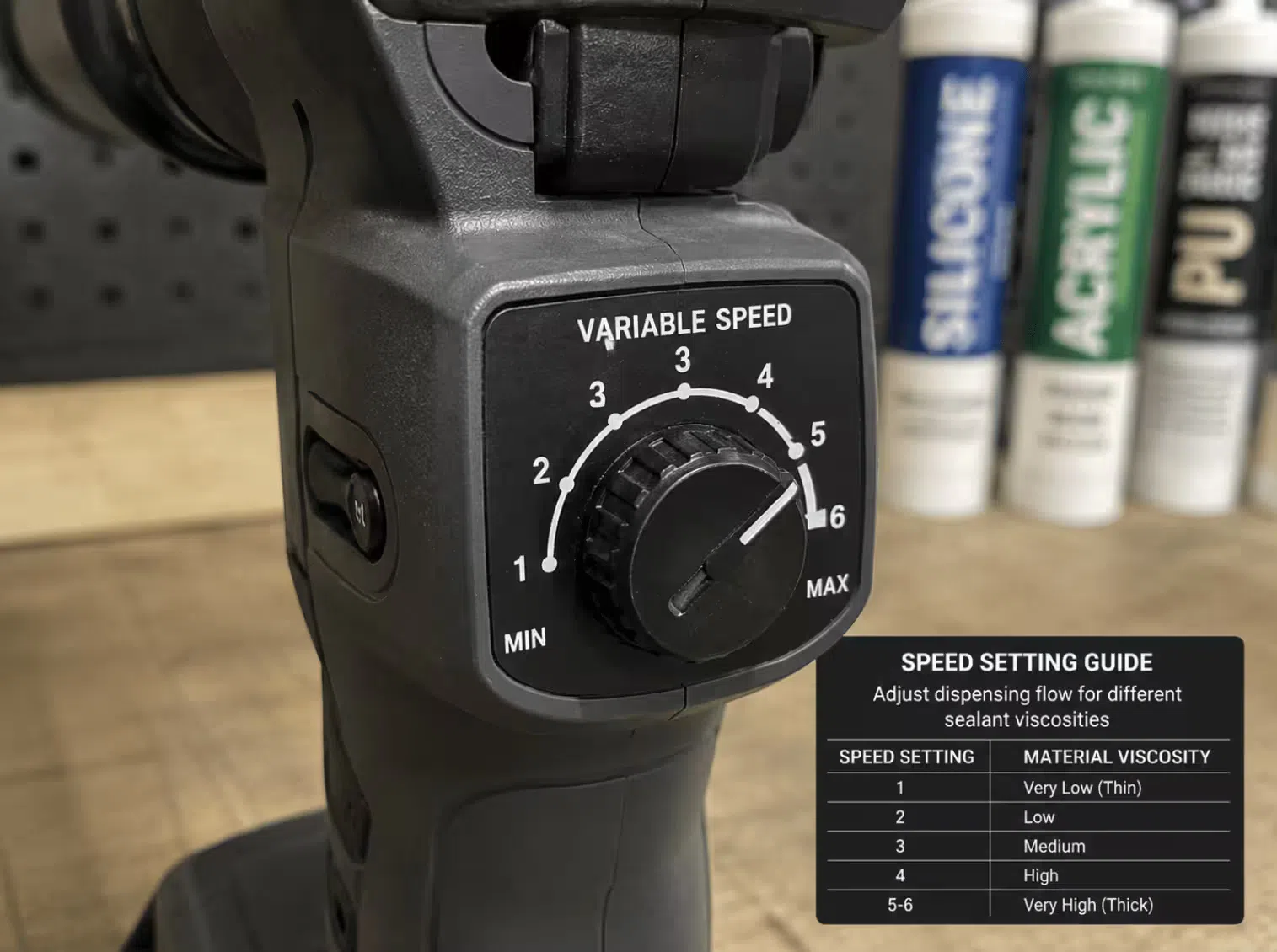
The main controls usually include a variable speed trigger, a speed dial, or both. These controls allow the user to adjust how quickly material flows from the nozzle. This matters more than many buyers realize. A narrow joint needs a slower, more controlled bead. A wider gap may need faster dispensing. A thicker sealant may also require a different setting than a softer acrylic caulk.
Another important feature is anti-drip. On many professional cordless electric caulking guns, the motor briefly reverses when the trigger is released. This pulls back pressure from the cartridge and helps prevent sealant from continuing to ooze out of the nozzle. Without this feature, the user often has to manually release pressure or deal with wasted material between passes.
In short, a good power caulking gun is not just about pushing material out. The real value is controlled dispensing: steady flow, less waste, and less strain on the operator.
Battery vs. Corded vs. Pneumatic Caulking Guns
When sourcing powered caulking guns, buyers usually compare three main types: battery-powered, corded electric, and pneumatic. They may look similar from the outside, but their working environments are quite different.
A battery caulking gun runs on a rechargeable battery pack. Its biggest advantage is mobility. The operator can move around a job site without dragging a power cord or air hose. This makes battery models especially suitable for construction sites, window and door installation, roofing, renovation work, and general field service.
The tradeoff is battery management. For light or medium use, one battery may be enough. For all-day professional work, users may need spare batteries or a fast charger.
A corded electric caulk gun plugs into a wall outlet or generator. It can run continuously as long as power is available, which may be useful for workshops, production benches, or fixed assembly areas. However, the power cord limits movement and can become a safety issue on busy job sites. For that reason, corded models are less popular with mobile contractors.
A pneumatic caulk gun uses compressed air from an air compressor. These tools are simple, durable, and easy to control through air pressure adjustment. They are common in factories, production lines, and industrial sealing environments where compressed air is already available. The downside is obvious: the compressor, hose, noise, and setup are all part of the package.
For most distributors serving construction, renovation, and installation markets, battery-powered caulking guns are often the most practical choice. They give end users the freedom to work without a compressor or power outlet, which is exactly what many job sites need.
Key Specifications to Check Before Ordering
Before adding a battery caulking gun to your product line, do not judge the tool only by appearance. Two models may look almost the same in photos but perform very differently in real use. These are the specifications worth checking.
Battery Voltage and Platform
Most professional cordless caulking guns use 12V, 18V, or 20V battery packs. In general, higher-voltage platforms can support stronger motors and higher dispensing force, which helps when working with thick sealants or adhesives.
Battery platform compatibility is also important. In many markets, contractors already own tools from brands such as DeWalt, Milwaukee, Makita, or Ryobi. If a caulking gun works with a battery platform they already use, it becomes easier to sell. It also reduces the need for extra chargers and separate battery systems.
For OEM or private-label programs, buyers should confirm battery voltage, capacity, charger input voltage, plug type, and whether the battery is included or sold separately.
Dispensing Force
Dispensing force determines how easily the gun can push material through the nozzle. It is usually measured in pounds or newtons.
A standard silicone sealant does not require extremely high force. Polyurethane sealant, MS sealant, and construction adhesive usually need more power. If your target customers work with high-viscosity materials, do not choose a low-force model just because it looks cheaper. That is how returns, complaints, and dramatic warehouse emails are born.
The safest approach is to test samples with the actual sealant brands your customers use.
Cartridge and Sausage Pack Compatibility
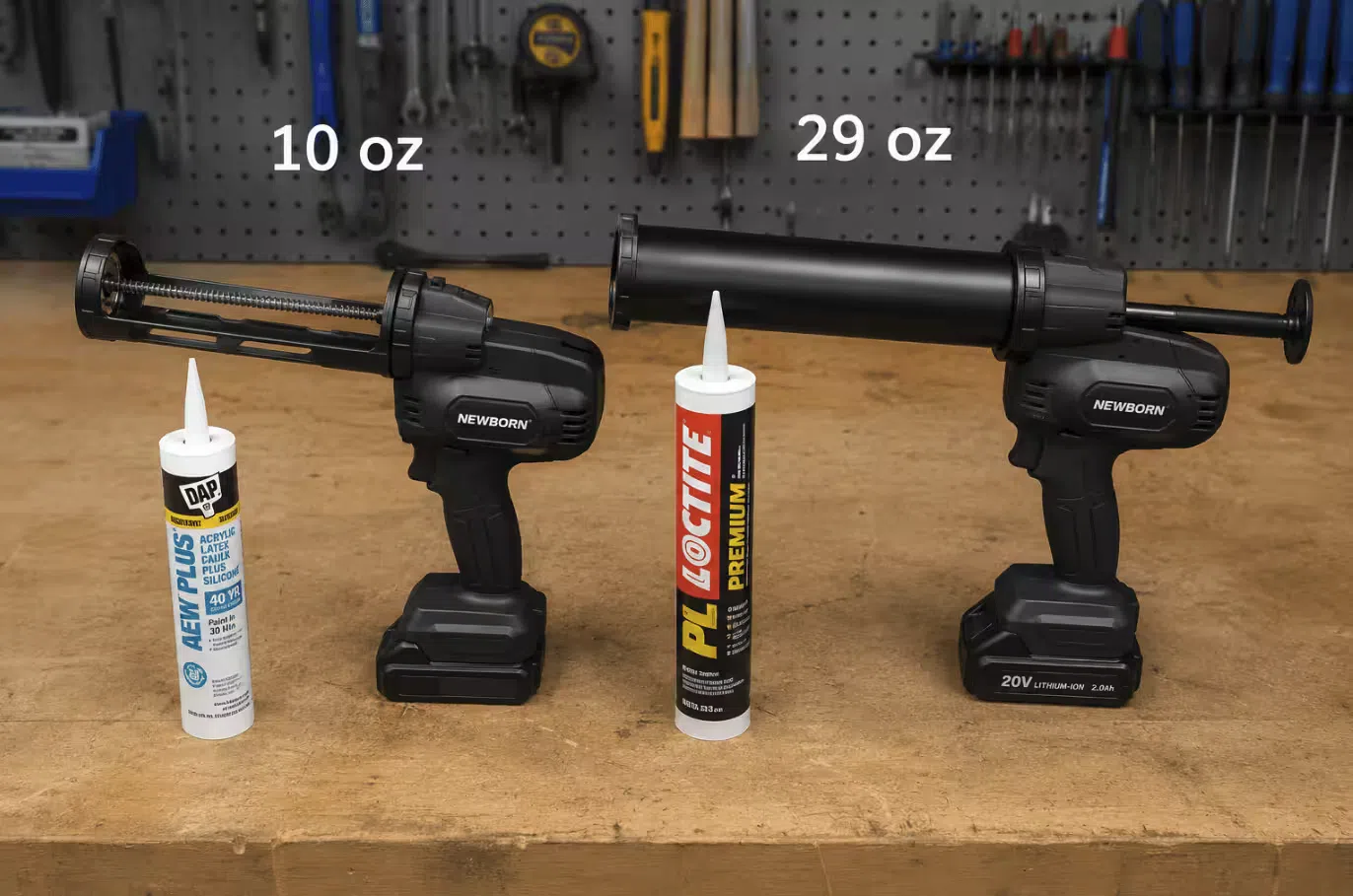
Check which cartridge sizes the gun supports. Common formats include 10 oz / 300ml cartridges, 28 oz, 29 oz, 30 oz cartridges, and 600ml sausage packs.
Some models are designed for only one cartridge size. Others support interchangeable barrels or holders, allowing the same tool platform to work with multiple formats. For wholesalers and distributors, multi-format compatibility can be a strong advantage because customer needs vary by region and application.
If your customers mainly use standard cartridges, a 10 oz model may be enough. If they work on facade sealing, industrial joints, or large-volume applications, larger barrels or sausage pack models may be more suitable.
Speed Control
Speed control affects bead quality. A cordless caulking gun with a variable speed trigger or multi-position speed dial gives users more control over flow rate.
For example, a low speed setting helps with narrow joints and detail work. A higher speed setting may be useful for long straight runs or larger gaps. For thicker materials, the operator may need to adjust speed carefully to avoid uneven flow.
A single-speed tool may be acceptable for basic use, but it is less flexible. For professional users, 4 to 6 speed settings are usually more practical.
Anti-Drip Function
Anti-drip is one of those features that sounds small until users have to work without it. When the trigger is released, pressure inside the cartridge can continue pushing sealant out of the nozzle. This creates mess, waste, and extra cleanup.
A proper anti-drip function helps release pressure automatically. For professional-grade battery caulking guns, this feature should be considered standard, not optional decoration for a brochure.
Weight and Balance
Always compare weight with the battery installed. Some product listings show bare tool weight only, which does not reflect real working conditions.
Balance also matters. A tool with poor front-end balance can feel heavier than it actually is, especially during overhead work or long sealing sessions. Grip shape, trigger position, barrel length, and battery placement all affect comfort.
For professional users, ergonomics can be just as important as dispensing force. A powerful tool that feels awkward after ten minutes is not exactly winning hearts on the job site.
Common Sealants and Adhesives Used With Battery Caulking Guns
A battery caulking gun can dispense many types of sealants and adhesives, but not every tool handles every material equally well. The material your customers use should guide your sourcing decision.
Silicone sealant is one of the most common materials. It flows relatively smoothly and is used for windows, doors, bathrooms, kitchens, and general sealing work. Most battery caulking guns can handle silicone without difficulty.
Acrylic sealant and latex caulk are also common in interior finishing, painting, and light construction. These materials usually require moderate dispensing force and work well with most cordless models.
Polyurethane sealant is thicker and more demanding. It is often used in construction joints, expansion joints, facade work, and outdoor applications. Buyers targeting these markets should choose models with higher dispensing force and stronger gear systems.
MS sealant, also known as modified silane sealant, sits somewhere between silicone and polyurethane in many applications. It offers good bonding and weather resistance, and most professional battery caulking guns can dispense it if the motor and push rod are properly designed.
Construction adhesive is usually the toughest material in this category. It is used for bonding panels, trim, subfloors, and other building components. Not every battery-powered caulking gun can handle thick construction adhesive reliably. If your customers use heavy-duty adhesive, confirm the tool’s maximum dispensing force before ordering.
What B2B Buyers Should Confirm With Suppliers
For wholesale, distribution, and OEM orders, the product itself is only part of the decision. Buyers also need to confirm packaging, spare parts, testing, and after-sales support. This is where many sourcing problems hide, because apparently life was not already complicated enough.
Battery and Charger Details
Confirm the battery voltage, battery capacity, charger type, input voltage, charging time, and plug standard. A tool that ships with the wrong charger plug creates immediate problems for customers.
If the gun is designed to work with a specific battery platform, check compatibility carefully. “Compatible with 18V battery” is not enough. Buyers should confirm exact battery interface, locking structure, and real-world fit.
Spare Parts Availability
Ask whether the supplier can provide replacement push rods, barrels, nozzles, seals, batteries, chargers, and other wear parts.
Professional users do not want to replace the entire tool because one small component fails. Spare parts availability improves customer satisfaction and helps distributors build long-term trust.
OEM Branding and Packaging
For private-label projects, confirm color options, logo placement, label design, manual language, packaging style, barcode requirements, and carton specifications.
A good OEM supplier should be able to support local market requirements, whether the products are sold through hardware stores, tool distributors, construction suppliers, or online channels.
Quality Inspection and Testing
Before bulk production, ask what tests are performed. Important checks may include dispensing force testing, battery runtime testing, anti-drip function testing, push rod alignment, trigger response, and charger safety inspection.
Sample testing is highly recommended. Use sealants and adhesives that are common in your target market. Testing only with easy-flow silicone may not reveal problems that appear with polyurethane or construction adhesive.
Price, MOQ, and Total Cost
Battery caulking gun price depends on motor quality, battery capacity, charger type, barrel design, accessories, packaging, and order quantity.
Do not compare only the bare tool price. Some suppliers quote a low price but exclude batteries, chargers, spare barrels, or packaging upgrades. For real cost comparison, calculate the complete set price and landed cost.
Also confirm MOQ, sample cost, lead time, warranty policy, and replacement terms before placing a bulk order.
FAQ
Is a battery caulking gun worth it for professional use?
Yes, especially for contractors and installers who apply sealant regularly. A battery caulking gun reduces hand fatigue, improves bead consistency, and helps speed up repetitive dispensing work. For occasional home use, a manual caulk gun may still be enough. For daily professional use, the battery-powered option is usually worth the upgrade.
What cartridge sizes do battery caulking guns support?
Most professional models support standard 10 oz / 300ml cartridges. Larger models may support 28 oz, 29 oz, 30 oz cartridges, or 600ml sausage packs. Some cordless caulking guns use interchangeable barrels, allowing one tool to work with different cartridge formats.
Can a battery caulking gun handle thick sealants?
It depends on dispensing force and motor design. Higher-voltage models, such as 18V or 20V tools, usually perform better with polyurethane sealant, MS sealant, and construction adhesive. Buyers should confirm the maximum dispensing force and test the tool with real materials before placing a bulk order.
What is the difference between a battery caulking gun and a pneumatic caulk gun?
A battery caulking gun uses a rechargeable battery and electric motor. It is portable and does not require an air compressor. A pneumatic caulk gun uses compressed air and must be connected to a compressor through a hose. Pneumatic models are often used in factories and industrial production lines, while battery models are better for mobile job site work.
How is an automatic caulking gun different from a manual caulk gun?
An automatic caulking gun uses electric power or compressed air to push material out of the cartridge. A manual caulk gun relies on hand pressure. Automatic guns reduce physical effort and provide more consistent dispensing during long jobs. Manual guns are simpler, lighter, and cheaper, but they are less efficient for repeated professional use.
Do battery caulking guns come in different battery platforms?
Yes. Many cordless caulking guns are designed around specific battery platforms, such as DeWalt 20V, Milwaukee M12/M18, Makita 18V, or Ryobi 18V. Contractors often prefer tools that work with batteries they already own. For wholesale buyers, choosing the right platform or offering compatible options can make the product easier to sell.
Looking for Battery Caulking Guns for Wholesale or OEM Supply?
If you are sourcing cordless caulking guns for wholesale, OEM, or bulk supply, contact our team with your target market, cartridge format, battery platform requirements, and expected order quantity.
We can help recommend suitable battery caulking gun models for your product line, including options for standard cartridges, large cartridges, and sausage pack applications.