A bulk caulk gun is a dispensing tool built for sealant and adhesive that comes in bulk containers rather than standard cartridges or sausage packs. For B2B buyers — wholesalers, distributors, construction suppliers, and procurement managers — understanding when bulk-pack dispensing is the right format helps you stock the correct tools for customers running high-volume sealing projects.
This guide covers what a bulk caulk gun is, how it compares to cartridge and sausage pack options, how bulk loading works, and what to verify before ordering cordless models for wholesale.
What Is a Bulk Caulk Gun?
A bulk caulk gun differs from a standard cartridge gun in one key way: it accepts open-ended bulk containers instead of sealed, pre-filled cartridges. Bulk containers typically hold 20 oz, 29 oz, or quart-sized amounts of sealant — two to three times the volume of a standard 10 oz cartridge.
The barrel has an open end where the bulk tube is loaded. A plunger system pushes material forward as the trigger is pulled. This design lets operators dispense more sealant before reloading, which matters on projects that require long continuous beads or high-volume application.
Contractors use bulk caulk guns for firestop systems, expansion joint sealing, curtain wall perimeter caulking, and large-area waterproofing. On these jobs, the time lost to reloading a standard cartridge gun adds up quickly across a crew.
When Bulk Pack Makes Sense Compared to Cartridge and Sausage
Choosing between cartridge, sausage pack, and bulk depends on project volume, material type, and how often the crew is willing to reload.
Cartridge (10 oz): The most common format. Easy to load, widely available, and suitable for small to medium jobs — windows, doors, touch-up work, and general maintenance. Most contractors start here.
Sausage pack (20 oz): A foil-walled cylindrical pack that fits into a sausage-style gun. It holds more material per load than a cartridge and produces less packaging waste. Sausage packs work well for medium-volume jobs like storefront installation, residential siding, and moderate expansion joint work.
Bulk (20 oz, 29 oz, quart): The highest-volume option per load. Bulk format makes sense when a crew runs continuous long beads across many linear feet — firestop penetration sealing, large curtain wall projects, bridge and highway joint work, or industrial plant maintenance. Fewer reloads mean less downtime and more consistent flow.
The crossover point is usually project scale. If crews are reloading every 15 to 20 minutes on a large project, switching from cartridge to bulk can save meaningful labor time over the course of a job.
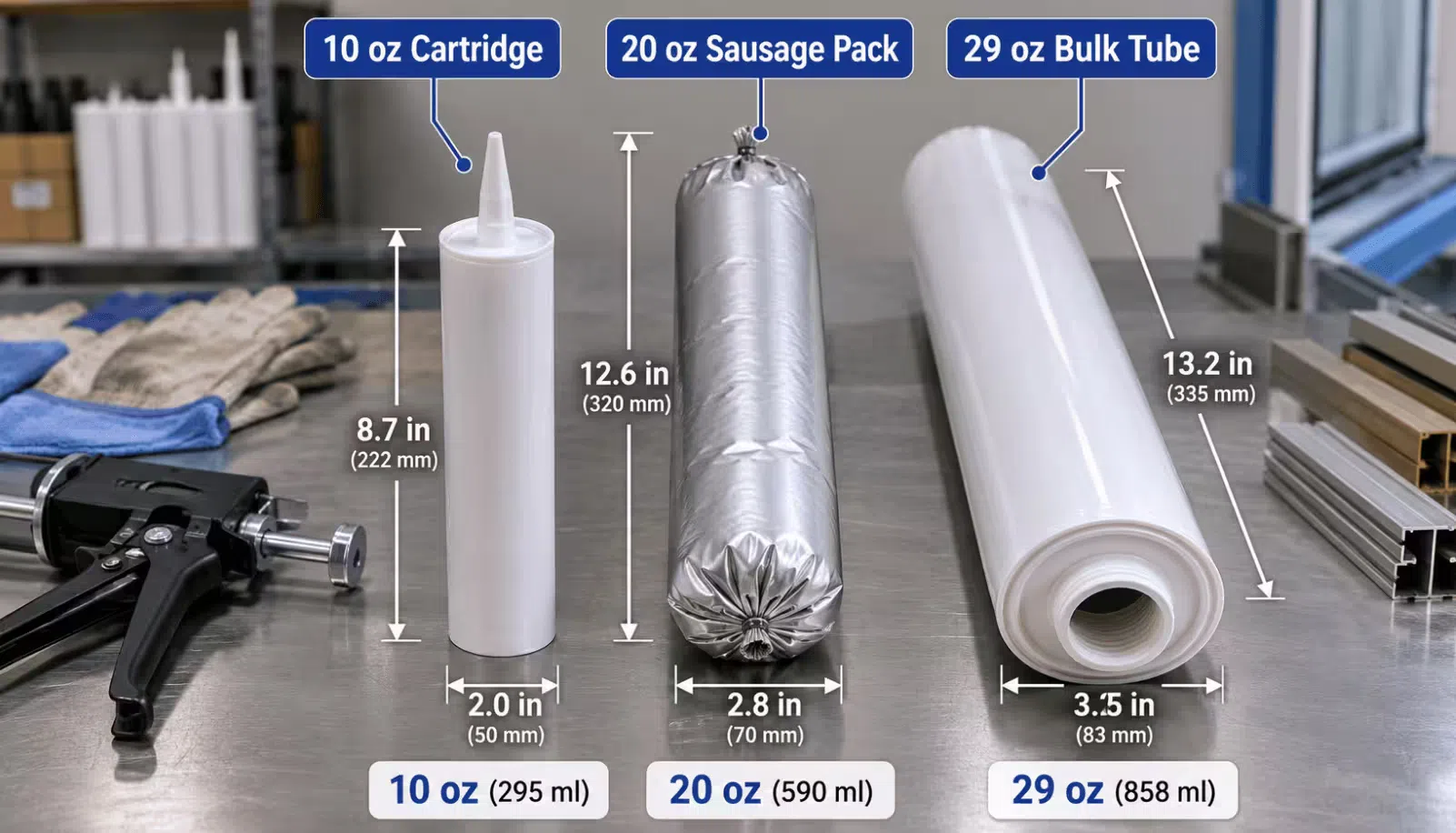
Cartridge, sausage pack, and bulk containers compared by volume — bulk holds two to three times more sealant per load.
How to Load a Bulk Caulk Gun
Loading a bulk caulk gun is different from loading a cartridge or sausage pack. The process depends on the barrel design, but most bulk guns follow a similar pattern.
Step 1: Open the barrel. Release the barrel latch or twist-open mechanism. The barrel should swing open or slide back to expose the loading chamber.
Step 2: Insert the bulk container. Place the bulk tube into the barrel with the nozzle end pointing forward. The container must sit flush against the barrel's front seal.
Step 3: Close and seat the plunger. Close the barrel and push the plunger forward until it contacts the back of the container. Some guns have a ratcheting plunger that clicks into position.
Step 4: Prime and test. Squeeze the trigger until sealant flows from the nozzle. If nothing comes out, check that the container's foil seal has been punctured and that the plunger makes full contact.
Common loading mistakes include failing to puncture the seal, leaving air gaps between the plunger and container, and using the wrong container size for the barrel diameter. These errors cause inconsistent flow, air pockets in the bead, or material leaking from the back of the barrel.
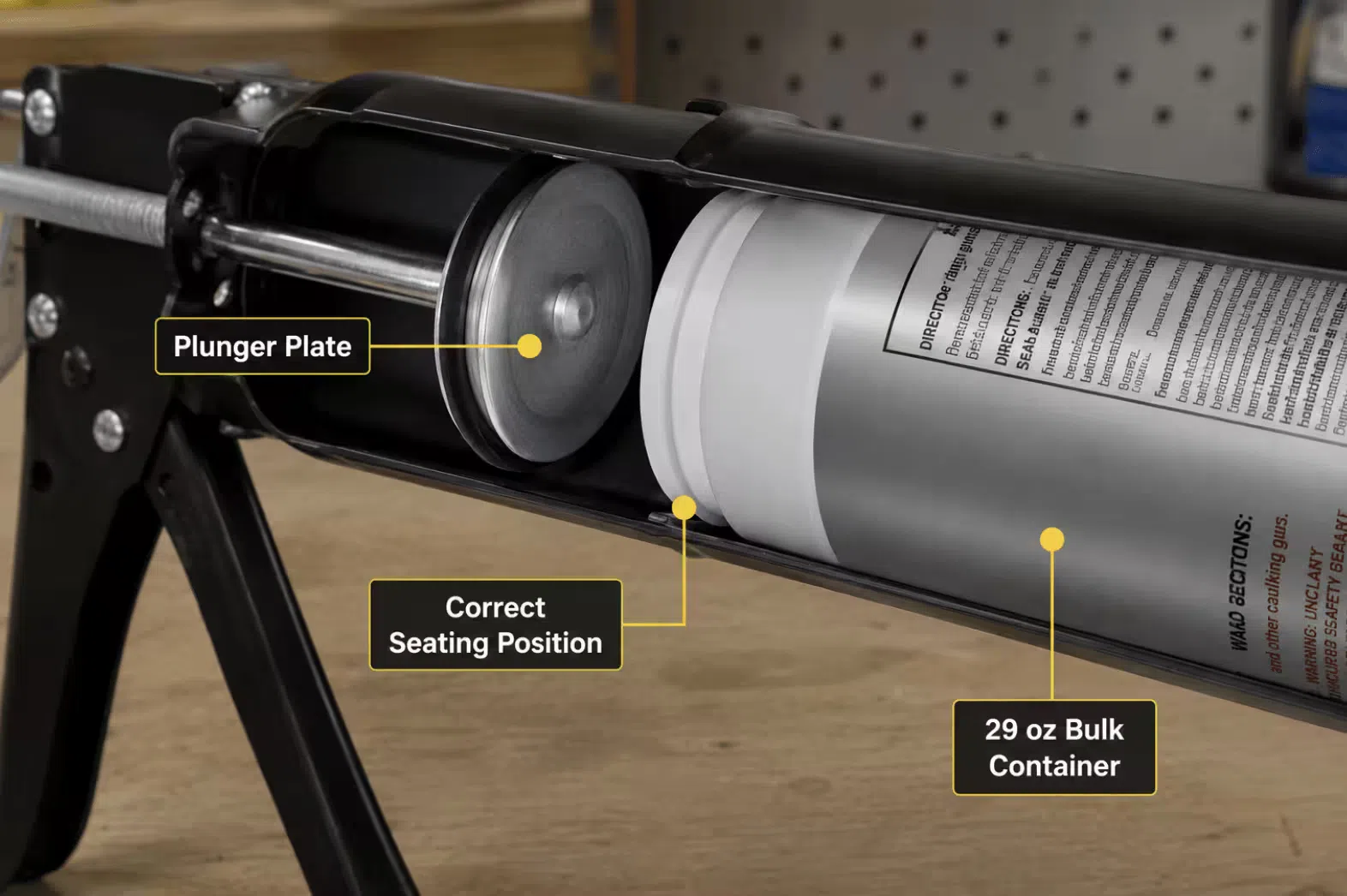
The plunger must seat firmly against the back of the bulk container to maintain consistent dispensing pressure.
Cordless Bulk Caulk Gun: Compatibility and Performance
A cordless caulking gun can handle bulk packs, but buyers should verify a few specifications before ordering.
Motor output and dispensing force. Bulk containers are often larger and may hold higher-viscosity materials than standard cartridges. The cordless gun needs enough motor output and thrust to push thick sealant at a steady rate. For industrial-grade sealants like polyurethane or firestop compounds, look for models with higher dispensing force ratings.
Speed control. Variable speed triggers or adjustable settings help operators manage different sealant viscosities. A slower speed works for thick firestop material; a faster speed suits thinner silicone. This matters more with bulk guns because the operator dispenses larger volumes per session. See our guide on cordless caulking gun battery and speed control specs for more detail on how these features work together.
Anti-drip function. When the operator releases the trigger, the gun should relieve internal pressure to stop material flow. Without this feature, sealant drips from the nozzle, wasting material and creating cleanup work. Cordless models with an anti-drip mechanism retract the plunger slightly on trigger release, breaking the pressure seal.
Battery platform and runtime. Bulk dispensing sessions run longer than cartridge sessions. A cordless bulk caulk gun needs enough battery capacity for extended use without frequent recharging. For crews working across a full job site without easy access to power outlets, battery reliability is essential.
The cordless advantage is straightforward on large job sites: no air compressor to set up, no hose to manage, and full mobility across multiple work areas. For contractors doing firestop on multi-story buildings or perimeter caulking on commercial facades, cordless dispensing removes the logistics overhead of pneumatic systems. Our comparison of cordless vs pneumatic caulking guns covers these trade-offs in more detail.
What to Check Before Ordering Bulk Caulk Guns for Wholesale
Distributors and procurement managers sourcing bulk caulk guns should evaluate these factors.
Pack size compatibility. Confirm which bulk container sizes the gun accepts — 20 oz, 29 oz, quart, or other formats. Some guns fit a single size; others accommodate multiple sizes with barrel adapters.
Barrel and plunger design. The barrel should seal tightly around the container to prevent backflow. The plunger should make full, even contact with the container base. Poor plunger fit is one of the most common causes of inconsistent dispensing.
Motor output for thick materials. Ask the manufacturer for dispensing force specifications. Guns rated only for thin silicone may not handle polyurethane, firestop, or construction adhesive in bulk format.
Battery and charger options. For cordless models, check battery voltage, amp-hour capacity, and whether the charger supports your target market's plug types. OEM orders often require region-specific charger configurations.
Spare parts availability. Bulk guns have more wear-prone components than cartridge guns — plunger seals, barrel liners, and nozzle adapters. Confirm that spare parts are available and that your supplier can fulfill replacement orders.
OEM options. For private-label or custom orders, confirm color, label design, carton packaging, and minimum order quantities early in the sourcing process.
FAQ
What is a bulk caulk gun and how does it differ from a cartridge gun?
A bulk caulk gun is designed for sealant that comes in open-ended bulk containers (20 oz, 29 oz, or quart), while a cartridge gun uses sealed 10 oz cartridges. Bulk guns hold more material per load and suit high-volume dispensing jobs where frequent reloading would slow the crew.
How do you load a bulk caulk gun?
Open the barrel, insert the bulk container with the nozzle end forward, close the barrel, and push the plunger until it contacts the back of the container. Puncture the container's seal before dispensing. The exact steps vary by model, but the principle is the same: the plunger must seat firmly to maintain dispensing pressure.
Is bulk loading better than sausage pack for large projects?
Bulk loading gives more material per load than sausage packs (20 oz sausage vs 29 oz or quart bulk), which means fewer reloads on very large projects. Sausage packs produce less packaging waste and swap faster. The right choice depends on project size, crew preference, and the sealant format your supplier carries.
Can a cordless caulking gun handle bulk pack sealant?
Yes, but verify that the model has sufficient motor output and dispensing force for the sealant viscosity you plan to use. Thick materials like firestop compound or polyurethane require higher thrust than thin silicone. Also check battery capacity — bulk sessions run longer than cartridge sessions.
What projects are best suited for bulk caulk guns?
Bulk caulk guns are most useful on projects requiring long continuous beads or high-volume application: firestop penetration sealing in multi-story buildings, expansion joint work on commercial and infrastructure projects, curtain wall perimeter caulking, and large-area waterproofing. Any job where crews would reload a cartridge gun every 15 to 20 minutes is a candidate for bulk format.
How do I know if my customers need bulk or cartridge dispensing?
Ask about project scale and material type. If their crews handle single-family window installs, cartridge guns are sufficient. If they seal firestop penetrations across a multi-story building or run expansion joints on a commercial facade, bulk dispensing saves significant reload time. The crossover point is usually when a crew spends more time reloading than dispensing.
Looking for cordless caulking guns that support multiple pack formats? Explore our cordless caulking gun range for cartridge, sausage pack, and bulk dispensing options available for OEM and wholesale supply.