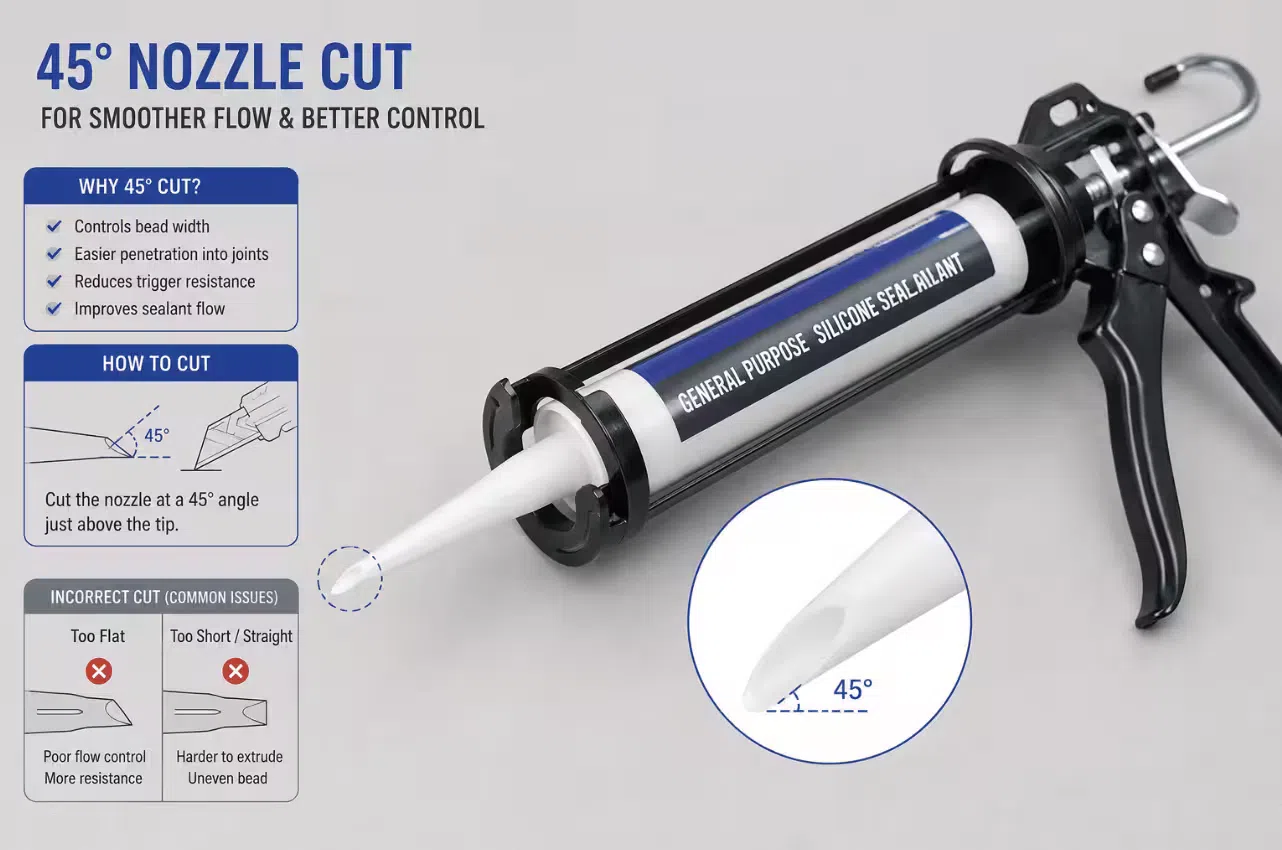
If your caulk gun is hard to squeeze, you are not alone. This is one of the most frequent complaints from construction workers, facility maintenance teams, and production staff who rely on manual caulking guns daily. A gun that feels stiff slows down work, produces inconsistent beads, and causes hand fatigue that compounds across a full shift.
The good news is that a caulk gun hard to squeeze usually traces to one of four causes: sealant that is too cold or thick for the gun, incomplete cartridge preparation, a thrust ratio below what the material needs, or a frame that flexes under load. Each cause has a practical fix, and understanding which one applies lets procurement managers decide whether to adjust work procedures or upgrade the tool.
Quick Self-Check: What Makes Your Caulk Gun Stiff
Run through this checklist before buying a replacement:
- Is the sealant temperature below 15°C? Cold sealant resists flow.
- Is the inner foil seal pierced in only one place? Thick sealants need more than one opening to flow freely.
- Is the nozzle cut smaller than the bead width you need? A pinhole opening creates unnecessary back pressure.
- Does the gun use a 7:1 thrust ratio? Low-ratio guns require more hand force with anything thicker than lightweight acrylic.
- Does the frame feel flexible when you squeeze? Thin stamped-metal frames bend, wasting some of the trigger force.
Two or more yes answers mean a combination of factors is at work. The sections below explain each cause and the practical response for B2B buyers who supply or use these tools.
Cause 1: Temperature and Sealant Viscosity
Silicone, polyurethane, and hybrid sealants thicken noticeably below 15°C. At low temperatures the same cartridge that dispenses smoothly in a heated warehouse becomes noticeably stiff on an outdoor jobsite. The material resists flow because its viscosity increases, not because the gun is defective.
Practical fixes for operations teams:
- Warm the cartridge in a bucket of warm water (not boiling) for 5 to 10 minutes before loading.
- Store sealant inventory in a heated area overnight during cold-weather projects.
- Switch to a higher thrust ratio gun for winter work to compensate for increased material resistance.
B2B buying note: Distributors supplying cold-climate markets should consider stocking 18:1 or higher thrust ratio guns as the baseline for winter-season orders. Customers who complain about stiff triggers in January are usually solving a cold-sealant problem that a higher-ratio gun addresses directly.
Cause 2: Improper Cartridge Preparation
The inner foil seal at the base of the nozzle is designed to keep sealant fresh during storage, but it creates the first point of resistance. Many users poke one small hole and expect full flow. In practice a single puncture creates a weak spot that the sealant has to force open, which adds to trigger effort.
Correct preparation:
- Cut the nozzle at a 45-degree angle to the bead width you need. A wider cut reduces back pressure.
- Pierce the foil seal in two or three places, or cut the full opening at once with a sharp blade.
- Remove dried sealant from a partially used nozzle before reloading.
Preparation mistakes are the easiest fix and require no equipment upgrade. For OEM buyers, adding pre-scored nozzles or a seal-piercing tool to the packaging can reduce end-user frustration without changing the gun specification.
Cause 3: Low Thrust Ratio — The Most Common Equipment Cause
Thrust ratio is the mechanical advantage the gun delivers. A 7:1 ratio means you apply seven units of force at the trigger for every one unit at the plunger. That works for low-viscosity acrylic sealants but not for thick adhesives, polyurethane sealants, or cold-weather dispensing.
Key Specification Table
| Specification | Unit | What It Affects | B2B Buying Note |
|---|---|---|---|
| Thrust ratio | Ratio (X:1) | Mechanical advantage — higher ratio = less trigger force needed | Choose 12:1 as minimum for general stock; 18:1 or 24:1 for customers using thick sealants |
| Frame material | Aluminum alloy or steel | Weight, corrosion resistance, stiffness under load | Aluminum suits mobile crews and overhead work; steel suits stationary heavy-duty use |
| Cartridge compatibility | ml (300 ml / 310 ml) | Fits standard sealant cartridges | 300 ml and 310 ml cartridges are interchangeable in standard 10 oz frames |
| Dripless mechanism | Yes / No | Releases cartridge pressure when trigger is released | Reduces dripping and material waste — confirm before ordering |
| Rod type | Smooth or ratcheted | Trigger feel and dispensing control | Smooth rod enables continuous variable pressure; ratcheted provides positive incremental engagement |
Application Matching Table
| Application | Recommended Gun Type | Key Specs to Check |
|---|---|---|
| General sealing — silicone, acrylic | Standard skeleton-frame manual (12:1) | Thrust ratio 12:1, dripless mechanism, 300 ml compatibility |
| Construction adhesives — polyurethane, hybrid | High-thrust manual (18:1 or 24:1) | Thrust ratio 18:1+, steel or reinforced aluminum frame |
| Cold-weather jobsite sealing | High-thrust manual (18:1+) | Thrust ratio 18:1+ to compensate for increased sealant viscosity |
| High-volume production dispensing | High-thrust manual (26:1) or pneumatic | Thrust ratio 26:1, durable frame, spare parts availability |
| Mobile installation crews | Lightweight aluminum frame (12:1 or 18:1) | Aluminum frame, dripless mechanism, 300 ml cartridge fit |
For distributors stocking for general trade, 12:1 is a practical minimum. If customers regularly report that their caulk gun is too hard to squeeze, moving them to an 18:1 model usually resolves the issue. The CAULKMFG manual component gun range includes models with thrust ratios from 7:1 to 26:1 (Items 03, 01, 04, and 02), giving buyers a choice across all typical sealant types.
Cause 4: Frame Quality and Design
Frame material and construction quality directly affect how much trigger force reaches the plunger. A frame that flexes under load absorbs energy that should go into dispensing.
Aluminum alloy frames are lighter and naturally rust-resistant. They reduce arm fatigue on long jobs and are preferred for mobile crews who carry their tools throughout a workday. Reinforced aluminum frames handle high-thrust operation without noticeable flex.
Steel frames are heavier and more rigid. They handle repeated high-thrust use without deforming, making them suitable for shop-floor dispensing or jobsites where weight is less of a concern. Steel frames should be coated or painted to resist corrosion in wet environments.
Dripless mechanism: A pressure-release feature that vents cartridge pressure when the trigger is released. Without it, pressure stays in the cartridge and can cause continued dripping or trigger binding over time. For B2B buyers, this is a simple spec check that affects end-user satisfaction and material waste.
B2B sourcing note: Offering both aluminum and steel frame options in your product line lets distributors serve customers who prioritize weight reduction and those who prioritize maximum rigidity. OEM buyers can specify frame material, handle color, and branding for their target market.
When to Upgrade vs. Fix
| Situation | Recommended Action | B2B Implication |
|---|---|---|
| Occasional cold-weather stiffness | Warm cartridges, check seal puncture | Train end-users — no inventory change needed |
| Dried sealant in the nozzle | Clean or replace the nozzle | Include spare nozzles in accessory packs for OEM orders |
| Thin acrylic sealant with a cheap gun | Keep using — not an equipment problem | No change needed |
| Regular hand fatigue with thick sealants | Upgrade to 18:1 or higher thrust gun | Restock with higher-ratio models; adjust inventory for your customer base |
| Crew of 5+ reporting the same problem | Stock higher-thrust models for next order | Update purchase specifications for bulk orders |
| Production-line adhesive dispensing | Evaluate high-thrust manual or pneumatic options | Check spare parts availability and barrel/nozzle replacement options before buying |
B2B buying note: When multiple end-users at the same customer site report trigger resistance, the gun spec is the common factor. Switching the recommended stock item to a higher-ratio model usually reduces repeat complaints and support calls. CAULKMFG offers sample testing and small-batch orders so distributors can validate new models before committing to container quantities.
FAQ
Why is my caulking gun so hard to push?
The most common reasons are cold sealant, an incompletely pierced foil seal, a nozzle opening that is too small, or a thrust ratio below what the sealant type requires. Start with cartridge preparation — warm the tube, enlarge the nozzle cut, and pierce the seal in two or three places. If the problem continues, check the thrust ratio.
Why is my caulk gun not pushing caulk out?
If the trigger moves but no sealant comes out, the plunger may not be seated against the cartridge base, or the rod may have slipped past the ratchet mechanism. Remove the cartridge and confirm the plunger rod engages properly. Also verify the inner seal is fully pierced — sealant cannot pass through an unbroken foil barrier.
What thrust ratio do I need for silicone sealant?
For standard silicone at room temperature, 12:1 is usually enough. For thick silicone or cold conditions, 18:1 provides smoother flow with less hand effort. Always check the sealant manufacturer's technical data sheet for recommended application temperature and dispensing force.
Can a high-thrust gun be used with thin acrylic sealant?
Yes. High-thrust guns work with all sealant types. The main difference is that a high-ratio gun dispenses sealant faster for the same trigger pull, so operators may need a lighter touch with thin materials to avoid over-application. Dual-ratio models (like CAULKMFG Items 03 and 04) offer both a low and high setting in one tool.
What frame material should I stock for general distribution?
Aluminum alloy frames appeal to a broader customer base because they are lighter and rust-resistant. Steel frames sell better in markets where maximum rigidity is the top priority, such as industrial supply channels. Distributors who stock both options cover both segments without carrying duplicate models.
What spare parts should I keep in stock for manual caulking guns?
The most commonly replaced parts are plunger rods (which can bend under heavy use), trigger pins, and retaining clips. For dripless models, check whether the pressure-release valve is serviceable. CAULKMFG offers replacement components for all manual gun models, and OEM buyers can specify included spare parts in bulk packaging.
Does CAULKMFG offer OEM or private-label options?
Yes. CAULKMFG provides OEM branding, custom colors, custom packaging, and model specification changes for volume orders. Buyers can select frame material, thrust ratio, handle color, rod type, and packaging format. Sample testing is available before bulk commitment.
Sourcing the Right Gun for Your Operation
When a caulk gun is hard to squeeze, the fix is usually straightforward — warm the sealant, improve cartridge prep, or move to a higher thrust ratio. For distributors and procurement managers who need to stock guns that end-users actually want to use, the CAULKMFG manual component gun range offers aluminum and steel frame models with thrust ratios from 7:1 to 26:1, dripless mechanisms, and OEM/private-label support.
To find the right model for your market, contact CAULKMFG with your typical sealant types, cartridge size (300 ml, 310 ml, or other), target market region, expected order quantity, and any OEM or private-label requirements. The product page at /manual-component-guns lists all available configurations.