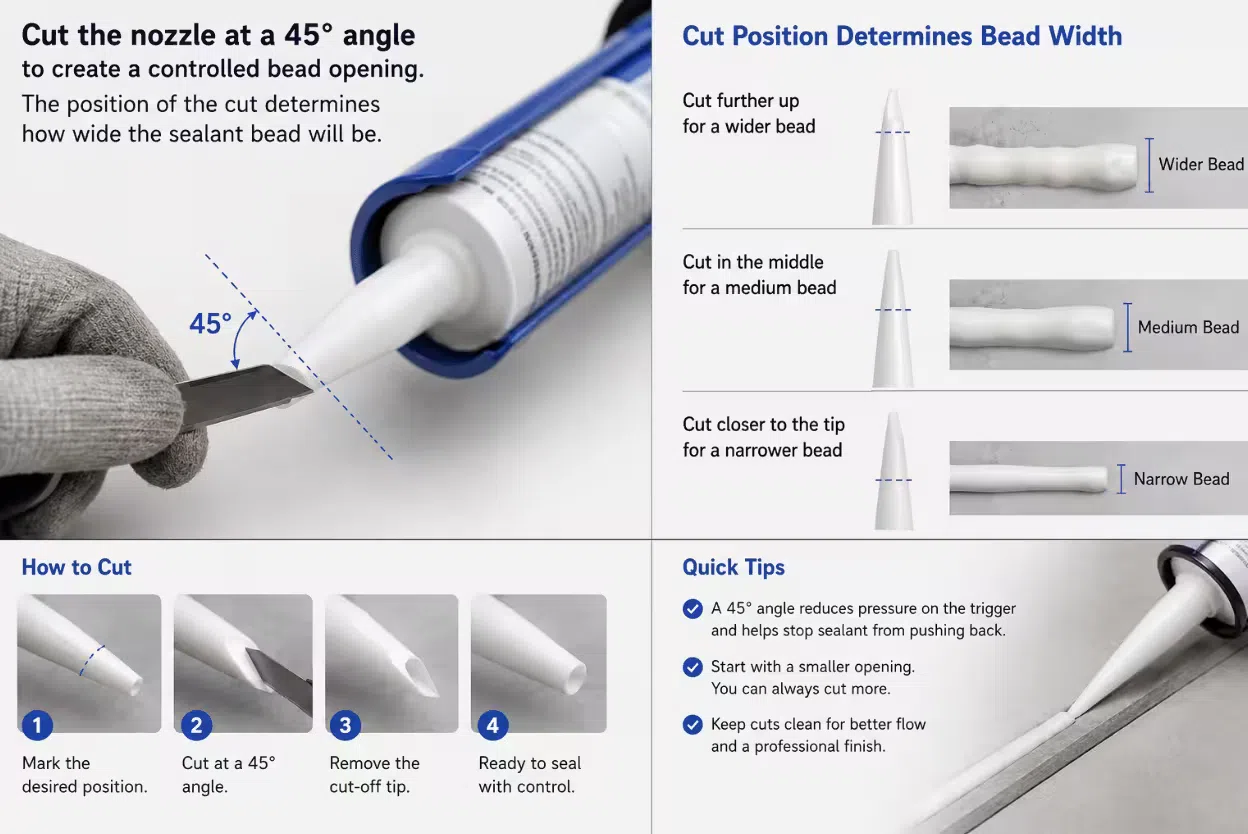
 Cutting a manual caulking gun nozzle at a 45-degree angle to create a controlled bead opening. The position of the cut determines how wide the sealant bead will be.
The nozzle on a manual caulking gun is the part that controls bead size, flow rate, and finish quality. A properly cut caulk gun nozzle prevents sealant waste, reduces operator rework, and produces a bead that meets job specifications. For B2B buyers sourcing manual caulking guns for distributors or OEM customers, understanding how nozzle cutting affects sealant dispensing helps when selecting models, training operators, and managing material costs. This guide covers nozzle cutting techniques, bead size selection, common mistakes, and nozzle options.
Why the Nozzle Matters for Manual Caulking Gun Performance
The nozzle is not an accessory — it is the primary control point for sealant dispensing. A cut that is too small creates backpressure that makes the trigger hard to squeeze, especially with thick materials. A cut that is too large produces a bead wider than needed, wasting sealant and creating a messy finish.
The correct nozzle cut depends on three factors: sealant viscosity, the required bead width, and the manual gun's thrust ratio. A high-thrust manual caulking gun — 18:1 or 26:1 — can push thick sealant through a small nozzle opening without excessive force. A lower thrust ratio gun, such as 7:1 or 12:1, works better with a larger opening and thinner sealants.
For B2B buyers, an operator who understands how the nozzle interacts with the gun reduces material waste by an estimated 20 to 30 percent compared to someone who cuts the nozzle at random. This matters for bulk contracting, production-line work, and any operation where sealant cost is a significant expense. When sourcing manual caulking guns in volume, check whether the gun has a built-in cutter that produces a clean cut without additional tools.
Key Nozzle Specifications Reference
| Specification | Unit | What It Affects | B2B Buying Note |
|---|---|---|---|
| Cut angle | degrees | Bead tracking along the joint line | Confirm operators can replicate a 45-degree cut across all gun types in stock |
| Nozzle opening width | mm | Bead size and sealant flow rate | Match to the most common bead sizes your customers require |
| Thread standard | Coarse or fine thread | Extension nozzle and replacement compatibility | Standardize on one thread type across all stocked gun models |
| Nozzle material | Plastic | Cut quality and reuse durability | Harder plastic holds a cleaner cut edge; softer plastic deforms under the blade |
How to Cut a Manual Caulking Gun Nozzle
The standard method is a 45-degree angled cut across the tip. This produces a pointed opening that follows the joint line naturally and releases the bead cleanly against the surface.
Tools for Cutting
A sharp utility knife produces the cleanest cut. The built-in cutter on many manual caulking guns — a small slot or blade on the side of the frame — can work in a pinch but often produces a rough or crushed cut edge. For B2B buyers stocking manual caulking guns for resale, the built-in cutter quality is a visible difference between budget and premium models. Distributors should test whether the cutter produces a clean slice without bending or splitting the nozzle material.
Cutting Steps
- Cut the nozzle at a 45-degree angle at one of the visible measurement rings along the tip.
- Cut closer to the narrow end for a small bead (3–4 mm) or closer to the wide end for a larger bead (6–10 mm).
- Pierce the inner foil seal inside the cartridge with a long wire or the puncture rod built into some gun models. This step is often skipped and is a common cause of no-flow complaints.
- Snap the cut piece off cleanly — do not twist or bend, which can split the plastic and create an uneven opening.
Application and Nozzle Cut Matching Table
| Application | Recommended Gun Type | Key Specs to Check |
|---|---|---|
| Window and door sealing | Standard manual caulk gun, 12:1 to 18:1 thrust | Nozzle cut at small ring, sharp blade for clean edge |
| Kitchen and bathroom silicone | Standard manual caulk gun, 7:1 to 12:1 thrust | Small nozzle opening to control low-viscosity silicone flow |
| General construction sealing | Manual caulk gun, 12:1 to 18:1 thrust | Middle ring cut, consistent 45-degree angle |
| Polyurethane adhesive bonding | High-thrust manual gun, 18:1 to 26:1 thrust | Larger nozzle opening to prevent backpressure buildup |
| Concrete crack filling | Heavy-duty manual gun, 24:1 to 26:1 thrust | Wide nozzle cut, inner seal fully pierced before use |
| Corner and edge beading | Any standard manual caulk gun | V-cut technique; sharper blade required for clean notch |
Nozzle Types for Manual Caulking Guns
Most 300 ml sealant cartridges use a standard threaded plastic nozzle that screws onto the cartridge tip. These nozzles are designed as single-use disposables but can be cleaned and reused if the sealant has not cured inside.
Standard Threaded Nozzle
This is the most common type supplied with sealant cartridges. It works with all manual caulking guns that accept the 300 ml cartridge format. The nozzle is cut to the desired bead size and screwed directly onto the cartridge.
Screw-On Replacement Caulk Nozzles
Some manufacturers offer replacement screw-on nozzles in fixed opening sizes. These eliminate the need to cut each nozzle manually and are useful for operations that use the same bead size repeatedly. For B2B buyers, stocking a set of standard replacement nozzles is a practical add-on item for distribution.
Caulk Nozzle Extensions
A caulk nozzle extension is a rigid or flexible tube that attaches to the standard nozzle to reach into tight spaces — behind sinks, inside wall cavities, or under countertops. Extensions are available in varied lengths and diameters. When recommending extension nozzles to wholesale customers, verify that the extension matches the cartridge thread standard. A caulking gun nozzle extension that does not seal properly creates leaks and messy joints.
Caulk Nozzle Applicators
Specialized caulk nozzle applicators are designed for corner beading, glazing, or panel bonding. These are less common in general distribution but useful for niche applications where bead placement must follow an exact profile.
Common Caulking Nozzle Mistakes
| Mistake | Cause | Result | Fix |
|---|---|---|---|
| Cutting too large a hole | Not checking bead size requirement | Sealant waste, messy bead, extra cleanup | Cut at the smallest measurement ring first and increase only if needed |
| Wrong cut angle | Not knowing the 45-degree standard | Bead does not track the joint line; poor adhesion | Always cut at 45 degrees |
| Built-in cutter produces rough edge | Gun cutter is dull or poorly designed | Ragged bead, uneven flow rate | Use a sharp utility knife |
| Not piercing inner foil seal | Assuming seal is pre-opened | No sealant flow; operator may replace cartridge unnecessarily | Pierce the foil with the gun puncture rod or a thin wire |
| Using a dull blade | Blade not replaced | Crushed nozzle opening, irregular bead shape | Replace blade before each cutting round |
Nozzle Care and Storage
Sealant left in the nozzle to cure creates a blockage for the next use. For occasional work, inserting a screw or nail into the nozzle opening slows curing. For daily operations, remove the nozzle and cap or seal the cartridge. If a nozzle becomes blocked, a thin wire can break through soft cured material, but fully cured sealant usually requires cutting further back or replacing the nozzle entirely.
For B2B buyers, nozzle-blockage downtime is a real cost in field operations. Including spare nozzles with each bulk cartridge order is a low-cost way to keep job sites running.
FAQ
What angle should I cut a caulk gun nozzle?
Cut the nozzle at a 45-degree angle. This creates a pointed opening that follows the joint line naturally. A shallower angle produces a wider bead; a steeper angle produces a narrower one.
How do I cut a V-shaped caulk tip?
A V-cut is made by cutting a small notch out of both sides of the nozzle tip. This is useful for corner and edge work where sealant needs to bond into both surfaces at once. The V-cut works best with medium-viscosity sealants like acrylic and requires a sharp blade.
What size nozzle should I use for silicone sealant?
For silicone sealant, cut at the smallest measurement ring — usually the first ring from the tip. This produces a 3–4 mm bead suitable for bathroom fixtures and window sealing. Silicone is low viscosity, so a small opening helps control flow and prevents dripping.
Can I reuse a sealant nozzle?
Yes, as long as the sealant has not fully cured inside. Clean the nozzle immediately after use. For short-term storage, insert a screw into the opening to slow curing. For B2B operations, replacing the nozzle with each new cartridge is more reliable than cleaning.
Why is my caulk gun nozzle clogging?
Clogging can happen when the inner foil seal was not pierced, when sealant dried inside the nozzle from a previous use, or when the sealant contains fillers that settle and block the opening. For thick sealants, a larger cut reduces backpressure and prevents clogging.
How do I match a caulk nozzle extension to a manual caulking gun?
Check the thread type on the cartridge tip. Most 300 ml cartridges use a standard coarse thread. The extension must match this thread standard. Some manual caulking guns include a puncture rod that clears the extension when changing cartridges, which is helpful for high-volume operations.
Do spare caulk nozzles come with wholesale manual caulking gun orders?
Most manual caulking gun orders include the standard nozzle attached to each cartridge rather than separate nozzles. CAULKMFG can include extra nozzle packs with wholesale or OEM orders. Contact the sales team to coordinate nozzle quantities alongside your cartridge order volume.
Sourcing Manual Caulking Guns for Your Business
A manual caulking gun with clean nozzle cutting, consistent thrust ratio, and a durable frame is a reliable tool for any construction, manufacturing, or sealing operation. CAULKMFG supplies manual caulking guns in thrust ratio options from 7:1 to 26:1 with aluminum alloy and steel frames for wholesale distribution.
When ordering, tell the sales team which sealant types and bead sizes you dispense most often. This helps match the right thrust ratio and model for your customers. Also include any nozzle configuration needs, extension requirements, and whether you need OEM branding or custom packaging.
To receive a quote, contact CAULKMFG with your sealant types, cartridge or pack size, target market, expected monthly order quantity, and any OEM or private-label requirements. The product team can recommend a suitable manual caulking gun model and nozzle plan for your distribution line.