When procurement managers compare cordless sausage caulking gun models, they often focus on battery life, barrel size, and weight. Those specs matter, but one number has a larger effect on daily dispensing performance than most buyers realize: the caulking gun thrust ratio. For anyone ordering, stocking, or specifying sausage pack dispensing tools for professional sealing work, understanding this specification helps avoid mismatched equipment and operator complaints.
What Is Caulking Gun Thrust Ratio?
Thrust ratio is the mechanical advantage a caulking gun provides when the operator pulls the trigger. A ratio of 10:1 means that for every 1 pound of force applied to the trigger, the gun delivers 10 pounds of push on the sealant inside the barrel. A higher number means less physical effort per pull and more force applied to the material.
This ratio is not the same as dispensing speed or battery power. Battery voltage determines how fast the motor runs, but thrust ratio determines how much push the mechanism transfers to the sealant. A cordless gun with a fast motor but low thrust ratio will still struggle with thick sealant — the motor spins, but the plunger cannot generate enough force to maintain steady flow.
For sausage pack format, thrust ratio matters more than many buyers expect. Sausage packs use flexible foil containers that sit inside an aluminum barrel. The plunger must push sealant through the full barrel length and out the nozzle. Compared to short rigid cartridges, sausage barrels create more internal friction. A sausage gun that works fine with a standard 10 oz cartridge may feel underpowered when loaded with a 20 oz sausage pack, especially with thicker sealant types.
How Thrust Ratio Affects Sausage Pack Sealant Flow
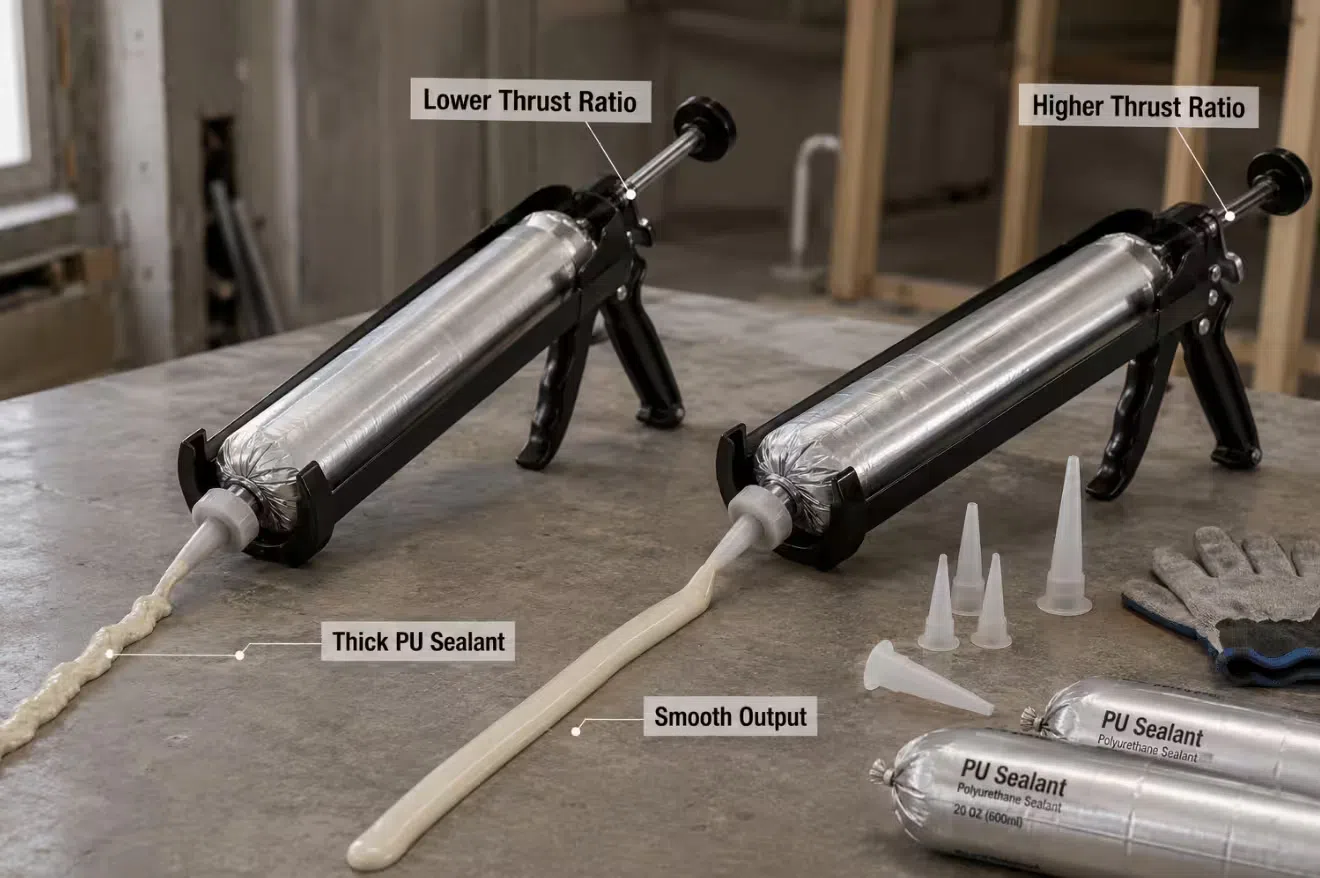
The relationship between thrust ratio and dispensing performance is straightforward: thicker sealant requires more force to maintain a consistent bead. Low-ratio guns — those in the 3:1 to 6:1 range — work acceptably with thin, free-flowing materials like standard silicone. But when the same gun is loaded with a polyurethane sealant or MS polymer from a sausage pack, the operator has to squeeze much harder on every pull. The bead becomes uneven, and the operator slows down or stops to rest.
Higher thrust ratios — 10:1 through 26:1 — solve this by multiplying the trigger force more aggressively. A 14:1 gun delivers steady flow with most standard sealants in sausage format. An 18:1 or higher ratio handles thick construction adhesives and heavy-bodied polyurethane without the operator fighting the tool on every stroke.
Rod Type Also Affects Flow Control
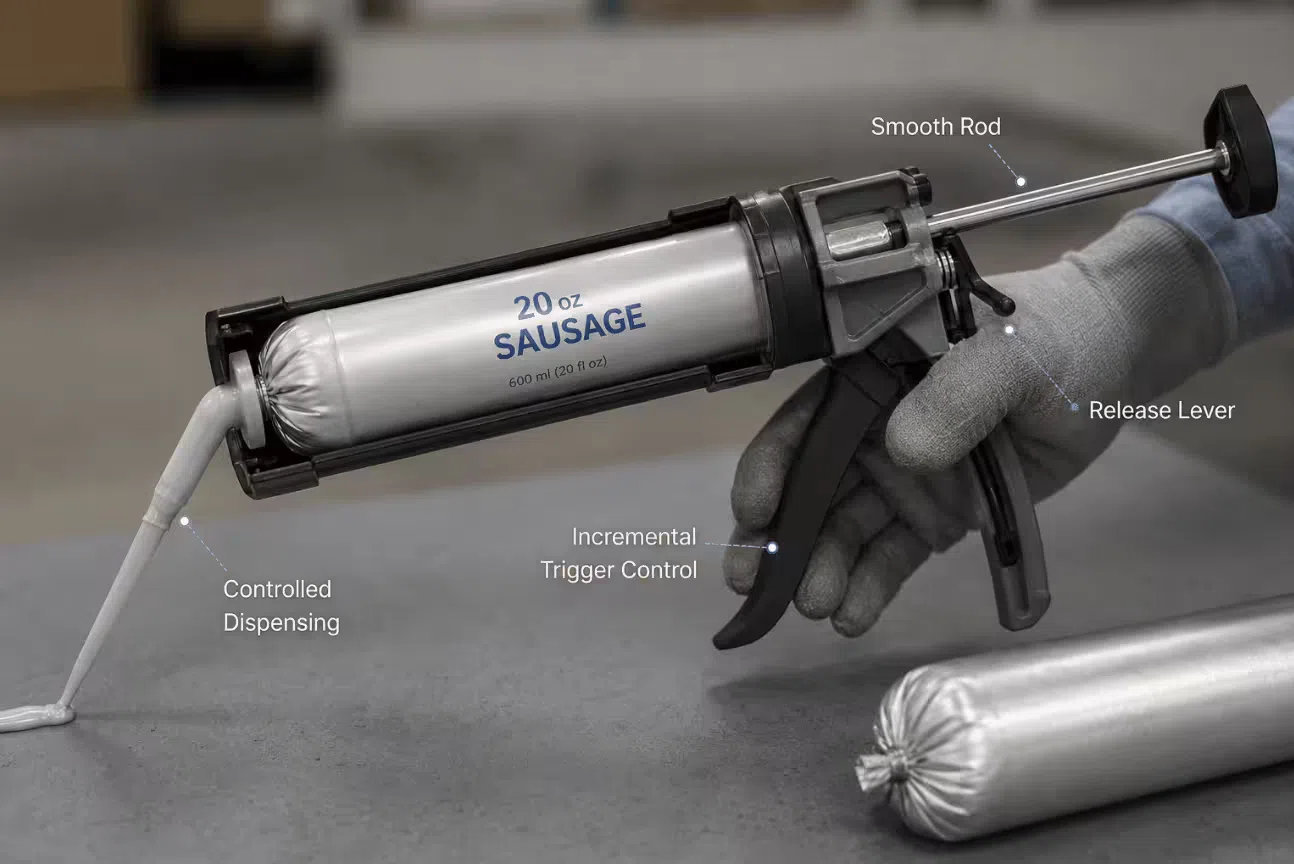
Not all guns with the same published thrust ratio deliver the same experience. Ratchet rod mechanisms operate in fixed increments — the trigger clicks forward in set steps, which can produce uneven bead flow. Smooth rod mechanisms allow the operator to pull the trigger in small, adjustable increments, giving much finer control over bead width and speed. When comparing cordless sausage caulking gun models, check whether the mechanism uses a smooth rod rather than relying on the thrust ratio number alone.
Matching Thrust Ratio to Your Sealant Type
The right thrust ratio depends on what sealant the end-customer will dispense. Different materials have different flow resistance, and the same gun can perform well with one sealant type and poorly with another.
| Sealant Type | Typical Viscosity | Recommended Minimum Thrust Ratio |
|---|---|---|
| Silicone (standard) | Low to medium | 6:1 to 10:1 |
| Acrylic latex | Low to medium | 6:1 to 10:1 |
| MS polymer | Medium to high | 10:1 to 14:1 |
| Polyurethane | High | 14:1 to 18:1 |
| Construction adhesive | Very high | 18:1 to 26:1 |
These are general ranges for temperate conditions. In cold weather, sealant viscosity increases — a polyurethane that flows well at 20°C becomes noticeably thicker at 5°C. Buyers serving markets with cold winters should consider specifying one ratio step higher than the warm-condition recommendation. A gun rated at 14:1 for summer use may feel stiff and underpowered during winter jobsite work with the same sealant.
For wholesale buyers who stock multiple sausage gun models, matching your product range to the most common sealant types in your market helps reduce returns. If most of your contractor customers use standard silicone and acrylic, a 10:1 to 14:1 range covers their needs. If your market includes curtain wall installers, waterproofing teams, or panel bonding crews who use polyurethane and MS polymer regularly, offering 14:1 to 18:1 models gives them the dispensing power they need.
What Else to Check Alongside Thrust Ratio
Thrust ratio is important, but it is one part of a complete specification. When evaluating a sausage pack caulking gun for wholesale or OEM orders, these additional specs affect real-world performance:
Barrel size and sausage pack compatibility. Confirm the barrel fits the exact sausage pack format used in your target market. The most common sizes are 20 oz (approximately 600 ml) packs, but some markets use different capacities. A mismatch between pack length and barrel depth causes loading problems and wasted material.
Battery platform. Cordless models run on lithium-ion batteries. Check the battery voltage (commonly 12V or 18V) and amp-hour rating. Higher voltage delivers faster motor speed; higher amp-hours extend runtime between charges. For high-volume sealing crews, a spare battery pack reduces downtime.
Dispensing speed control. Some cordless sausage caulking guns offer variable speed triggers or speed settings. This feature lets operators adjust flow rate for different joint widths and sealant types — useful when the same crew works on both fine detail joints and wide construction gaps in a single day.
Anti-drip mechanism. When the operator releases the trigger, residual pressure in the barrel can push sealant out of the nozzle, creating drips and waste. A pressure-release mechanism on the plunger reduces this problem. For sausage pack guns, where barrel volume is larger than standard cartridges, anti-drip becomes more important because more residual pressure builds up during dispensing.
Tool weight and balance. A loaded 20 oz sausage gun weighs more than a loaded 10 oz cartridge gun. Operators who use the tool all day notice the difference. Aluminum barrel construction helps reduce weight while maintaining durability. Balanced tool geometry — where the center of gravity sits close to the operator's grip — reduces wrist strain during extended use.
Choosing the Right Thrust Ratio for Your Market
For distributors and wholesale buyers, the question is not just which thrust ratio is best in general — it is which ratio matches the sealant types and work volume your customers deal with daily.
Contractors who do light-duty residential sealing — bathroom silicone, window trim, small gaps — usually work with low-viscosity sealants. A sausage gun in the 10:1 to 14:1 range handles these materials comfortably, and the lower ratio keeps the tool price competitive for cost-sensitive buyers.
Professional sealing crews working on commercial construction — curtain wall installation, structural waterproofing, large panel bonding — need higher ratios. These teams run thick sealants continuously, and operator fatigue from low-ratio guns becomes a real productivity problem. Specifying 18:1 or higher for this segment prevents complaints about stiff dispensing and keeps bead quality consistent across long workdays.
For OEM and private-label orders, including thrust ratio in your specification sheet helps your customers understand what they are getting. Many end-users do not know to ask about thrust ratio, but they notice immediately when a gun cannot maintain steady flow with their preferred sealant. By matching thrust ratio to the intended sealant type at the specification stage, you reduce after-sales support and build customer confidence in your product range.
If you are sourcing cordless sausage caulking guns for wholesale distribution or private-label supply, you can request an instant quote for model options with different thrust ratios, battery platforms, and barrel configurations.
FAQ
What does caulking gun thrust ratio mean?
Thrust ratio is the mechanical multiplier between the force you apply to the trigger and the force the gun applies to the sealant. A 10:1 ratio means 1 pound of hand force produces 10 pounds of push on the sealant. Higher ratios make it easier to dispense thick materials and reduce operator fatigue during extended use.
What thrust ratio do I need for sausage pack sealant?
For standard silicone and acrylic sealants in sausage packs, 10:1 to 14:1 is usually sufficient. For thicker materials like polyurethane, MS polymer, or construction adhesives, 14:1 to 18:1 maintains steady flow. In cold weather, consider one ratio step higher than the warm-condition recommendation because sealant viscosity increases as temperature drops.
How do I use a sausage caulking gun with the right thrust ratio?
Load the sausage pack into the barrel, attach the nozzle, and select a speed setting if the gun has one. Pull the trigger steadily — a higher thrust ratio gun requires less force per pull. For thick sealants, a slow, steady pull produces a more consistent bead than rapid trigger pumping. If the gun feels stiff or the bead is uneven, the thrust ratio may be too low for the sealant viscosity.
Can I use a low-ratio gun with thick sealant in a sausage pack?
Technically yes, but the operator will have to apply much more force per trigger pull. Over a full workday, this leads to hand and forearm fatigue, uneven bead quality, and slower work speed. For daily professional use with thick sealants, a higher ratio gun is a better investment than asking operators to work harder with a low-ratio tool.
Does thrust ratio affect battery life on cordless guns?
Indirectly, yes. A higher thrust ratio means the motor encounters less resistance when pushing sealant, so it draws less current per trigger pull. In practice, this can extend battery runtime slightly compared to a low-ratio gun working against the same thick sealant. The effect is small compared to battery capacity (amp-hours), but it contributes to overall efficiency on long jobs.
What is the difference between a sausage caulking gun and a cartridge gun?
A sausage caulking gun uses a barrel designed for flexible foil sausage packs, typically holding 20 oz (600 ml) of sealant. A cartridge gun uses a cradle that holds rigid plastic or cardboard cartridges, usually 10 oz or 28 oz. Sausage guns offer higher capacity per load and less packaging waste. The cordless sausage caulking guns on this page are designed specifically for sausage pack dispensing with rechargeable power.
If you need help selecting the right cordless sausage caulking gun model for your market, contact us for wholesale pricing and model specifications.