When procurement managers and distributors compare cordless caulking guns, the specification sheet lists numbers like dispensing force, speed settings, and anti-drip features. These numbers only matter when you understand what they mean for the person holding the tool. A cordless caulking gun that delivers the right force for thick construction adhesive and the right speed control for clean window sealing will perform differently from one built only for thin bathroom silicone.
This article explains the key performance specifications for any battery-powered caulking gun — dispensing force, speed control, anti-drip design, battery platform, and cartridge compatibility — so B2B buyers can evaluate models with more confidence before placing wholesale or OEM orders.
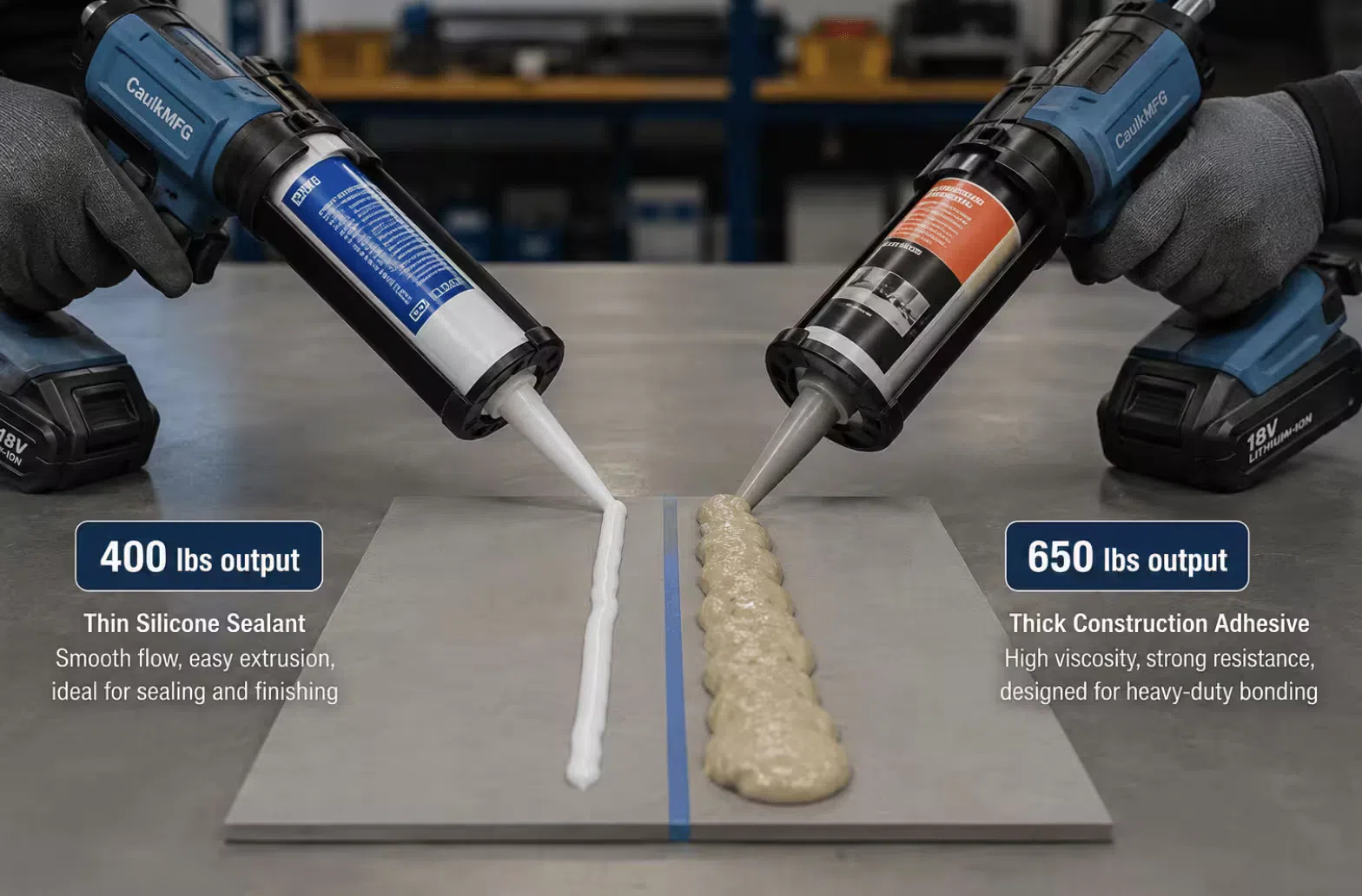 Cordless caulking guns with 400+ lbs dispensing force handle standard sealants; 650+ lbs models are needed for thick construction adhesives and cold-weather applications.
Dispensing Force: What the Numbers Mean for Material Performance
Dispensing force is the push power that drives the plunger rod forward into the cartridge, measured in pounds (lbs) or Newtons (N). This number tells you how easily the cordless caulk gun can move sealant or adhesive out of the tube.
For thin to medium-viscosity materials — bathroom silicone, acrylic caulk, and general-purpose sealant — a cordless caulking gun with 400 to 550 lbs of force is usually enough. Most professional 10 oz models fall in this range.
For thick construction adhesives, polyurethane sealants, and cold-weather applications, the force requirement goes up. Heavy-duty caulking gun models in the cordless category typically deliver 650 to over 1,700 lbs of dispensing force. These models handle 29 oz cartridges and sausage packs where the material is denser and the plunger has to push through more resistance.
The practical difference shows up on the job site. A cordless caulking gun rated at 400 lbs of force can push through most professional adhesives consistently, but guns with lower ratings may stall when the material is cold or when the nozzle opening is too small. For B2B buyers, asking about dispensing force before ordering helps match the right model to the sealant types your market actually uses.
Speed Control: Triggers, Dials, and How They Affect Bead Quality
Speed control on an electric caulk gun determines how fast the plunger moves sealant through the nozzle. Two main mechanisms are available: variable speed triggers and preset speed dials.
A variable speed trigger works like a power tool trigger. The harder you squeeze, the faster the motor pushes the plunger. This gives the user dynamic control — useful for curved surfaces, window corners, and transitions between wide and narrow joints. Users in field discussions report that keeping the speed low on the trigger gives better control for precision sealing, allowing them to dispense, set the bead, and clean up excess before moving on.
Preset speed dials limit the maximum feed rate to a fixed number of settings, usually 5 or 6. These dials cap the flow rate — for example, 0 to 160 mm/min — so the user cannot accidentally over-dispense. For high-volume sealing work like curtain walls, expansion joints, or large-area waterproofing, a preset dial keeps the bead consistent across long runs.
The interaction between speed and material viscosity matters. When dispensing thicker sealants, the plunger can push material faster than it flows out of the nozzle. This causes pressure buildup, uneven beads, and sometimes back-leaks. Users solve this by cutting a larger nozzle opening and setting the speed to a lower level. For B2B buyers, a cordless caulking gun with both a variable trigger and a speed dial gives the widest range of control across different sealant types.
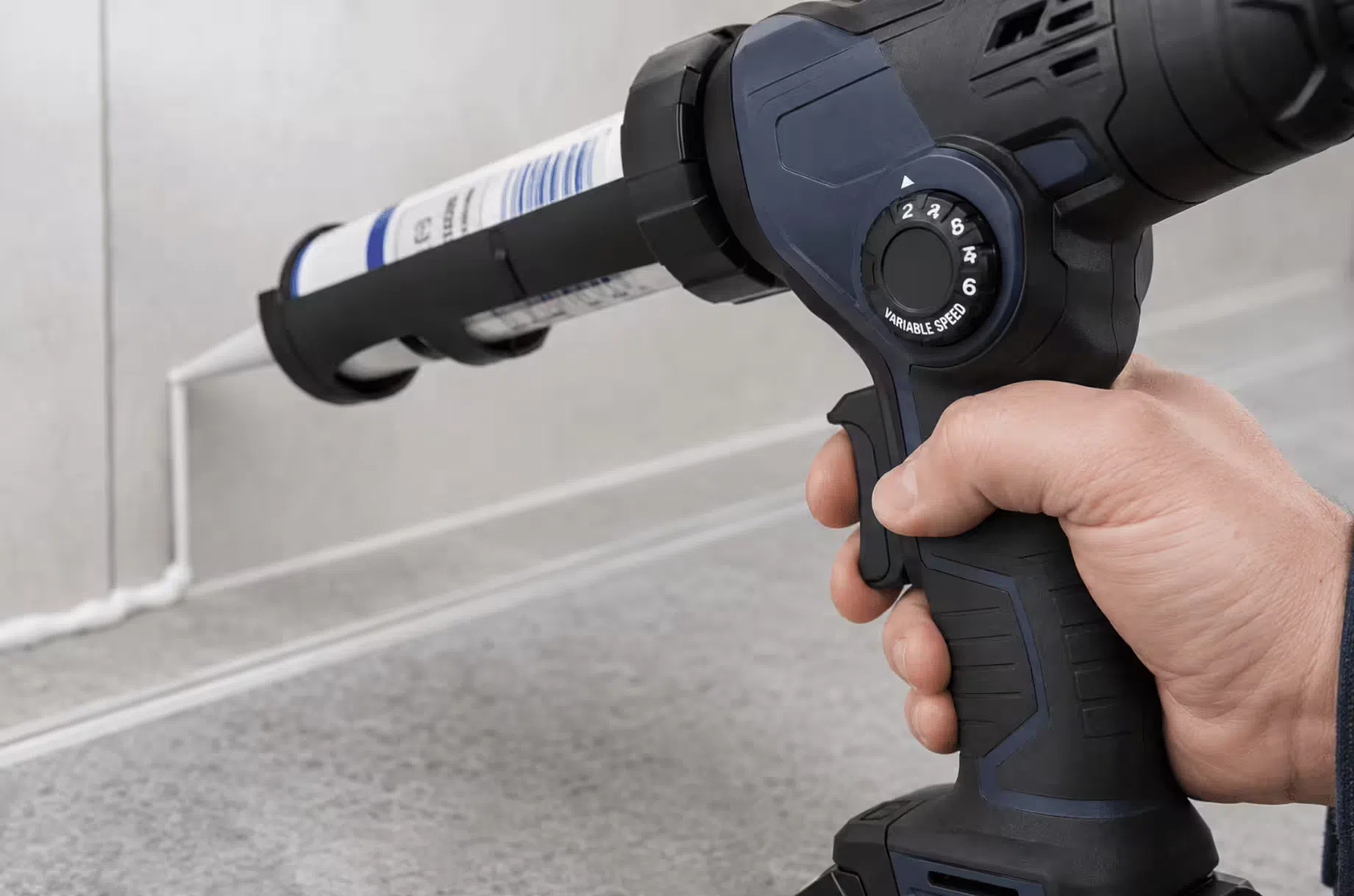 A cordless caulking gun with both a variable speed trigger and a preset dial lets users adjust flow rate for different sealant viscosities and joint widths.
Anti-Drip Design: How Cordless Guns Prevent Run-On
When a user releases the trigger on a cordless caulking gun, residual pressure inside the cartridge can keep pushing sealant out of the nozzle. This run-on wastes material, creates mess, and costs cleanup time.
Most professional cordless models solve this with an auto-reverse mechanism. When the trigger is released, the motor briefly pulls the plunger rod back a few millimeters. This drops the pressure inside the cartridge and stops the flow.
The anti-drip mechanism on a cordless gun works differently from a manual dripless caulk gun. Manual dripless guns use a spring-loaded clutch plate that retracts the smooth rod when you release the trigger handle. Cordless guns use the motor to retract the plunger, so the anti-drip action is tied to the electronic trigger release rather than a mechanical spring.
Speed setting also affects dripping. At lower speed settings, the residual pressure in the cartridge is lower, so the anti-drip mechanism has less work to do. At high speed settings, the pressure is higher and the retraction needs to be faster. For B2B buyers, checking whether the anti-drip mechanism is tested at the gun's maximum speed — not just at low speed — is a useful quality indicator when sourcing cordless caulking guns for wholesale.
Battery Platform and Runtime
The battery on a cordless caulking gun determines how long the tool runs between charges and how much dispensing force it can sustain. Battery voltage (typically 12V, 18V, or 20V) affects the motor's power output. Higher voltage generally supports higher dispensing force and more consistent performance under load.
Battery capacity, measured in amp-hours (Ah), determines how many cartridges the gun can dispense per charge. A 2.0Ah battery on a well-designed cordless caulking gun can typically dispense 20 to 40 standard 10 oz cartridges before needing a recharge. Actual runtime varies with material viscosity, speed setting, and dispensing force used.
For B2B buyers evaluating a rechargeable caulk gun, the battery platform matters for two reasons. First, buyers who also stock other cordless power tools from the same platform can offer customers battery compatibility across tools — a selling point for contractors and maintenance crews. Second, battery platform availability affects after-sales service and replacement battery sourcing. Confirming the battery type, voltage, and charger compatibility with your target market's existing tool platforms before placing a wholesale order can reduce customer complaints and increase reorder rates.
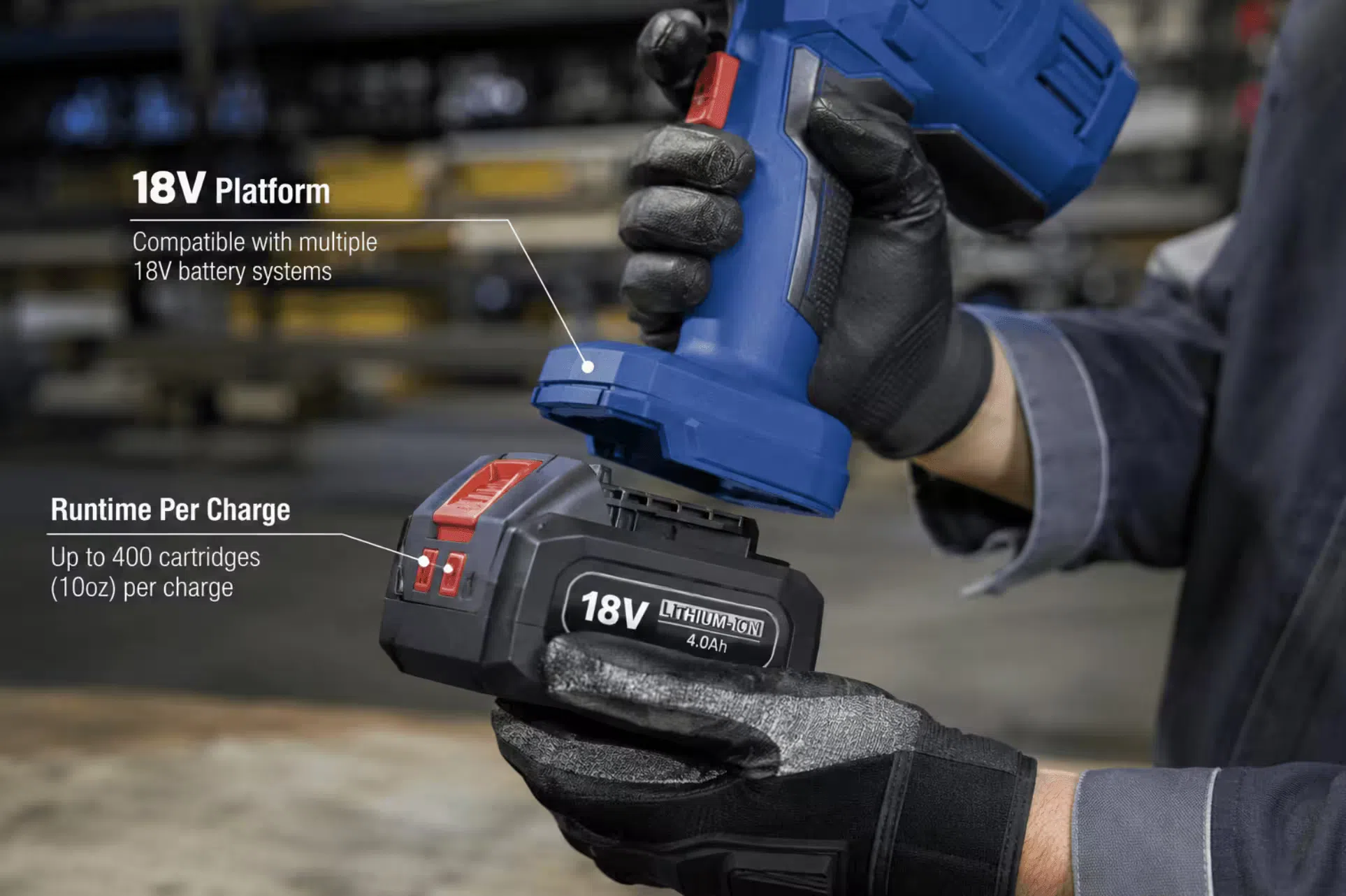 Battery platform compatibility matters for B2B buyers — confirming voltage, amp-hours, and charger type before ordering reduces after-sales issues.
Cartridge Size and Format Compatibility
Cordless caulking guns are designed for specific cartridge sizes and pack formats. The most common are:
- 10 oz (300ml) cartridge — the standard size for general sealing and adhesive work
- 29 oz (600ml) cartridge — larger cartridge for high-volume jobs, curtain walls, and expansion joints
- Sausage pack (600ml) — soft foil packs that require a different barrel or follower plate
Not every cordless model supports all formats. Some are cartridge-only. Others accept both cartridges and sausage packs with a change of the follower plate. For distributors and construction suppliers, stocking models that cover the most common pack formats in your market reduces the number of SKUs needed and simplifies ordering.
If your customers check cordless caulking gun reviews before buying, the cartridge format is often the first filter. A contractor who uses 29 oz cartridges daily will not consider a 10 oz-only model, regardless of its speed control or dispensing force. For OEM and wholesale orders, confirming cartridge compatibility with the sealant brands in your target market is a practical first step.
FAQ
Are battery-powered caulk guns any good for professional use?
Yes. A battery-powered caulking gun delivers consistent dispensing force without manual squeeze effort. Professional contractors, window installers, and maintenance crews use them for high-volume sealing, thick adhesives, and long sealing runs where manual guns cause hand fatigue. The key is matching the dispensing force and speed control to the material types and job conditions in your market.
What does dispensing force mean on a caulking gun?
Dispensing force is the push power that drives the plunger into the cartridge, measured in pounds or Newtons. Higher force means the gun can push thicker materials more easily. A cordless caulking gun with 400 lbs of force handles standard silicone and acrylic caulk. Models with 650 lbs or more handle thick construction adhesives, polyurethane, and cold-weather applications.
How does speed control work on a cordless caulking gun?
Most cordless models use either a variable speed trigger, a preset speed dial, or both. A variable speed trigger adjusts flow based on how hard you squeeze. A preset speed dial limits the maximum feed rate to a fixed number of settings, usually 5 or 6 speeds. Combined, they give the user precise control over bead width and material flow for different sealant viscosities.
What is the difference between a cordless caulking gun and an electric caulk gun?
A cordless caulking gun runs on a rechargeable battery and has no power cord. The term "electric caulk gun" can include both cordless and corded models. For B2B buyers, cordless models are more practical for job-site use because they do not require a fixed power source or air compressor. The terms are often used interchangeably in product listings.
What cartridge sizes are available for cordless caulking guns?
Common sizes include 10 oz (300ml), 29 oz (600ml), and 600ml sausage packs. Some models also support selected dual-cartridge configurations. The right size depends on the sealant packaging commonly used in your market. Confirming cartridge compatibility before placing a wholesale order avoids mismatches between the gun and your customers' sealant supply.
What should B2B buyers check before ordering cordless caulking guns?
Check dispensing force (match to material viscosity), speed control type (variable trigger vs preset dial), anti-drip mechanism, battery voltage and capacity, cartridge size compatibility, charger type and plug, spare parts availability, and OEM packaging requirements. For wholesale orders, also confirm color options, label design, carton packing, and user manual language for your target market.
For wholesale and OEM cordless caulking gun supply, browse our cordless caulking gun models or request a quote for bulk orders.