A cordless sausage caulking gun is a battery-powered dispensing tool designed for 600ml sausage pack sealants. Unlike standard cartridge guns that hold rigid 10oz or 28oz tubes, this style uses a barrel-shaped holder for flexible sausage tubes, giving users higher material capacity and fewer reloads during extended sealing work. For distributors, construction suppliers, and wholesale buyers, understanding how these cordless caulking guns work makes it easier to match the right model with professional customers handling large-area sealing projects.
How the Sausage Pack Format Works
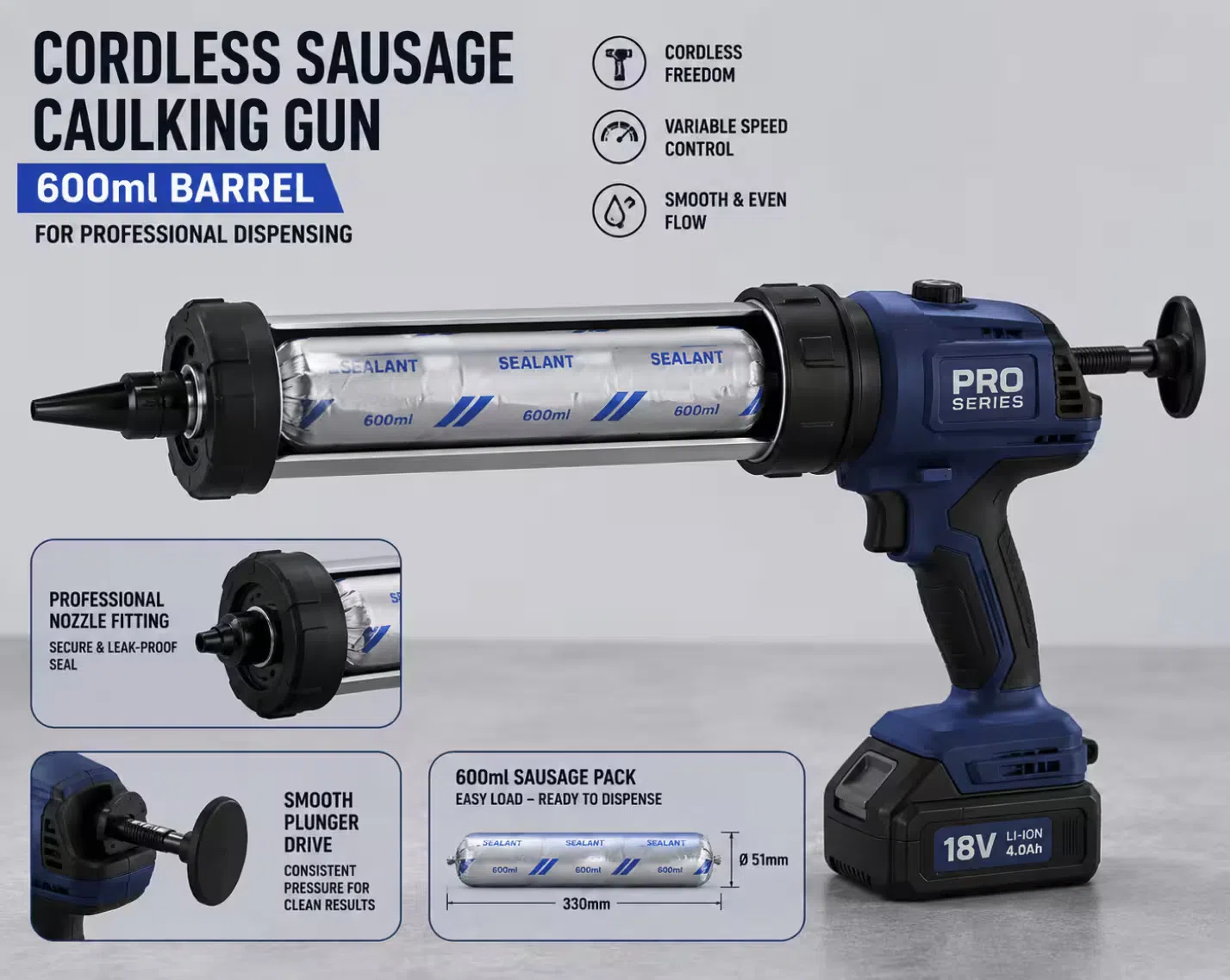
A sausage caulking gun holds a flexible foil or plastic tube, called a sausage pack, inside a cylindrical barrel. When the user pulls the trigger, a motor-driven piston pushes against the back of the pack and forces sealant out through a nozzle at the front. The barrel design can support different sausage sizes, with 600ml, or approximately 20oz, being one of the most common formats for professional use.
Compared with rigid cartridge tubes, sausage packs contain more sealant per load and typically create less packaging waste. A single 600ml sausage tube holds about twice the material of a standard 10oz cartridge, which means fewer interruptions during long runs of window sealing, curtain wall installation, or waterproofing work. The flexible tube also collapses as it empties, helping reduce unused sealant left inside the packaging.
For users working on ladders, scaffolding, or elevated positions, such as window installers sealing exterior frames, the higher capacity of a sausage pack caulking gun reduces how often they need to stop and reload. That can be a practical advantage for contractors who spend long hours on repetitive sealing tasks.
Battery and Motor Specs That Matter
A battery operated sausage caulking gun runs on a rechargeable battery, typically 12V or 18V, that powers a motor to drive the dispensing piston. Battery voltage affects how much force the tool can deliver. Higher-voltage 18V models generally provide more dispensing force, which helps push thicker sealants such as polyurethane, MS polymer, or construction adhesive through the nozzle. Lower-voltage 12V models are usually lighter and often better balanced, which matters when the user is working overhead or holding the gun for extended periods.
For B2B buyers sourcing electric sausage caulking guns, the battery platform is an important consideration. Many professional users already own tools from a specific battery system, such as DeWalt 20V, Milwaukee M12/M18, or Makita 18V, and often prefer caulking guns that share the same batteries and chargers. This can reduce total cost of ownership and simplify inventory management for contractors who carry multiple cordless tools.
Dispensing force, measured in newtons (N), determines how well the gun handles different material viscosities. A model designed mainly for silicone sealant may have lower dispensing force than one intended for heavy construction adhesive. When sourcing tools for wholesale or OEM programs, ask the manufacturer about the maximum dispensing force and which material types the gun is rated to handle.
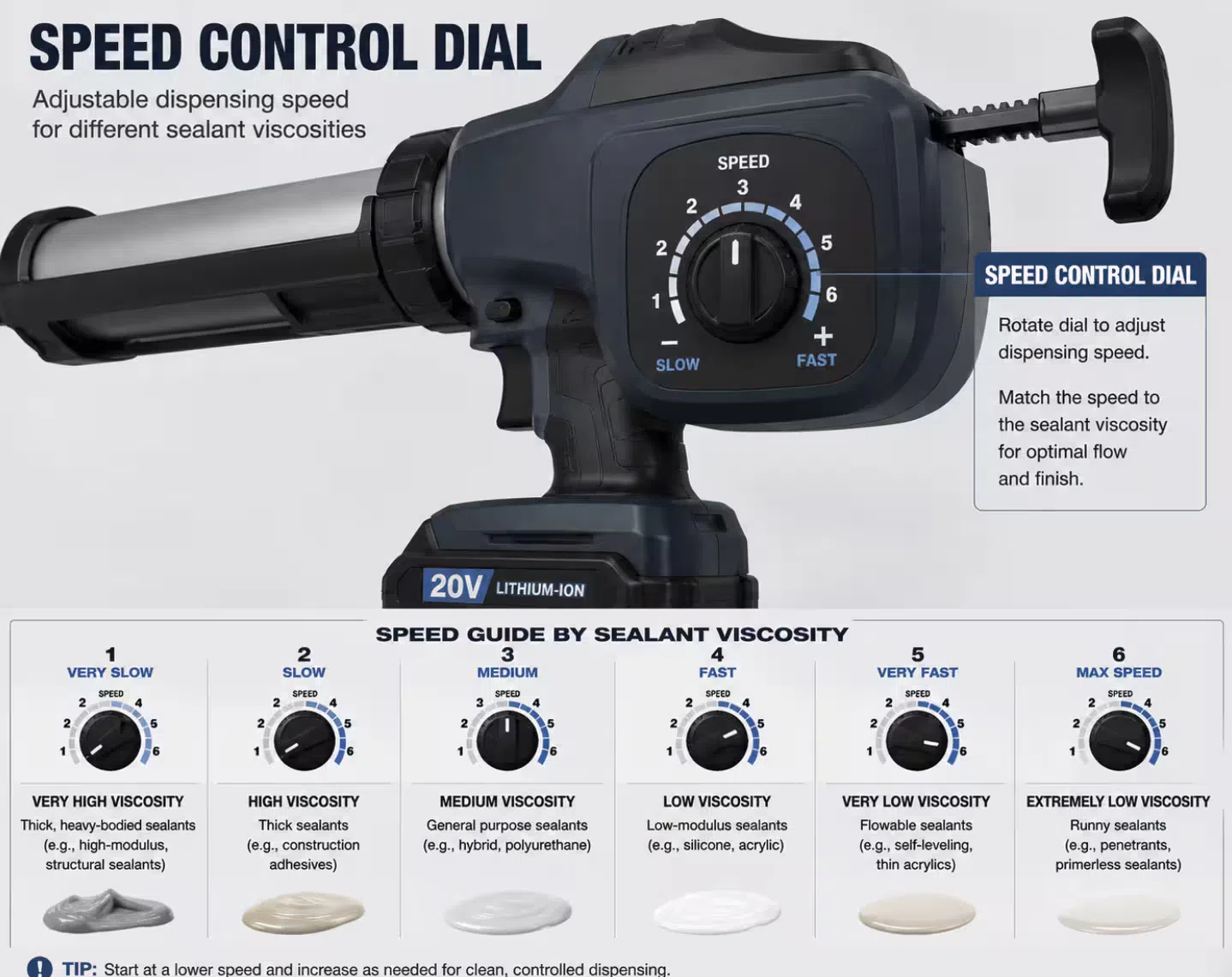
Speed control is another specification that affects the user experience. Most cordless sausage caulking guns offer a stepped speed dial with 3 to 6 settings, letting the operator adjust how quickly sealant flows. Some users prefer a continuously variable trigger, similar to a drill trigger, for finer control, especially when applying sealant in visible areas where bead consistency matters. Professional buyers serving precision-focused markets should check whether the model uses a stepped dial or a variable trigger.
The anti-drip function, sometimes called auto-retract, pulls the piston back slightly when the user releases the trigger. This relieves pressure inside the sausage tube and helps prevent sealant from continuing to drip out of the nozzle. For sausage pack models, anti-drip is especially useful because each tube holds more material, and wasted sealant can add up over a full day of work.
When Sausage Packs Make Sense for Professional Sealing
Sausage pack cordless caulking guns are a practical choice for specific types of professional work. Their higher material capacity and efficient barrel design suit projects with long runs of continuous sealing, where stopping to reload a cartridge every few meters can slow down the job.
Window and door installation is one of the most common applications. Contractors sealing window frames, door perimeters, and exterior trim often use large quantities of sealant in a single day. A cordless sausage caulking gun lets them load a 600ml tube and work for longer stretches between refills. The same applies to curtain wall installation on commercial buildings, where sealing joints between glass panels and metal frames requires steady material flow over large surface areas.
Waterproofing projects, including basement sealing, roof flashing, and expansion joint treatment, can also benefit from the sausage pack format. These jobs typically require more sealant than standard residential caulking, and the 600ml capacity reduces the number of cartridge changes needed.
Fire caulking is another application where cordless sausage caulking guns are widely used by professionals. Fire-stopping contractors sealing penetrations through fire-rated walls and floors in apartment buildings, hospitals, and commercial facilities may work through many sausage tubes per day. The cordless format removes the need for air compressors and hoses, which is especially useful in occupied buildings or tight mechanical rooms.
For general residential work, such as small gaps around sinks, bathtubs, or interior trim, a sausage pack cordless gun may be more tool than the job requires. Many professionals keep a manual caulk gun or smaller cartridge model for quick touch-up and detail work, reserving the cordless sausage model for larger projects.
Sausage vs Cartridge in Cordless Models
The main operational difference between sausage pack and cartridge cordless caulking guns is how the sealant is held and dispensed. In a cartridge model, the sealant sits inside a rigid plastic or cardboard tube with a built-in nozzle. In a sausage model, the material is packed in a flexible foil tube that fits into the gun's barrel, and a separate nozzle attaches to the front.
Sausage pack guns typically hold more material per load, commonly 600ml compared with about 300ml for a standard 10oz cartridge, which reduces reload frequency. However, sausage packs require the user to cut open the tube tip and attach a nozzle before loading, adding a small preparation step compared with pre-sealed cartridges.
For B2B buyers, the choice between sausage and cartridge models depends on the end user's workload. Contractors handling large commercial or industrial projects, including curtain walls, fire stopping, and waterproofing, often prefer sausage caulking guns for the capacity advantage. Residential contractors and maintenance crews usually prefer cartridge models for convenience and lower per-unit material cost.
Some cordless caulking gun models accept both sausage packs and cartridges by swapping the barrel or using an adapter. These sausage-style caulking gun designs with dual-format capability can be useful for distributors serving customers with mixed workloads.
What to Check When Sourcing Cordless Sausage Caulking Guns
For wholesale, OEM, and private-label buyers, the following specifications help narrow down suitable cordless sausage caulking gun models before placing an order.
Barrel size and sausage compatibility. Confirm which sausage pack sizes the gun accepts. The most common format is 600ml, but some markets also use 400ml or other custom sizes. The barrel diameter and length should match the sausage pack dimensions used in your target market.
Battery platform and voltage. Check whether the gun runs on 12V, 18V, or 20V batteries, and whether the battery system is proprietary or compatible with common tool platforms. In markets where contractors already own a specific brand's tools, battery compatibility can be a strong selling point.
Dispensing force. Ask for the maximum dispensing force in newtons. Higher force, often above 3,000N, is better suited to thick construction adhesives and polyurethane sealants. Lower-force models in the 1,500-2,500N range are usually suitable for silicone and acrylic sealants.
Speed control type. Stepped dials with 3-6 speed settings are common on many models. Variable-speed triggers offer finer control but may increase cost. Confirm which type the model uses and whether the speed range covers the material types common in your market.
Anti-drip function. Verify whether the model includes an auto-retract or pressure-release feature. Many professional users expect this function, and it helps reduce material waste during stop-and-start work.
Weight and balance. Cordless sausage caulking guns are heavier than manual guns because of the battery, motor, and barrel. Models using 12V batteries tend to be lighter and better balanced than 18V models. In markets where users work on ladders or overhead, weight is an important selection factor.
Spare parts and accessories. Check availability of replacement barrels, push plates, nozzles, batteries, and chargers. Reliable after-sales parts support helps distributors maintain customer satisfaction and encourage repeat orders.
OEM requirements. Confirm color options, label design, packaging, user manual language, plug type for chargers, and any market-specific compliance requirements before mass production.
FAQ
How do you use a sausage caulking gun?
Cut the tip of the sausage pack tube at a slight angle, insert it into the gun's barrel, attach a nozzle to the barrel front, and close the end cap. Pull the trigger to start dispensing. Adjust the speed dial to match the sealant viscosity and the bead width required. When finished, release the trigger and let the auto-retract feature relieve pressure before setting the tool down.
Is an electric sausage caulking gun better than a manual one?
An electric sausage caulking gun uses battery power to push sealant out of the pack, reducing hand effort compared with a manual caulk gun. For large sealing projects, including window installation, fire stopping, and waterproofing, the powered format can save time and reduce fatigue. For small repair jobs or tight spaces, a manual gun is often lighter and easier to control.
Which brands make cordless sausage caulking guns?
Brands such as Milwaukee, DeWalt, Makita, and Ryobi offer cordless caulking guns compatible with sausage packs. Each brand uses its own battery platform, so the best choice often depends on which battery system the end user already owns. Factory-direct models from caulking gun manufacturers can also provide wholesale and OEM options with custom branding and packaging.
What is the difference between a 12V and 18V cordless sausage caulking gun?
A 12V model is usually lighter and better balanced, making it easier to handle on ladders or during overhead work. An 18V model delivers more dispensing force, which helps with thicker sealants and adhesives. For general silicone and acrylic sealant work, 12V is often sufficient. For heavy construction adhesive or high-viscosity polyurethane, 18V typically provides more consistent flow.
Can a cordless sausage caulking gun dispense construction adhesive?
Yes, many cordless sausage caulking guns are designed to handle construction adhesives, polyurethane sealants, and MS polymers in addition to standard silicone. The key specification to check is the maximum dispensing force, since thicker materials require higher force, often above 3,000N, for smooth, consistent flow. Confirm the model's rated material types before ordering.
How many sausage tubes can a cordless gun dispense per battery charge?
Battery life varies by model, battery capacity, and material viscosity. Some professional users report completing several boxes of sausage tubes on a single charge with efficient 12V models, but thicker materials will consume more battery per tube. For extended jobs, carrying a spare battery is standard practice.
Looking for cordless sausage caulking guns for your product line? Request a quote for wholesale, OEM, and bulk supply from a factory-direct caulking gun manufacturer.