An epoxy dispensing gun pushes two-component adhesives out of dual cartridges at the correct ratio. For distributors, adhesive brands, and procurement managers, matching the dispensing gun to the adhesive product line is a practical ordering decision. When the gun specs do not match the adhesive requirements, the result is uneven output, incomplete mixing, and failed bonds.
This guide explains the key specifications that determine whether a dispensing gun will work with a given two-component adhesive: mixing ratio, cartridge capacity, dispensing force, and drive type. Each section connects the spec to the practical problem it prevents and the ordering check it requires.
Mixing Ratio — The First Spec to Check
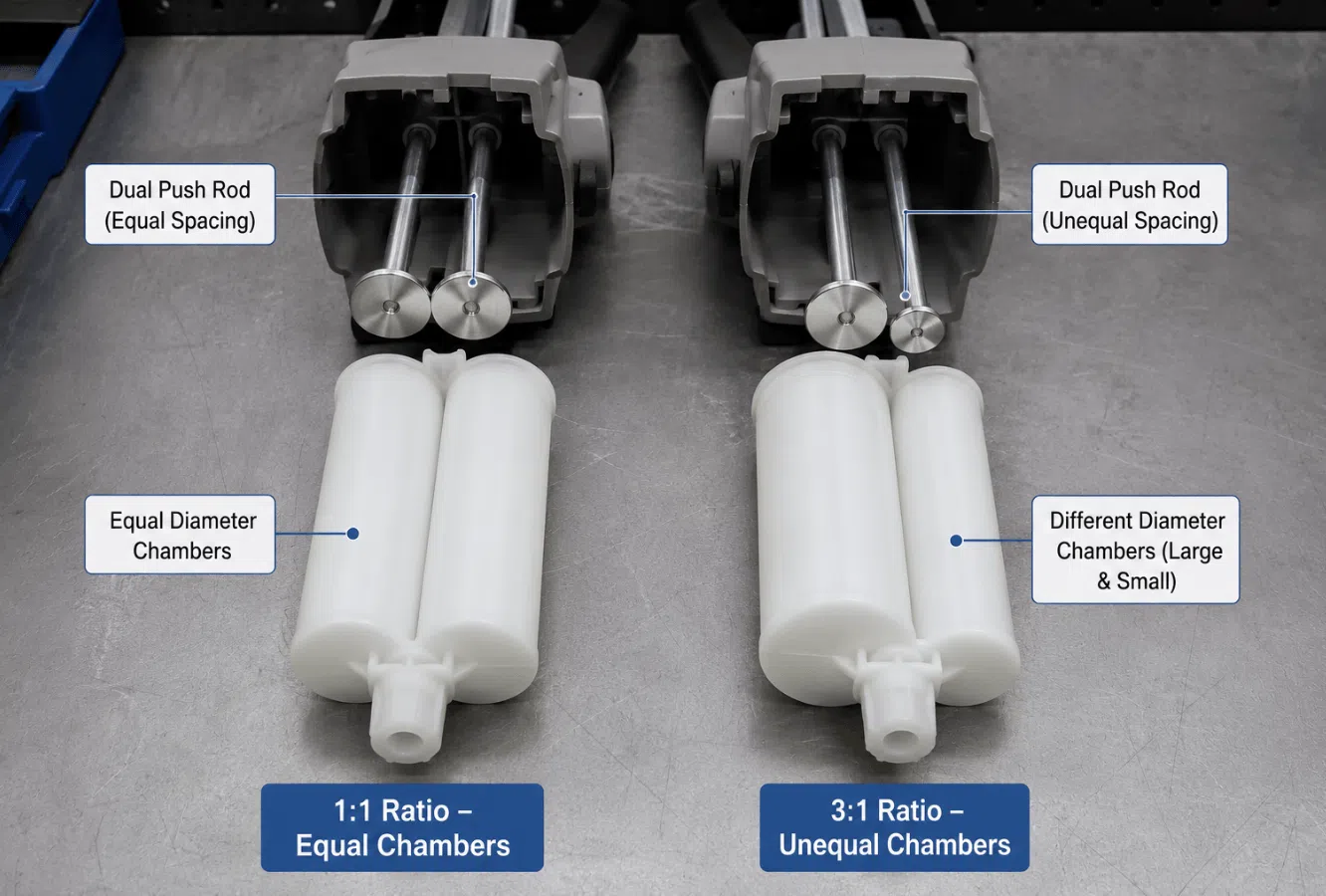
The mixing ratio is the most important specification to match. Two-component adhesives pack two different materials — often labeled A and B — in separate chambers of one cartridge. The ratio tells you the relative volume of each component. A 1:1 ratio means both chambers are the same size. A 2:1, 3:1, or 4:1 ratio means one chamber holds two, three, or four times the volume of the other.
A dispensing gun designed for 1:1 cartridges has two equal-sized push rods. A gun designed for 3:1 cartridges has one push rod that is larger than the other. If you load a 3:1 cartridge into a 1:1 gun, the smaller chamber empties first. The adhesive dispenses with the wrong proportion of A and B, and the mixed material will not cure correctly.
This is not a minor calibration issue. An incorrect ratio produces a weak bond or no bond at all. For structural adhesives used in construction, automotive assembly, or industrial bonding, the failure can be expensive and difficult to diagnose after the fact.
Before ordering, confirm the gun's rated mixing ratio against the adhesive cartridge specification. Common ratios include 1:1, 2:1, 3:1, 4:1, and 10:1. If your product line includes adhesives at multiple ratios, you may need ratio-specific guns for each. Cordless dual cartridge models like the EG02 (1:1 ratio, 200ml) and EG03 (3:1 ratio, 400ml) are built with the correct chamber geometry for each format.
Cartridge Capacity and Size
Dual cartridge systems come in standard sizes: 50ml, 200ml, 400ml, and 600ml. The right size depends on the job volume and the adhesive product format.
A 50ml cartridge works for precision bonding, small repairs, and applications where material waste must be minimal. A 200ml cartridge covers moderate assembly work — enough material for several joints or bonds without frequent reloading. A dual cartridge epoxy gun in the 400ml range handles mid-volume structural bonding, while 600ml cartridges suit high-output factory and jobsite work where reduced downtime matters.
Using an oversized cartridge for a small job wastes adhesive. Using an undersized cartridge for a large job means stopping to reload every few minutes, which slows work and creates more opportunities for mixing errors at each reload.
When ordering for wholesale or OEM supply, consider which cartridge sizes your end users actually need. Stocking a range — or confirming that your gun supplier offers models across the size spectrum — prevents the mismatch between the adhesive format and the available dispensing tool. The EG04, for example, handles 585ml cartridges at a 3:1 ratio, which covers a common structural adhesive format.
Dispensing Force and Drive Type
Dispensing force determines how much pressure the gun applies to push the adhesive out of the cartridge. This matters most for high-viscosity two-component adhesives — structural epoxies, heavy-duty polyurethanes, and thick acrylic adhesives. If the gun cannot generate enough force, the adhesive dispenses unevenly or stops flowing entirely.
There are three main drive types:
Manual guns use a trigger or lever to push the rod. They work well for low-viscosity adhesives and small jobs, but the operator's hand strength limits the dispensing force.
Cordless guns use a rechargeable battery to drive the push rod. They provide consistent force without operator fatigue, which makes them suitable for mobile jobsites, workshop use, and repetitive dispensing tasks. A cordless dual cartridge epoxy gun can handle higher-viscosity adhesives than a manual gun because the motor delivers steady, repeatable pressure.
Pneumatic guns use compressed air. They offer the highest dispensing force but require an air supply, which limits mobility. Pneumatic guns are common in fixed factory settings where compressed air is already available.
For B2B buyers evaluating an electric 2 part epoxy gun for distribution, the key question is whether the target users work on mobile jobsites or in fixed workshops. Cordless models cover the broadest range of field conditions. When specifying a cordless model, check the dispensing force rating against the adhesive manufacturer's recommended dispensing pressure.
How to Check Compatibility Before Ordering
Before placing a wholesale or OEM order, run through this compatibility checklist:
Adhesive type and viscosity. Confirm whether the gun will dispense epoxy, polyurethane, silicone, acrylic, or structural adhesive. High-viscosity grades require more dispensing force. Request viscosity data from the adhesive supplier if it is not on the product sheet.
Mixing ratio. Verify that the gun's rated ratio matches the adhesive cartridge. Do not assume a single gun handles all ratios.
Cartridge capacity. Match the gun model to the cartridge size your market uses most. The EG02 handles 200ml at 1:1, while the EG04 handles 585ml at 3:1.
Nozzle compatibility. Check that the gun accepts the mixing nozzle type required by the adhesive cartridge. Static mixing nozzles are standard for most two-component systems, but nozzle diameter and connection type vary by manufacturer. These adhesive dispensing tips help prevent field compatibility problems.
Drive type. Match manual, cordless, or pneumatic to the end user's work environment.
For OEM projects and wholesale orders, request a sample gun and test-fit it with the actual adhesive cartridge before committing to production. This simple step prevents compatibility problems that are expensive to fix after the order ships.
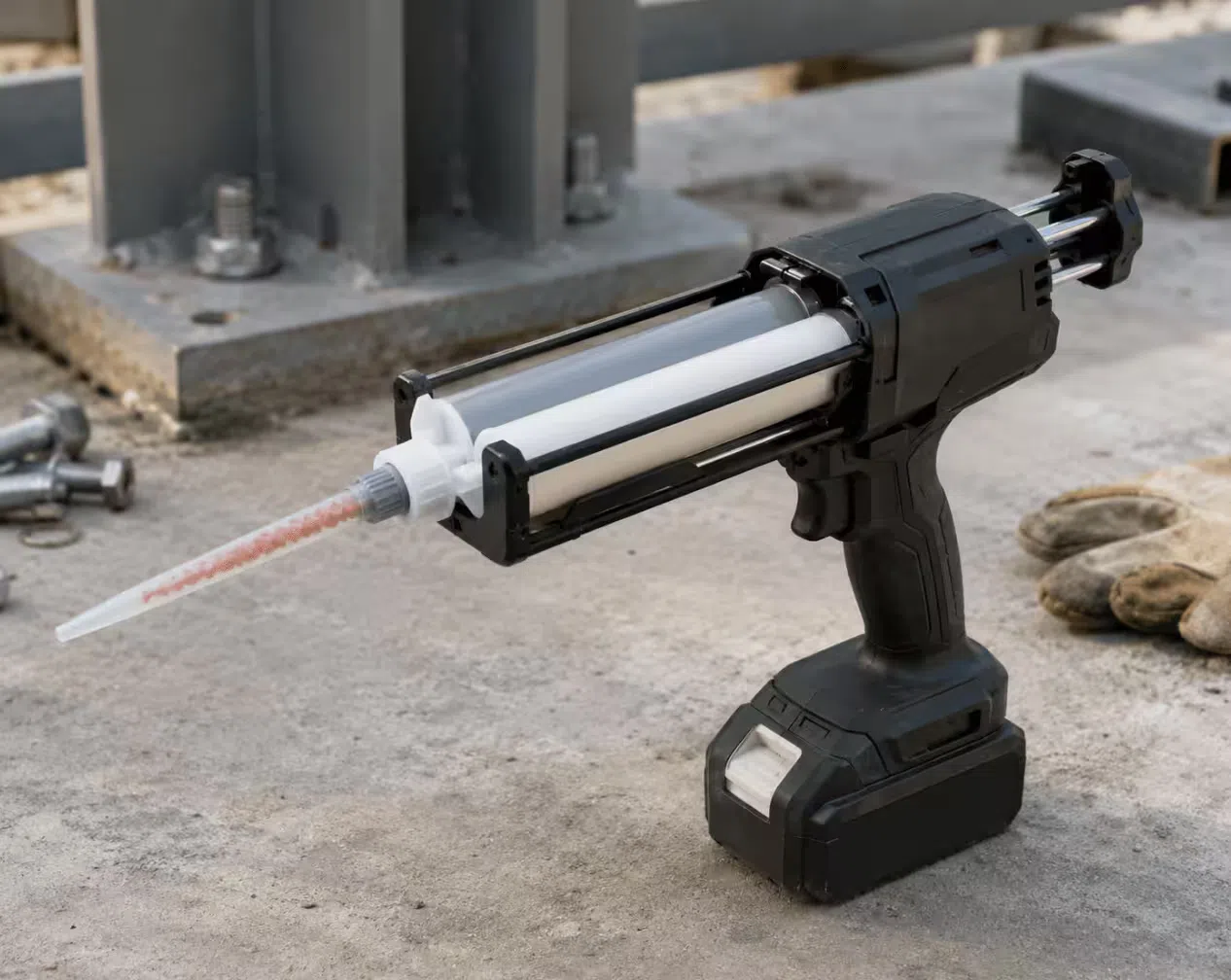 A cordless dispensing gun lets operators dispense two-component adhesives on mobile jobsites without a compressed air supply.
FAQ
What is an epoxy dispensing gun used for?
An epoxy dispensing gun is used to push two-component adhesives out of dual cartridges through a static mixing nozzle. The gun applies equal or ratio-correct pressure to both chambers so the A and B components mix in the right proportion as they exit the cartridge. This is necessary for adhesives that cure through a chemical reaction between two parts — epoxy, polyurethane, silicone, and structural adhesives all require this type of dispensing.
What size dual cartridge epoxy gun do I need?
The size depends on the cartridge format your adhesive uses and the job volume. A 50ml gun suits precision work and small repairs. A 200ml gun covers moderate assembly and bonding. A 400ml to 600ml gun handles high-volume structural work. Check the adhesive product sheet for the cartridge size, then match the gun model to that format.
How do you use an epoxy dispensing gun?
Load the dual cartridge into the gun with both chambers seated against the push rods. Attach a static mixing nozzle to the cartridge outlet. Squeeze the trigger or press the power button to begin dispensing. The gun pushes both components through the nozzle, where they mix as they flow. Dispense a small amount onto scrap material first to confirm the mix is uniform before applying to the workpiece. Replace the nozzle when it starts to clog or when the adhesive begins to set inside it.
Can I use one dispensing gun for different mixing ratios?
No. A dispensing gun built for 1:1 cartridges cannot correctly dispense 2:1 or 4:1 cartridges because the push rod sizes and chamber geometry are different. Using the wrong ratio gun causes one component to run out before the other, producing an incorrect mix. If your product line includes adhesives at multiple ratios, you need ratio-specific guns for each.
If you are sourcing cordless dispensing guns for two-component adhesive applications, our cordless dual cartridge gun models cover the most common mixing ratios and cartridge sizes for wholesale and OEM supply. View our cordless dual cartridge gun models or request a quote for your next order.