Distributors and procurement managers who source manual caulking guns for wholesale or OEM face a practical question: what separates a high quality caulk gun from a cheap one that will jam, drip, or fatigue operators within weeks? The price difference per unit is often small at wholesale quantities, but the performance difference shows up in reorder rates, end-user complaints, and return frequency.
This guide covers four specifications that define a quality manual caulking gun — frame material, thrust ratio range, dripless mechanism, and rod type — and how to match them to your customers' applications.
Frame Material and Construction
The frame is the structural backbone of any manual caulking gun. When the frame bends or develops dents, cartridges no longer fit squarely, the rod binds, and the gun becomes unusable. Professional contractor reviews and manufacturer experience both confirm that thin-gauge metal frames are the most common failure point in low-cost guns.
Manual caulking gun frames are typically made from two material types:
All-metal frames use stamped or welded steel. They are heavier and resist deformation under repeated high-thrust use. These frames suit distributors supplying heavy-duty construction or industrial customers who use thick sealants daily.
Aluminum-alloy frames weigh less and resist denting and rust, which matters for humid or coastal job sites. The lighter weight also reduces shipping costs for bulk wholesale orders and lowers hand fatigue for operators who carry the gun between work areas.
For B2B buyers evaluating quality, check the frame thickness at the barrel channel where the cartridge sits. A quality frame typically uses at least 1.2 mm material in this load-bearing area. Thinner frames tend to deform when operators use high-thrust ratios or drop the gun on concrete.
Frame replacement parts such as barrel channels, trigger assemblies, and rod guides are available for most CaulkMFG models. Distributors who stock replacement components can offer their customers a longer service life per gun rather than selling new guns for each broken frame.
Thrust Ratio Range
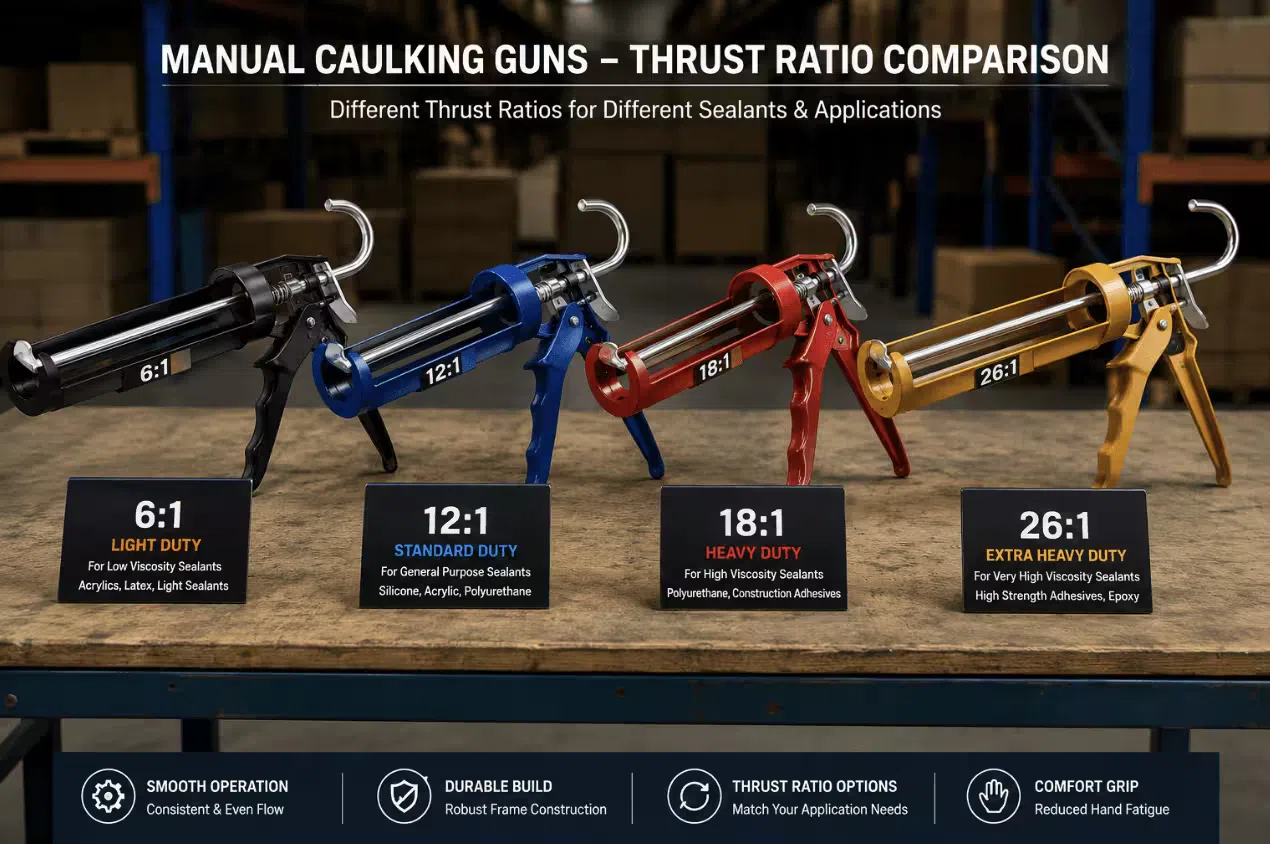
Thrust ratio determines how much plunger force the trigger delivers to the sealant cartridge. A 12:1 thrust ratio means each pound of trigger pressure applies 12 pounds of force to the sealant. Manual 300 ml cartridge guns typically offer thrust ratios from 7:1 up to 26:1.
Lower ratios (7:1 to 12:1) work for low-viscosity materials like acrylic latex caulk and standard silicone. Higher ratios (18:1 to 26:1) are needed for thick sealants, cold-weather dispensing, and high-build adhesives. A high ratio caulking gun lets operators dispense thick material with controlled trigger pressure instead of straining against the rod.
For wholesale buyers, stocking models at several thrust ratio points covers more customer applications. A contractor who applies silicone windows all day does not need the same gun as a factory crew dispensing construction adhesive at 5 °C.
Thrust Ratio to Application Reference
| Thrust Ratio | Typical Sealant Type | Applications | Recommended Model Type |
|---|---|---|---|
| 7:1 – 12:1 | Acrylic latex, standard silicone | General sealing, window trim, kitchen and bath | Standard frame, basic dripless |
| 12:1 – 18:1 | Medium polyurethane, hybrid sealants | Construction sealing, door and window installation | Mid-range, smooth rod recommended |
| 18:1 – 26:1 | Thick adhesives, high-build sealants | Industrial sealing, cold-weather work | Full-metal frame, high-leverage design |
Dripless Mechanism
A dripless caulk gun includes a pressure-release feature that relieves cartridge pressure when the trigger is released. Without this mechanism, compressed sealant inside the cartridge continues to ooze out of the nozzle after the operator stops squeezing, wasting material and creating cleanup work.
The practical test for a dripless mechanism is simple: load a cartridge, dispense a short bead, then release the trigger fully. A good mechanism stops flow within about one second. If the mechanism continues to ooze or fails to release pressure fully, the gun will waste sealant on every job.
For B2B buyers supplying construction contractors or factory maintenance teams, the dripless mechanism is a high-value feature. Contractors who apply sealant across multiple joints per day can waste 5 to 15 percent of each cartridge through dripping alone, depending on sealant viscosity and gun quality. A reliable dripless gun eliminates that waste.
Some dripless designs use a thumb-operated release latch on the rod. Others use an internal pressure-relief valve in the trigger assembly. Both approaches work when well-made. The main requirement is that the release is positive — it must disengage the plunger fully, not just reduce pressure partially.
Rod Type: Smooth Rod vs Ratchet Rod
Smooth rod mechanisms use a friction plate that grips the rod at any position. The operator can advance the sealant in small, continuous increments. This design produces a consistent bead and allows fine adjustment. Smooth rod guns typically use higher thrust ratios (12:1 and above) and are the standard for professional use.
Ratchet rod mechanisms engage in fixed tooth increments. The operator must advance the rod one notch at a time, making fine bead control difficult. Ratchet rods typically deliver lower thrust ratios (around 5:1 to 7:1). While cheaper to manufacture, they are the main cause of operator complaints about poor sealant control.
For wholesale and OEM distribution, smooth rod models are the safer stocking choice. End users who receive a smooth rod gun are more likely to report satisfaction with bead quality and trigger control. Ratchet rod models may still serve budget-conscious buyers, but distributors should confirm that their customer base prefers them.
Practical Specification Summary
| Specification | Unit | What It Affects | B2B Buying Note |
|---|---|---|---|
| Frame material | Aluminum alloy or steel | Durability, weight, corrosion resistance, shipping cost | Check frame thickness at barrel channel |
| Thrust ratio | Ratio (e.g., 12:1) | Dispensing force, sealant viscosity range, operator fatigue | Stock multiple ratios for varied customer needs |
| Dripless mechanism | Yes / No | Material waste, job-site cleanup, operator satisfaction | Verify positive pressure release in sample testing |
| Rod type | Smooth or ratchet | Bead control, trigger precision, user satisfaction | Smooth rod preferred for wholesale default stock |
Application Matching Table
| Application | Recommended Gun Type | Key Specs to Check |
|---|---|---|
| General construction sealing | Smooth rod, 12:1–18:1 thrust | Aluminum alloy frame, dripless mechanism |
| Heavy-duty industrial sealing | Smooth rod, 18:1–26:1 thrust | Full-metal frame, high-thrust smooth rod |
| Silicone and acrylic dispensing | Smooth rod, 7:1–12:1 thrust | Lightweight frame, basic dripless |
| Contractor supply stock | Mix of 12:1 and 24:1 smooth rod | Smooth rod, durable frame, tested dripless |
How to Order for Wholesale and OEM
CaulkMFG offers four manual caulking gun models in 300 ml cartridge format, with thrust ratios from 7:1 to 26:1, aluminum alloy or full-metal frames, and smooth or ratchet rod options. All models include a dripless mechanism.
For wholesale orders, available options include custom color matching, logo branding, private-label packaging, and mixed-model container shipments. Sample units are available for quality evaluation before bulk commitment. Replacement parts such as rod guides and trigger assemblies can be included with the order to support distributor after-sales service.
When you are ready to order, tell your CaulkMFG representative:
- Your target market and expected annual volume
- Preferred thrust ratio range and frame material
- Cartridge size (300 ml or other)
- Color and logo requirements
- Shipping destination and delivery timeline
FAQ
What makes a caulking gun high quality? Three specifications determine caulking gun quality: a frame that resists bending (aluminum alloy or heavy-gauge steel), a thrust ratio matched to the intended sealant viscosity, and a dripless mechanism that stops flow completely when the trigger is released. A smooth rod is preferred but not strictly required for every application.
What is the best thrust ratio for a manual caulking gun? The best thrust ratio depends on the sealant. For typical silicone and acrylic sealants, 12:1 is usually enough. For thick adhesives, polyurethane, or cold-weather dispensing, 18:1 to 26:1 works better. Buyers who stock multiple ratios cover a wider range of customer applications.
How does frame material affect caulking gun quality? Frame material determines how well the gun resists denting and bending under repeated use. Aluminum alloy resists rust and weighs less, making it a good choice for portable use and humid environments. Steel frames are heavier but offer maximum durability for industrial applications. Both are quality choices when the frame gauge is adequate.
Is a smooth rod caulk gun better than a ratchet rod? For most professional and industrial applications, yes. Smooth rod mechanisms allow continuous trigger control and finer bead adjustment. Ratchet rods advance in fixed increments and offer less control. Smooth rod guns also usually have higher thrust ratios, reducing operator fatigue on longer jobs.
What should I look for when buying caulking guns for wholesale? Check the frame thickness at the barrel channel, confirm the thrust ratio range, test the dripless mechanism with a loaded cartridge, and verify the rod type. Order samples before committing to bulk quantities. Stock models at different thrust ratios to match customers working with silicone, polyurethane, or construction adhesives.
Can I get custom branding on caulking guns for my distribution? Yes. CaulkMFG offers OEM matching on all four manual models, including custom frame colors, logo printing or embossing, private-label packaging, and mixed-container configurations. Minimum order quantities apply per configuration.