Manual caulking guns are standard equipment for construction sealing, window installation, and general repair work. But caulking gun prices vary widely, from entry-level models at low cost to heavy-duty guns with high thrust ratios. For B2B buyers — distributors, wholesalers, and OEM procurement managers — understanding what drives the price of a manual caulking gun leads to better bulk purchasing decisions, fewer returns, and tools that match the end user's sealant and workload.
This guide covers the main factors that affect manual caulking gun pricing: thrust ratio, frame material, dripless mechanism, and OEM options. It also provides practical price comparison information for stocking and ordering decisions.
How Thrust Ratio Affects Pricing
The thrust ratio tells you how much mechanical force a caulking gun applies to the cartridge plunger with each trigger pull. A 7:1 gun delivers 7 units of output force for each unit of input. A 26:1 gun delivers 26 units.
Low-ratio guns (7:1 to 12:1) cost less to manufacture because the internal mechanism uses fewer or simpler components. They work well with standard sealants — acrylic latex, basic silicone — where the material flows easily. With thicker products such as polyurethane, hybrid polymers, or cold-weather sealants, a low-ratio gun requires noticeably more hand force. Users commonly describe them as hard to squeeze.
High-ratio guns (18:1 to 26:1) use stronger rods, reinforced frames, and more mechanical leverage. They cost more at wholesale pricing but handle a wider range of sealant viscosities. A distributor who stocks only low-ratio guns risks receiving complaints about hand fatigue and poor bead control from customers who use heavy sealants. Stocking at least one high-thrust option alongside standard models serves a broader range of end users.
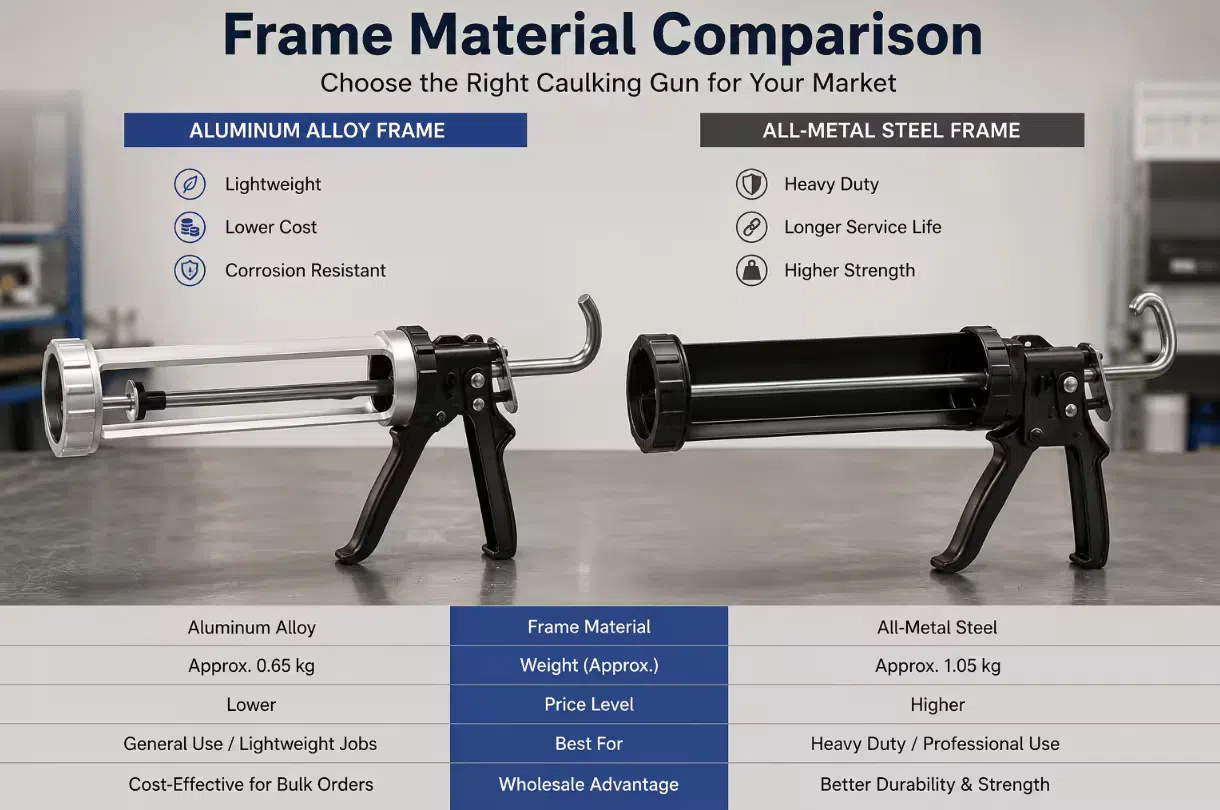
Frame Material: Aluminum Alloy vs. All Metal
The frame material affects both the retail price and the intended use case. The two most common options are aluminum alloy and all-metal steel construction.
Aluminum alloy frames are lighter, which reduces hand fatigue over long sealing jobs. They resist corrosion better in damp or outdoor conditions. But aluminum alloy costs more per unit, so these guns sit at a higher caulking gun price point.
All-metal frames are heavier and more durable at a lower cost. They hold up well in workshop and factory environments where the gun is used in a fixed location. The added weight is less noticeable for short-duration tasks. However, mobile contractors who carry the gun across a job site may find all-metal guns tiring.
For wholesale buyers, the choice between aluminum and steel should match the end user's daily work pattern. A supplier serving construction crews who seal windows for hours may prefer aluminum alloy despite the higher wholesale cost. A supplier supporting factory maintenance teams may choose all-metal frames for their durability and lower price.
Dripless vs. Standard Mechanism
A dripless caulk gun includes a pressure-release feature. When the user releases the trigger, the rod retracts slightly, relieving pressure inside the cartridge so sealant stops flowing immediately. A standard mechanism does not release pressure, so caulk continues to drip from the nozzle after the trigger is released.
The dripless mechanism adds cost because it requires additional spring-loaded components and precise manufacturing. But it reduces sealant waste, cuts cleanup time, and produces cleaner beads. Professional users frequently describe the dripless feature as the single most valuable upgrade from a cheap caulk gun. On Reddit, contractors who switched from a basic $5 gun to a $25 dripless model report that bead control improved immediately — material waste dropped and they no longer had to clean dripping sealant off adjacent surfaces.
For B2B buyers, the decision depends on the end user's application. Customers who apply sealant in visible areas — interior trim, window frames, finished surfaces — benefit from dripless control. Customers who apply sealant in hidden or rough areas may accept a standard mechanism at a lower price. Distributors who stock both options give their buyers a choice rather than forcing one configuration.
OEM, Wholesale, and Bulk Pricing
Beyond physical features, the caulking gun price for B2B buyers depends on ordering terms. Manual caulking guns reach buyers through retail distribution and through direct wholesale or OEM channels.
Retail prices for manual guns typically range from $5 for a basic model to over $40 for a high-thrust, dripless gun. But wholesale per-unit prices are lower, especially at higher order volumes. Buyers who order bulk caulk gun quantities directly from the manufacturer reduce per-unit costs significantly.
OEM and private-label options add another dimension. Manufacturers who offer custom branding, custom colors, custom packaging, and mixed-model container loads apply different pricing structures. The minimum order quantity (MOQ) and the extent of customization determine the per-unit price. A standard-model order at full container volume costs less per gun than a mixed-model order with custom colors and branded packaging.
Distributors who define their requirements clearly — sealant type, cartridge size, target market, expected order volume, and any OEM or private-label needs — receive more accurate pricing than buyers who ask for a generic quote.
Manual Caulking Gun Price Comparison
| Specification | Unit | What It Affects | B2B Buying Note |
|---|---|---|---|
| Thrust ratio | :1 ratio (e.g., 12:1, 18:1) | Trigger effort and compatible sealant viscosity | Higher ratio costs more but handles thick sealants without complaints |
| Frame material | Aluminum alloy or steel | Weight, durability, corrosion resistance | Aluminum costs more; steel is cheaper but heavier |
| Dripless mechanism | Yes / No | Sealant waste, bead quality, cleanup time | Adds cost but reduces complaints from precision users |
| Rod type | Smooth or ratchet | Trigger smoothness and pressure release | Smooth rod supports dripless feature at higher cost |
| Cartridge size | Typically 300 ml (10 oz) | Standard sealant tube compatibility | Confirm standard cartridge size for your market |
Application Matching for B2B Orders
| Application | Recommended Gun Type | Key Specs to Check |
|---|---|---|
| Interior sealing with silicone or acrylic sealant | Standard 12:1, aluminum alloy or steel frame | Lightweight frame, smooth rod, optional dripless |
| Window and door installation with polyurethane | Professional 18:1, steel or aluminum alloy | High thrust ratio, dripless mechanism |
| Construction adhesive and thick sealants | Heavy-duty 24:1–26:1, steel frame | Maximum thrust ratio, reinforced frame |
| Factory and workshop dispensing | Economy 7:1–12:1, steel frame | Lowest per-unit cost, durable all-metal frame |
| Mobile contractor with mixed materials | Professional 18:1, aluminum alloy | Balance of weight, thrust, and dripless control |
When selecting stock quantities, one high-thrust model can serve multiple heavy-duty applications, while the standard model covers the largest volume of everyday sealing tasks. Distributors who carry both a standard option and a professional option tend to satisfy the widest range of buyers without tying up capital in slow-moving models.
FAQ
What makes one manual caulking gun more expensive than another? Three factors drive the price: thrust ratio, frame material, and whether the gun has a dripless pressure-release mechanism. Higher ratios cost more but handle thick sealants. Aluminum alloy frames are lighter and more expensive than steel. Dripless mechanisms add cost but reduce waste and improve bead quality.
Is a more expensive caulk gun worth the higher price for professional use? For most professional users, yes. A gun in the $20–$30 wholesale range typically provides a metal frame, a dripless mechanism, and a thrust ratio of 12:1 or higher. Users who switch from a budget gun to this tier consistently report better bead control and less hand fatigue.
What thrust ratio gives the best value for general sealing work? A 12:1 ratio covers most standard sealants — silicone, acrylic, and hybrid products — without excessive hand effort. For thicker materials such as polyurethane or construction adhesive, an 18:1 ratio or higher is the recommended starting point.
Why is my caulk gun hard to squeeze even though I bought a cheap model? Low-ratio guns (7:1 to 10:1) require more hand force per trigger pull because the mechanism does not provide enough mechanical advantage for thicker sealants. Checking the thrust ratio before ordering prevents this problem.
Can I get custom-branded manual caulking guns at wholesale pricing? Yes. Manufacturers offer OEM and private-label options with custom colors, branding, and packaging. The MOQ and the level of customization affect the per-unit price. Providing clear specifications before requesting a quote produces more accurate pricing.
How do bulk orders reduce the cost per caulking gun? Manufacturers apply volume-based pricing tiers. Larger orders reduce per-unit costs for materials, assembly, and packaging. Mixed-model container loads and standardized OEM configurations can lower pricing further.
Does a caulking gun price vary by region? Yes. Shipping costs, import duties, and local distribution affect regional pricing. Buyers outside North America should confirm pricing for their specific market and verify regional cartridge and fitting compatibility.
Sourcing Manual Caulking Guns for Your Business
Selecting the right manual caulking gun at the right price starts with understanding the specifications that affect cost and performance. Whether you need economy models for basic sealing or heavy-duty guns for construction adhesives, knowing the role of thrust ratio, frame material, and dripless design helps you make informed ordering decisions.
For accurate pricing on your requirements, contact CAULKMFG with your sealant type, target market, expected order quantity, and any OEM or private-label needs. Providing complete application and volume details from the start ensures you receive pricing matched to your actual use case, not a general estimate.