When a construction crew orders a manual dual cartridge gun for two-part epoxy or structural adhesive, the first question is not which brand to buy — it is which cartridge capacity fits the job. A 50ml gun handles small repair kits. A 600ml gun runs through a full shift of anchor installation. Choosing the wrong capacity means wasted adhesive, frequent reloads, or a gun body that does not even fit the cartridge format your adhesive supplier uses.
This guide walks through the 50ml to 600ml capacity range, explains how mixing ratios affect gun selection, and gives procurement teams a framework for matching dual cartridge gun specifications to real project needs.
Why Cartridge Capacity Matters for Two-Component Adhesive Dispensing
A dual cartridge gun dispenses two chemical components — labeled A and B — from side-by-side cartridges. The gun's paired plungers push both components into a static mixer nozzle at the correct ratio. When the capacity is too small, the operator stops to reload every few minutes. When it is too large for intermittent use, partially filled cartridges may cure inside the gun before the next application.
For B2B buyers stocking adhesive dispensing equipment, capacity affects three things: reload frequency, adhesive waste, and whether the gun body physically fits the supplier's cartridge format. A 200ml gun and a 400ml gun may look similar, but their plunger stroke, barrel diameter, and cartridge holder dimensions are different. You cannot swap between sizes without changing the entire gun.
Understanding the 50ml, 200ml, 400ml, and 600ml Capacity Range
Each capacity tier serves a different dispensing pattern. Here is what procurement teams and distributors should know.
50ml compact cartridge series. The smallest dual cartridge guns available. They fit 50ml cartridges in common ratios like 1:1 and 10:1. Automotive body shops, electronics assembly teams, and repair technicians use 50ml glue applicator guns for precise small-volume bonding. The compact body fits in a tool pouch, but output per cartridge is low — typically enough for 10 to 20 anchor points or short bond lines.
200ml medium cartridge series. A 200ml dual cartridge gun is the most common size for mid-volume construction adhesive work. Contractors use these for structural bonding, window and door installation, and concrete crack injection. The 200ml cartridge holds enough material for a half-day of moderate dispensing without the weight of larger formats. For adhesive brands that package in 200ml side-by-side cartridges, this is the default gun size.
400ml large cartridge series. When dispensing volume increases — anchoring rebar in commercial construction, bonding panels in industrial assembly — a 400ml cartridge gun reduces reload frequency. The trade-off is a heavier body and more trigger effort per stroke. Check whether your adhesive supplier actually offers 400ml cartridges before ordering this size, because not all two-part adhesive brands package in this format.
600ml cartridge systems. The largest standard format for dual cartridge guns. These guns are built for continuous dispensing on construction sites — anchor installation crews, structural retrofit projects, and heavy industrial maintenance. A 600ml adhesive dispenser gun handles a full shift of anchor work with fewer cartridge changes, but the body is noticeably heavier and requires more hand force on manual models.
Matching Mixing Ratios to Cartridge Capacity
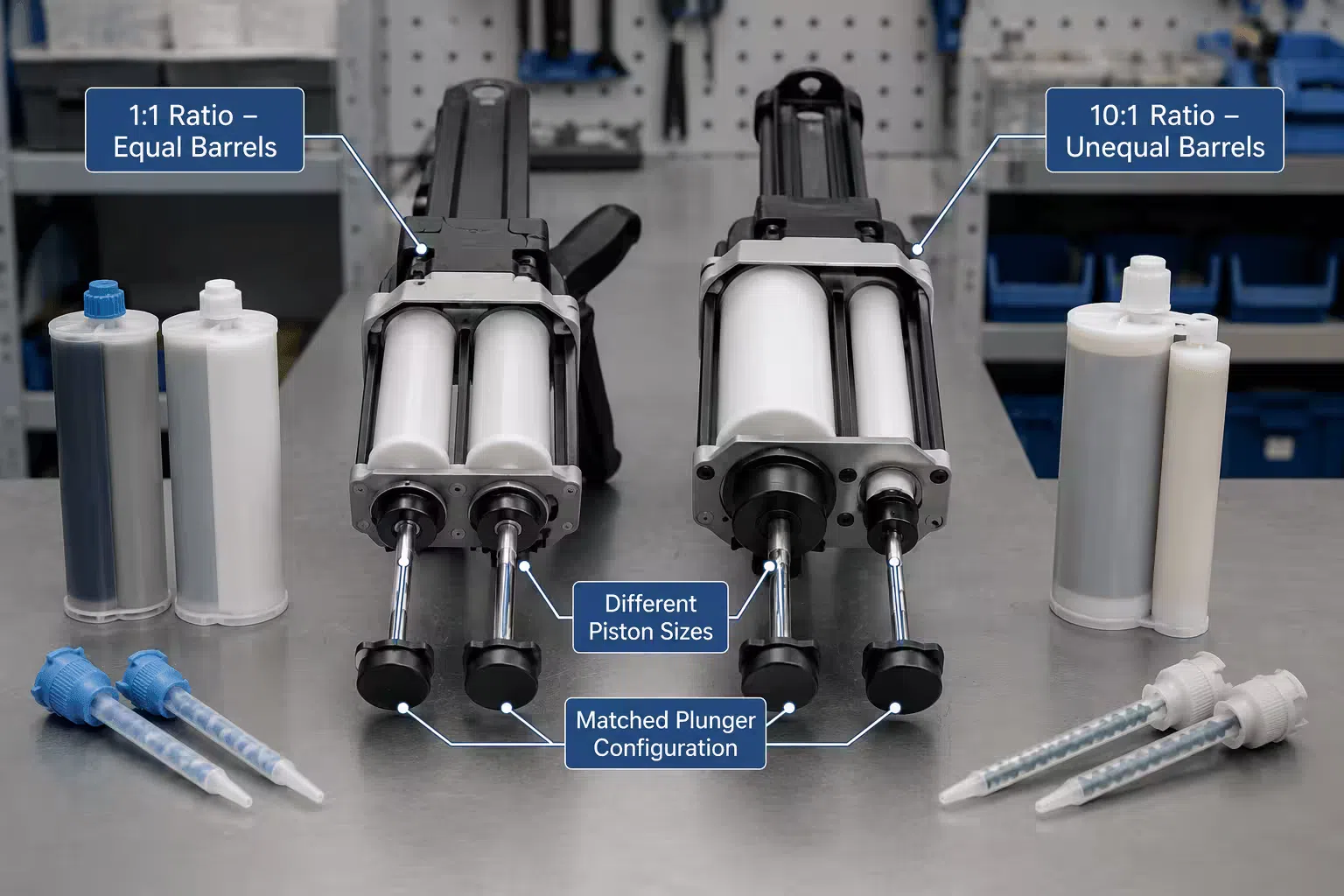
Cartridge capacity and mixing ratio are separate specifications, but both must match for the gun to work. A dual cartridge gun built for 1:1 ratio has equal-diameter barrels. A 10:1 gun has one barrel significantly larger than the other. The two specifications are not interchangeable.
Common mixing ratios for dual component cartridge guns:
- 1:1 — Equal parts A and B. Used for many structural epoxies and acrylic adhesives.
- 2:1 — Two parts resin to one part hardener. Common in construction-grade epoxy systems.
- 3:1 — Found in some industrial bonding adhesives.
- 1:4 and 10:1 — High-hardener-ratio systems for specialty applications.
If an adhesive supplier packages a two-part epoxy in a 200ml cartridge at 1:1 ratio, you need a 200ml 1:1 gun. The same adhesive in a 400ml 2:1 cartridge requires a different gun body entirely. This is one of the most common ordering mistakes in B2B procurement: assuming a single gun handles all cartridge sizes and ratios.
Contractors who work with fast-cure two-part epoxy know that dispensing speed matters as much as capacity. Once the epoxy starts mixing in the static nozzle, the working time is limited. A manual dual cartridge gun with smooth, consistent trigger action lets the operator control flow rate and finish the application before the mixed adhesive begins to cure.
Static Mixer Nozzle Compatibility and Why It Matters
The static mixer nozzle is where the A and B components actually combine. Without a properly matched nozzle, the adhesive does not mix evenly — which leads to weak bonds, inconsistent cure, and failed quality checks. Every dual cartridge system uses a specific nozzle connection type, and the nozzle must match both the cartridge outlet and the adhesive viscosity.
An epoxy mixing gun paired with the wrong nozzle will dispense material that looks mixed but contains streaks of unmixed resin or hardener. Field crews sometimes notice this as soft spots or uneven cure in bonded joints. The fix is not to squeeze harder — it is to use the correct nozzle for the cartridge system.
When ordering, verify three things: the nozzle connection thread size, the nozzle length (longer nozzles provide more mixing elements for thicker adhesives), and whether the nozzle is disposable or reusable. Most construction applications use disposable static mixer nozzles because cleaning them between uses is impractical.
Choosing Manual Operation for Field and Jobsite Use
Manual dual cartridge guns have a clear advantage in certain field conditions: no battery, no air compressor, no power cord. For elevated work, confined spaces, and remote jobsites without reliable power, a manual gun eliminates the most common equipment failure point — dead batteries.
For non-sag and high-viscosity compounds like structural anchoring epoxy, manual operation gives the operator direct control over dispensing force. The resistance felt through the trigger tells the operator how fast the material is flowing. Cordless guns apply constant motor force, which can cause over-dispensing in thick materials or on vertical surfaces.
A production manager equipping a crew of 10 installers should consider the work environment first. If the crew works on scaffolding, in mechanical rooms, or on outdoor concrete structures without charging stations, manual guns remove the battery management problem entirely. For benchtop assembly or fixed-station work with high daily volume, a cordless dual cartridge gun may reduce operator fatigue — but that is a different purchasing decision.
Practical Ordering Checklist for B2B Buyers
Before placing a bulk order for manual dual cartridge guns, procurement teams should confirm these specifications with both the adhesive supplier and the gun manufacturer:
- Cartridge capacity — Match the gun to the adhesive supplier's cartridge format. Do not assume all 200ml cartridges fit all 200ml guns; verify the exact dimensions.
- Mixing ratio — Confirm the A:B ratio. A 1:1 gun will not work with 10:1 cartridges.
- Cartridge holder compatibility — Some adhesive brands use proprietary cartridge shapes. Verify that the dual cartridge holder accepts your brand's format.
- Static mixer nozzle type — Order the correct nozzle connection for the gun and cartridge system.
- OEM and branding requirements — If you distribute under your own brand, confirm the manufacturer offers OEM color and logo customization.
- Surface preparation accessories — Two-part adhesive bonds fail when the substrate is dirty. Pair the gun with wire brushes and blow-out fittings for complete field kits.
For a full range of manual adhesive dispensing guns and detailed model specifications, visit the manual dual cartridge guns product page. If your operations also require single-component cartridge guns for standard sealants, matching each tool type to the dispensing pattern prevents over-investment in the wrong equipment.
FAQ
What is a manual dual cartridge gun used for?
A manual dual cartridge gun dispenses two-component adhesives — structural epoxy, AB glue, and acrylic adhesives — from side-by-side cartridges through a static mixer nozzle. Construction crews use them for anchor installation, crack injection, and structural bonding. Industrial maintenance teams use them for equipment repair and panel bonding.
Which cartridge sizes are available for manual dual cartridge guns?
They are available in 50ml, 200ml, 400ml, and 600ml capacities. The 50ml size suits small repair and touch-up work. The 200ml format is the most common for general construction adhesive applications. The 400ml and 600ml sizes are for higher-volume dispensing on construction sites and industrial maintenance projects.
Can one manual dual cartridge gun fit different mixing ratios?
No. A gun built for one ratio (such as 1:1) has barrel diameters sized for that ratio. A 1:1 gun cannot physically accept 10:1 cartridges because the barrel diameters are different. Each ratio requires a dedicated gun body or a model with a swappable cartridge holder system.
Are manual dual cartridge guns suitable for epoxy adhesive?
Yes. Manual dual cartridge guns are widely used for two-part epoxy dispensing. The controlled trigger action works well with non-sag, high-viscosity epoxy. For fast-cure epoxy, a gun with smooth trigger response helps the operator finish the application before the mixed adhesive begins to set in the nozzle.
When should I choose manual instead of cordless or pneumatic?
Choose manual when the jobsite has no reliable power, when the crew works at height or in confined spaces, or when the adhesive is thick enough to need direct operator control over dispensing force. For high-volume benchtop or fixed-station work, a cordless dual cartridge gun may reduce operator fatigue.
How do I use a cartridge gun for the first time?
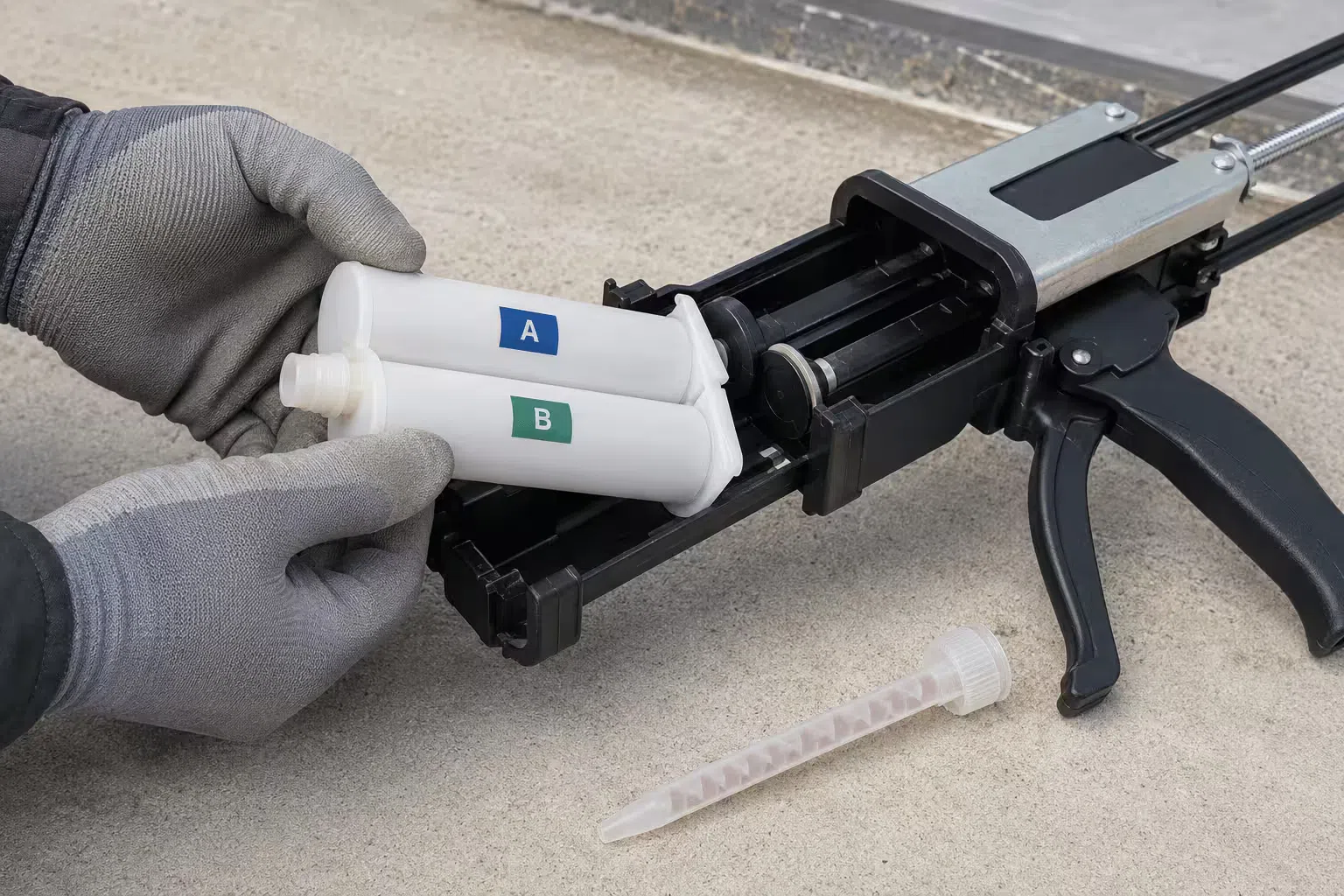
Load the dual cartridge into the holder with A and B cartridges in their correct positions. Attach the static mixer nozzle. Squeeze the trigger slowly until both components appear at the nozzle tip — this confirms the plungers are seated. Then dispense at a steady rate. Used cartridges and nozzles are disposable.
What is the difference between a dual cartridge holder and a single cartridge holder?
A dual cartridge holder holds two side-by-side cartridges and has paired plungers that push both components at the same time. A single cartridge holder is for one-component sealants or adhesives and uses one plunger. The two types are not interchangeable.
Do heavy duty glue guns work with two-part adhesives?
Heavy duty single-component glue guns are designed for high-viscosity one-part materials like construction sealant. They are not suitable for two-part adhesive dispensing because they lack the dual-plunger mechanism and ratio-specific barrel design. For two-part adhesives, use a dual component cartridge gun instead.