Pneumatic Caulking Gun Specifications: Air Pressure, Thrust Ratio, and Cartridge Compatibility
When a procurement manager or distributor evaluates a pneumatic caulking gun for a product line, the spec sheet is where the real decision happens. These tools are not standardized — models differ in operating pressure range, air consumption, thrust force, cartridge format, and barrel material. Each of these numbers affects whether the gun works reliably with the sealants and adhesives end customers actually use. This article explains what the key specifications mean for ordering, stocking, and supporting users who rely on compressed-air dispensing in professional and industrial settings.
What a Pneumatic Caulking Gun Spec Sheet Actually Tells You
A typical spec sheet for an air powered caulking gun lists operating pressure in PSI or bar, air consumption in CFM or L/min, thrust force in kgf or lbf, compatible cartridge sizes in ml or oz, and barrel material. These five numbers define the gun's real-world capability. A distributor who stocks only one pneumatic model needs to know whether that model covers the sealant range most customers use — thin silicone, medium acrylic, thick polyurethane, or two-part epoxy. A factory buyer placing a container order needs to confirm that the spec matches the air systems common in the destination market. These are not abstract details; they are ordering constraints.
Air Pressure Requirements — Matching the Gun to the Compressed Air Setup
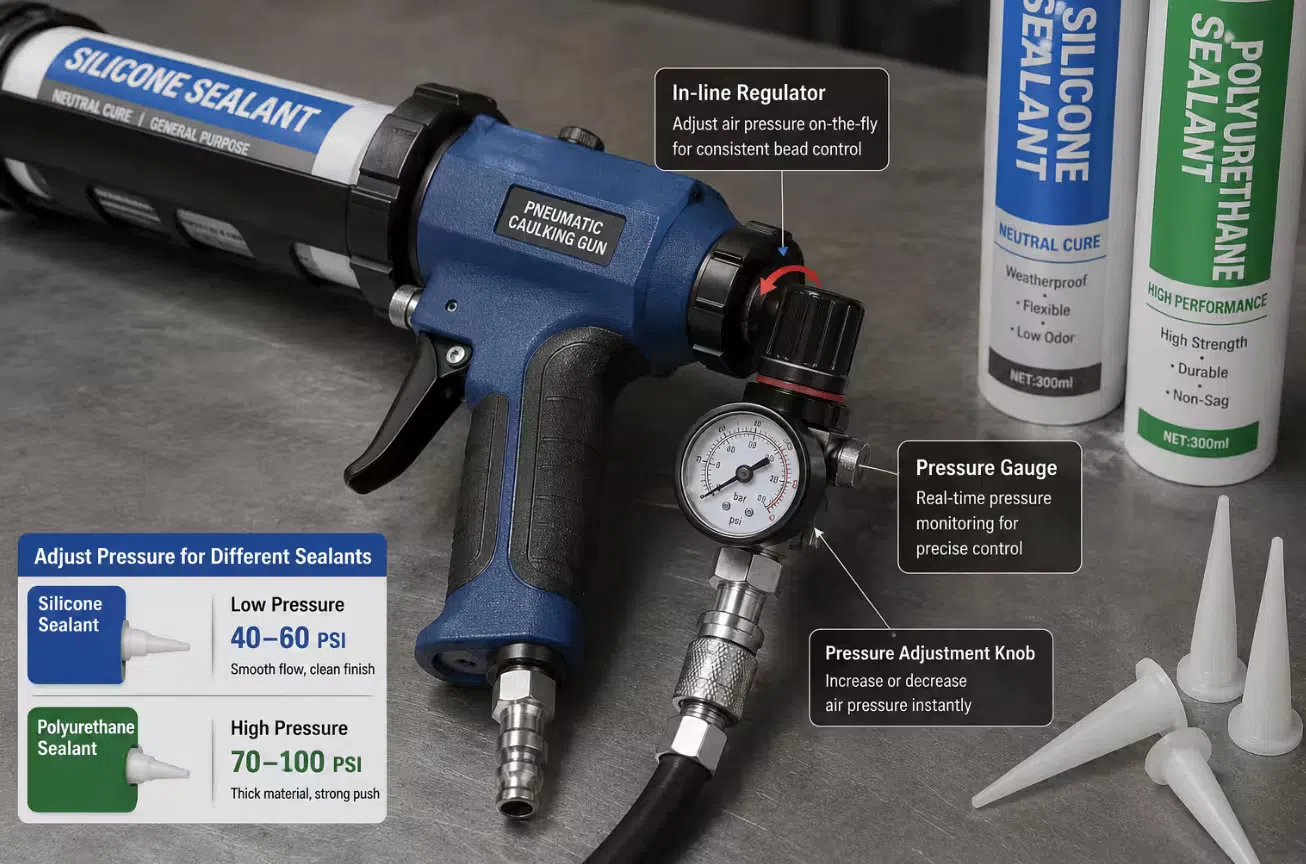
Most pneumatic caulking guns operate between 40 and 90 PSI, but the useful range is narrower than it looks. At the low end, below about 50 PSI, the gun may not generate enough force to push thick sealant through a standard nozzle at a workable speed. At the high end, above 85 PSI, bead control becomes harder and material waste increases. The practical working range for most single-component sealants is 60 to 80 PSI.
Air consumption, measured in CFM (cubic feet per minute), matters just as much as pressure. A gun rated at 4 to 6 CFM at 90 PSI will cycle a small pancake compressor frequently during continuous runs. One user on a tool forum described an air gun that "used a ton of air" — the compressor could not keep up on long beads, and the operator had to pause and wait for pressure to rebuild. For production lines where the gun runs for hours, a shop compressor with a 20-gallon or larger tank and sustained CFM output above the gun's rating is the practical minimum. For intermittent job-site use, a portable compressor may work, but the buyer should confirm the compressor's duty cycle can handle the tool's air demand.
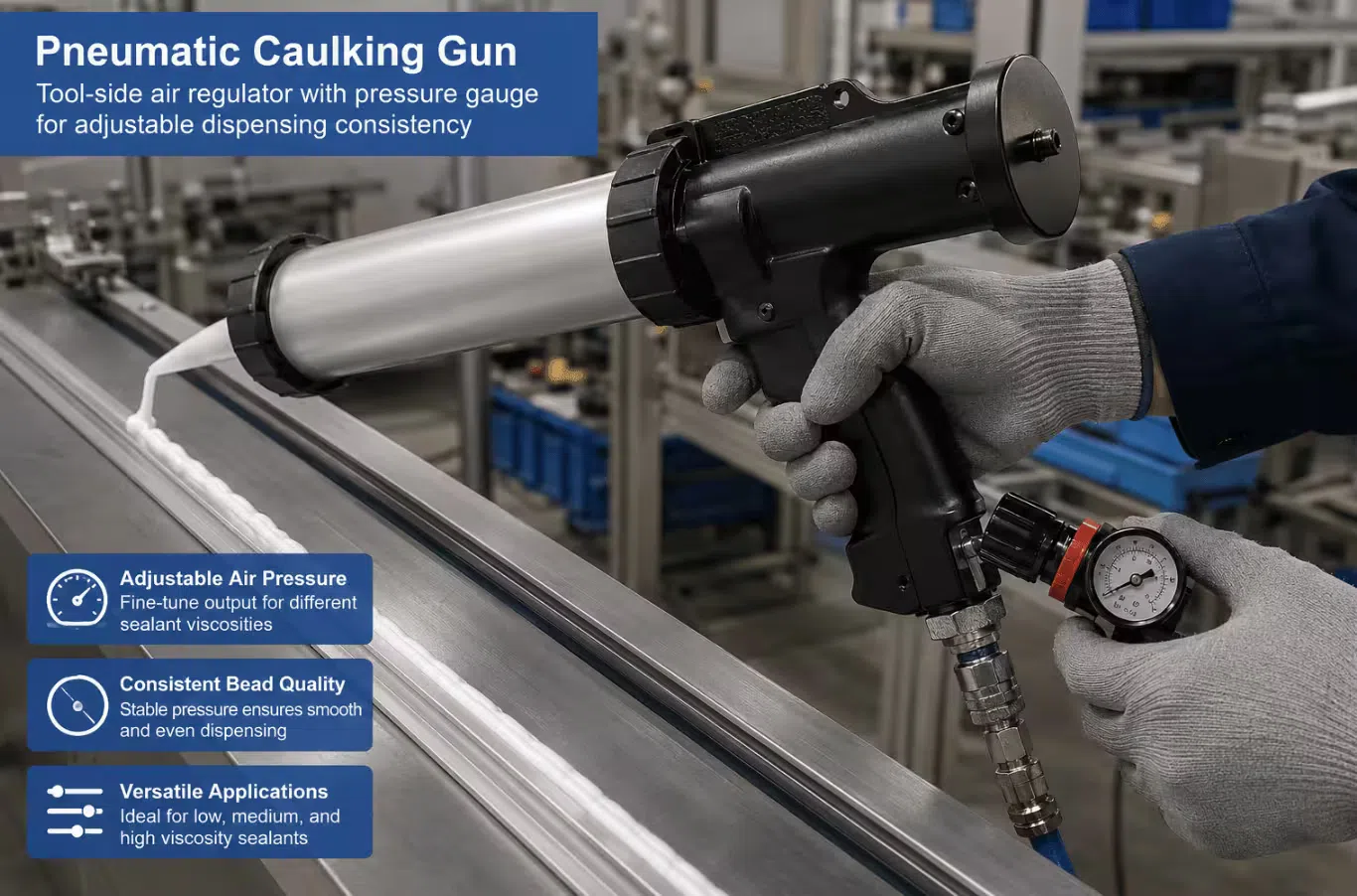
Another spec point that field users emphasize is the location of the pressure regulator. A high pressure caulking gun connected directly to a compressor at 90 PSI gives the operator no way to adjust flow when switching from thin silicone to thick construction adhesive. An in-line regulator mounted at the gun — sometimes called a tool-side regulator — lets the operator dial pressure up or down without walking back to the compressor. Experienced users on trade forums distinguish between a real pressure regulator and a simple flow-restrictor valve: the regulator controls pressure, while the flow valve only restricts volume. A compressed air caulking gun that ships with a built-in tool-side regulator saves the buyer from sourcing a separate fitting and ensures the end user can adjust on the fly.
Thrust Force and Dispensing Power — Matching the Gun to Sealant Viscosity
Thrust force, typically listed in kilograms-force (kgf) or pounds-force (lbf), describes how hard the gun pushes the piston against the cartridge or sausage pack. Entry-level pneumatic applicator guns may produce 150 to 250 kgf. Mid-range professional models deliver 300 to 450 kgf. Heavy-duty industrial guns exceed 500 kgf, and some high-output designs reach 900 kgf or more.
Higher thrust is not automatically better. A tool that produces 900 lbf of force can burst a standard plastic cartridge if the nozzle is partially clogged or if the operator dispenses construction adhesive through a tip cut too small. On a trade forum, one user noted a high-thrust gun could "easily burst tubes if the nozzle is clogged." The same unit, however, is the right tool for cold-weather work — sealant viscosity increases as temperature drops, and a 250-kgf gun that works fine with silicone at 20°C may struggle with the same material at 5°C.
For B2B buyers, the practical rule is to match thrust to the material portfolio the gun is sold to support. A pneumatic air caulking gun sold into window installation, where operators use medium-viscosity silicone and acrylic, needs 250 to 350 kgf. A pneumatic sausage gun sold into industrial waterproofing, where crews dispense high-viscosity polyurethane or MS sealant from 600ml sausage packs in all weather conditions, needs 400 kgf or more. If the buyer's customers apply two-part epoxy, the gun must deliver thrust evenly to both barrels of a dual cartridge — a requirement that low-end models often fail to meet.
Cartridge Compatibility — Standard Sizes, Sausage Packs, and Bulk Formats
Pneumatic caulking guns come in three feed types: standard cartridge, sausage pack, and bulk loading. Each has different barrel dimensions and plunger designs, and they are not interchangeable.
Standard cartridge guns accept 310ml (roughly 10 oz) plastic or metal cartridges — the most common format in construction and general industrial use. The barrel inside diameter must match the cartridge outer diameter. Too loose and the cartridge can shift under pressure; too tight and loading becomes difficult. Some air caulk gun models are designed for 300ml European-standard cartridges, while others accept the slightly larger 310ml size common in North America. A 2mm difference can cause a cartridge to jam.
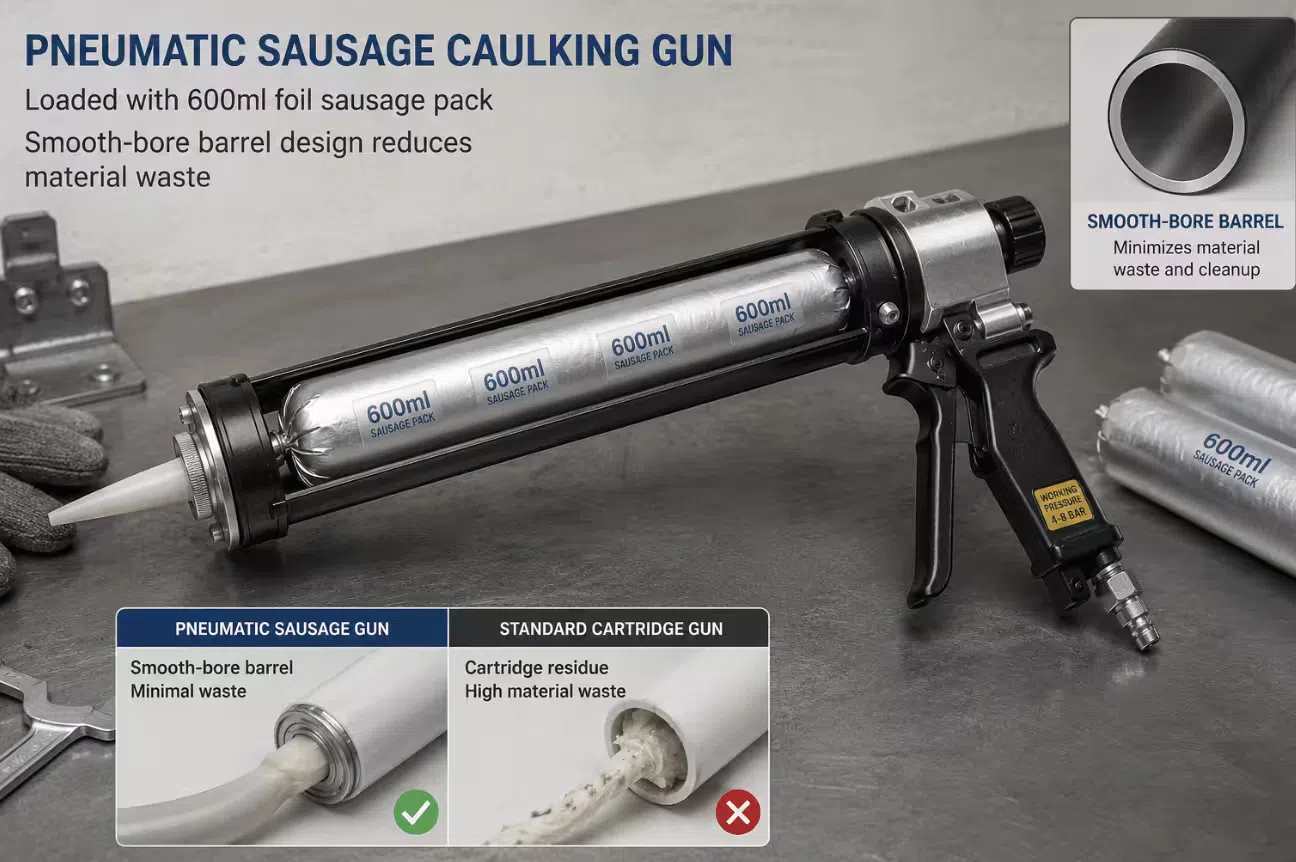
The pneumatic caulking gun 600ml format uses foil sausage packs instead of rigid cartridges. These guns have a smooth-bore barrel with a plunger that pushes directly against the foil. They produce less waste because the foil collapses completely, and they allow faster reloading during continuous work. For B2B supply into professional construction markets — especially Europe and Asia-Pacific where 600ml sausage packs are standard — a pneumatic sausage caulking gun with a 600ml barrel is the core SKU. Some pneumatic bulk caulking gun models accept 20 oz or 28 oz bulk sausage packs, which are common in North American industrial and waterproofing applications.
Barrel material affects both durability and operator comfort. Steel barrels handle higher pressure and resist job-site dents, but the extra weight matters when operators hold the gun overhead for extended periods. Aluminum barrels reduce weight and resist corrosion, making them a better fit for marine and outdoor sealing. Composite barrels are lighter still but may not tolerate the sustained pressure of high-thrust industrial guns.
What B2B Buyers Should Confirm Before Ordering
Before placing a bulk order, procurement teams should verify several specification points that directly affect end-user satisfaction and after-sales support.
First, confirm the air inlet size and thread standard. Most pneumatic tools use 1/4-inch NPT or BSP fittings, but regional variations exist. A gun with a non-standard fitting forces the end user to hunt for adapters, and that creates a poor first experience — the kind that leads to returns.
Second, check the pressure relief mechanism. Well-designed pneumatic caulking guns include an instant air-shutoff valve that stops material flow the moment the trigger is released. One user on a tool forum described a cheap air gun that "continues to gush after the trigger is released" — a sign that the shut-off valve is either missing or poorly designed. For a distributor, this is a defect risk. A gun that drips after release wastes sealant, creates cleanup work, and generates warranty claims.
Third, ask about spare parts availability. Pneumatic guns contain wear components — O-rings, piston seals, trigger springs, and air valves. A supplier who stocks replacement seal kits and can ship them with the order reduces the support burden on the distributor. If seals are non-standard sizes not available from general industrial suppliers, the gun becomes unserviceable once they wear out.
Fourth, confirm OEM configuration options when sourcing for private label. This includes barrel color, grip material, packaging design, user manual language, and cartridge compatibility range. Factory-direct pneumatic caulking gun suppliers can typically handle these requests when specified at the order stage, but the buyer must communicate the requirements before production begins.
FAQ
What is a pneumatic caulking gun?
A pneumatic caulking gun is a dispensing tool that uses compressed air instead of hand force to push sealant or adhesive out of a cartridge or sausage pack. It connects to an air compressor through a standard air hose and uses a trigger-activated valve to control material flow. These tools are common in professional settings where operators dispense sealant repeatedly — construction crews, window installers, factory assembly lines, and auto body shops. Compared to manual caulking guns, pneumatic models reduce hand fatigue and produce a more consistent bead over long runs.
How does a pneumatic caulking gun work?
Compressed air from a connected compressor enters the gun body through the air inlet. When the operator pulls the trigger, the air pushes a piston forward, which drives a plunger against the back of the sealant cartridge or sausage pack. The sealant exits through the nozzle. When the trigger is released, a shut-off valve vents the air pressure and stops the plunger. The operator can adjust air pressure at the gun or compressor to control dispensing speed and bead size.
What air pressure does a pneumatic caulking gun need?
Most pneumatic caulking guns operate in the 40 to 90 PSI range, with 60 to 80 PSI being the most common working range for standard sealants. Higher-viscosity materials such as polyurethane or construction adhesive may require pressure at the upper end of that range. The gun's air consumption in CFM determines the compressor size needed — a gun rated at 4 CFM at 90 PSI needs a compressor that can sustain that output for continuous work without cycling excessively.
What materials can a pneumatic caulking gun dispense?
Pneumatic caulking guns can dispense silicone sealant, acrylic sealant, polyurethane sealant, MS polymer sealant, construction adhesive, butyl sealant, and other single-component materials in standard cartridges or sausage packs. Dual-component pneumatic guns handle two-part epoxy and structural adhesive systems. The gun's thrust force and pressure range must match the material viscosity — thick, high-viscosity adhesives require more thrust than thin silicone formulations.
Can pneumatic caulking guns dispense sausage packs?
Yes. Dedicated pneumatic sausage guns accept 600ml foil sausage packs, which are widely used in professional construction for window sealing, curtain wall installation, and waterproofing. The sausage pack format reduces cartridge waste and allows faster reloading. Some models also accept 20 oz or 28 oz bulk sausage packs for North American industrial applications. A standard cartridge gun cannot accept sausage packs unless it has a removable barrel or a sausage-pack-specific design.
What is the difference between a pneumatic caulking gun and an air powered caulking gun?
There is no technical difference — "pneumatic caulking gun" and "air powered caulking gun" refer to the same type of tool. Some manufacturers and retailers use one term or the other in product listings, but both describe a caulking gun that runs on compressed air. The term "air caulking gun" is also used interchangeably in some markets, particularly North America.