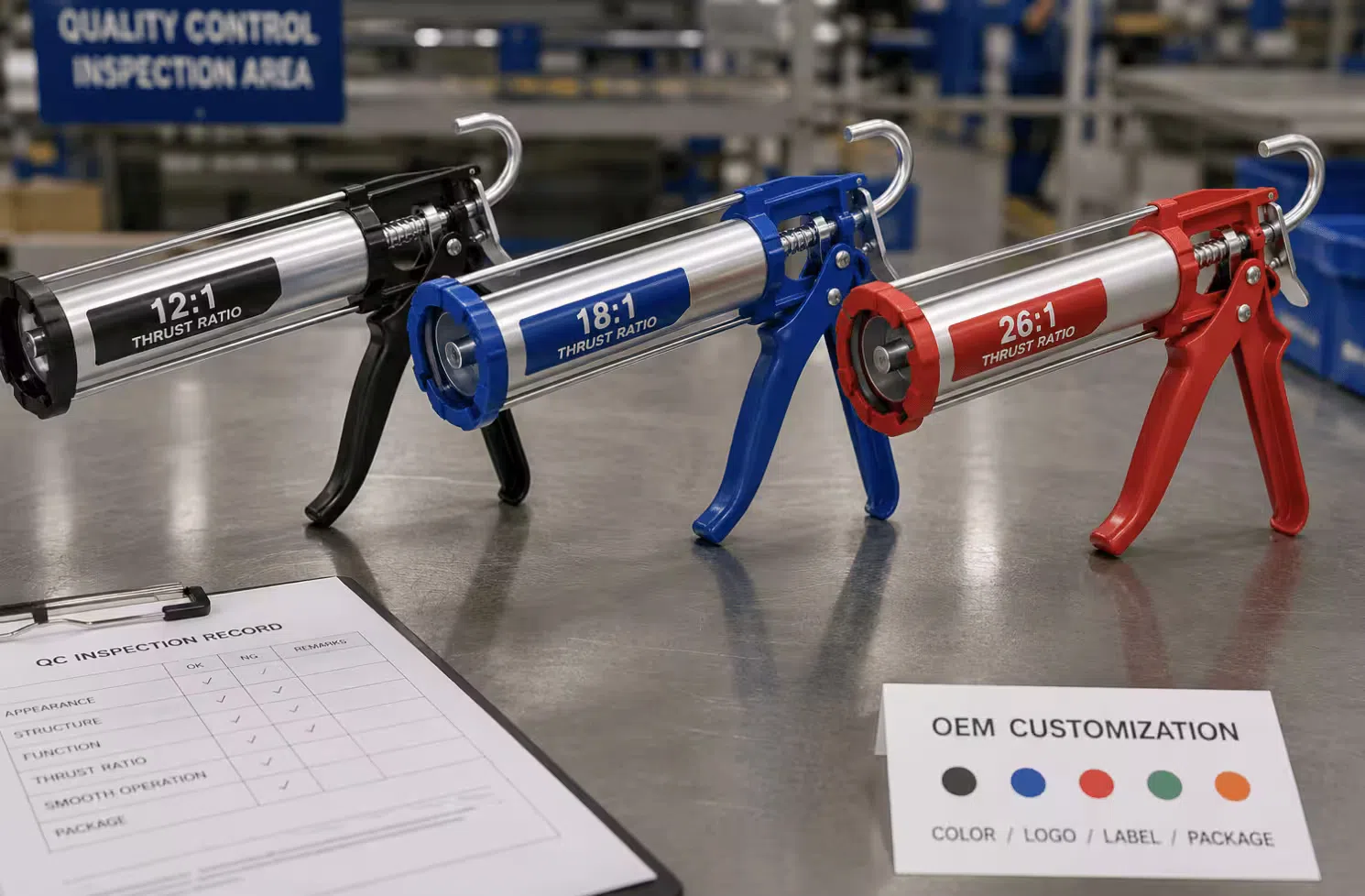
B2B buyers sourcing cartridge caulking guns for wholesale distribution or OEM programs face a market with hundreds of factory suppliers and wide quality differences. Knowing what to verify before placing a wholesale or cartridge caulking gun wholesale order — frame material, available thrust ratios, cartridge compatibility, color and packaging options, and pre-shipment inspection procedures — separates a reliable supply partner from a costly sourcing mistake. This guide covers the key evaluation points for manual cartridge caulking gun OEM orders from cartridge gun manufacturers.
Understanding Factory Capability for Cartridge Caulking Guns
Not every cartridge caulking gun factory offers the same quality or customization range. The first step in evaluating a supplier is confirming what models they manufacture and whether those models match your target market.
A capable factory should produce multiple thrust ratio variants. A range covering 7:1 for light silicone sealants up to 26:1 for thick polyurethane and construction adhesives tells you whether the factory serves only basic markets or can supply professional-grade tools.
Frame material is equally important. Factories that offer both aluminum alloy and steel frame options demonstrate broader capability. Aluminum frames are lighter and resist corrosion, which matters in coastal or high-humidity markets. Steel frames provide more durability at a lower material cost, which suits price-sensitive bulk orders.
Ask for a model specification sheet listing thrust ratio, frame material, cartridge capacity, and dripless mechanism for each model they produce. Compare the range against what your wholesale customers typically need.
Frame and Build Quality
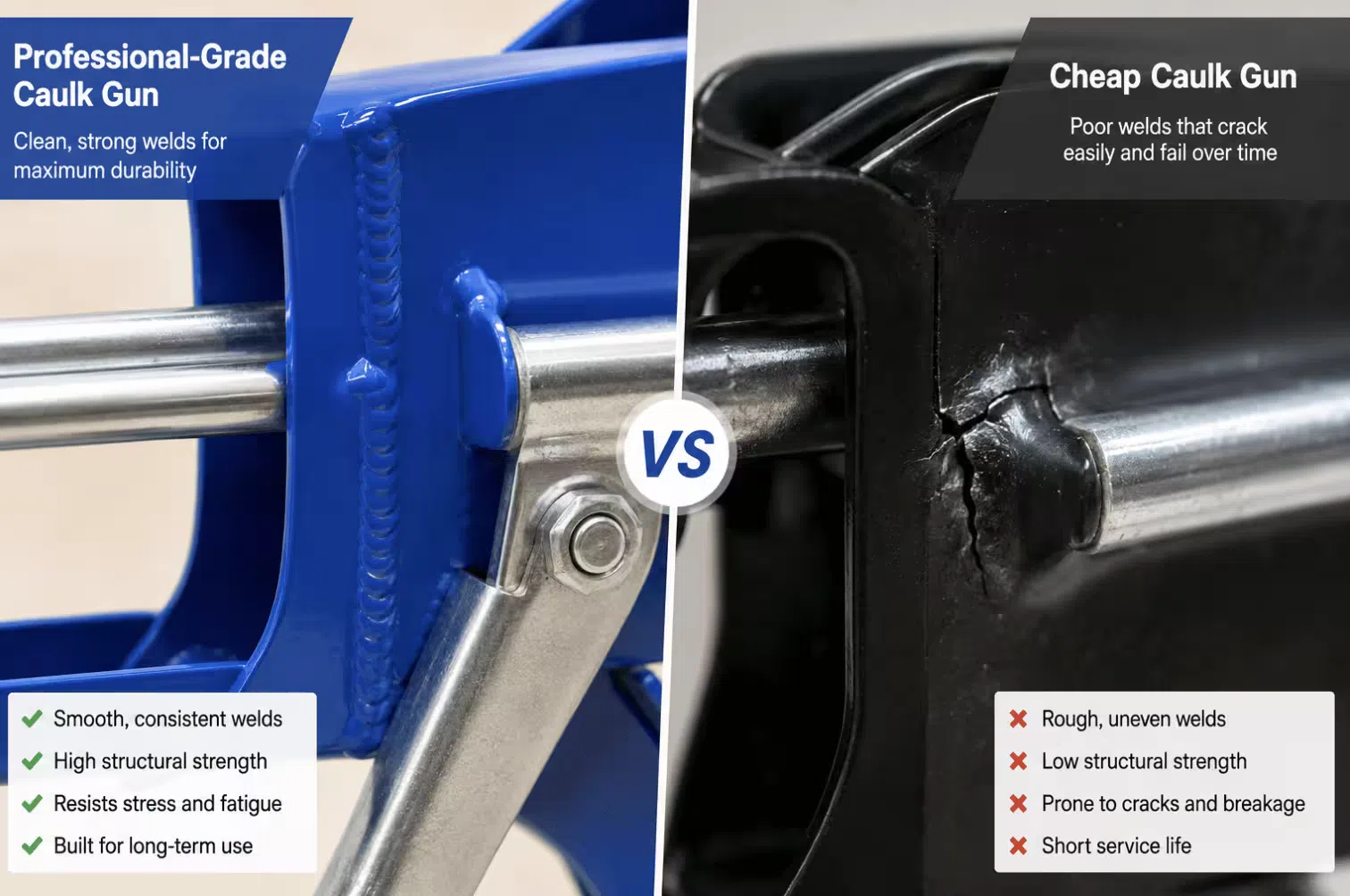
The frame is the structural backbone of any manual cartridge caulking gun. A weak frame bends or cracks under repeated high-thrust use, especially when dispensing thick sealants. B2B buyers who stock guns for professional users need to confirm the factory uses adequate gauge metal and proper welding.
Points to verify with the factory before ordering:
- Frame material thickness: Thinner metal bends at the handle or pressure plate joint during heavy use
- Weld quality: Clean, continuous welds at the handle-to-frame junction and rod guide
- Release lever and trigger alignment: Misaligned parts cause binding and inconsistent dispensing
Cheap guns use thin steel or low-grade aluminum that flexes under load. The frame fails first at the handle joint, which cannot be repaired economically. Professional-grade guns use thicker metal and reinforced weld points.
Most reliable cartridge caulking gun manufacturers include pre-shipment function checks — inspecting frame alignment, trigger smoothness, and rod straightness before packing. Ask whether the factory performs individual or batch-level function testing on outgoing wholesale orders.
Thrust Ratio and Dripless Mechanism for OEM Orders
Thrust ratio determines how much mechanical force the trigger applies to the plunger rod. A higher ratio means more force per trigger pull. This matters when the gun must dispense heavy materials.
| Specification | Typical Range | What It Affects | B2B Buying Note |
|---|---|---|---|
| Thrust ratio | 7:1 to 26:1 | Dispensing force for light vs heavy sealants | Confirm your target materials; offer multiple ratios in your lineup |
| Frame material | Aluminum alloy or steel | Weight, corrosion resistance, durability | Aluminum for weight-sensitive markets, steel for cost-sensitive bulk orders |
| Dripless mechanism | Spring-loaded release or cam-type | Stops material flow when trigger is released | Required for professional users; ask the factory if standard or optional |
| Cartridge capacity | 300 ml / 310 ml standard | Which cartridge sizes the gun accepts | Most markets use 300 ml or 310 ml rigid cartridges |
The dripless mechanism uses a spring or cam system to retract the plunger rod slightly when the release lever is engaged, relieving pressure inside the cartridge. Without this feature, sealant continues to ooze after the user stops squeezing, wasting material and creating cleanup work.
For wholesale stocking, confirm whether the dripless mechanism is standard or optional on the models you plan to order. In many factories, the dripless version adds a small cost premium over the basic model.
Customization Options: Color, Branding, and Packaging
A major advantage of OEM orders is customization. Cartridge caulking gun suppliers typically offer several levels depending on order volume. Buyers looking for caulk gun wholesale pricing should confirm the factory covers their preferred tier.
- Frame color: Standard color options such as blue, black, red, yellow, and gray; custom Pantone matching available for larger orders
- Branding: Logo placement on the frame, handle, or label area; some factories offer embossed or molded branding
- Packaging: Individual boxes, poly bags, bulk cartons, or retail-ready clamshell packaging
- Model labeling: Custom model numbers, barcodes, or specification stickers
The typical MOQ for color customization starts at 1,000 to 3,000 units per model. Standard color models with basic branding usually have lower MOQ thresholds. Factories that offer multiple color and packaging options signal that they serve export and distributor markets.
Quality Assurance and Pre-Shipment Inspection
Reliable factories follow a standard QC process before shipping bulk orders. Understand what is checked and whether you can request additional inspection steps.
Common factory QC checks:
- Appearance inspection: Scratches, paint defects, or surface marks
- Function test: Trigger action, rod movement, and release lever operation
- Fit check: Frame accepts standard 300 ml or 310 ml cartridges without binding
- Dripless test: Release mechanism stops material flow when engaged
For larger orders, many buyers request a pre-shipment inspection report or hire a third-party inspection service. The factory should accommodate reasonable inspection requests as part of the purchase agreement.
Application Matching Guide
The table below maps common sealant and adhesive types to recommended cartridge caulking gun specifications for wholesale stocking decisions.
| Application | Recommended Thrust Ratio | Key Specs to Check |
|---|---|---|
| Silicone sealant, acrylic sealant | 7:1 to 12:1 | Standard dripless, aluminum or steel frame |
| Polyurethane sealant, hybrid sealant | 18:1 to 24:1 | Higher thrust ratio, reinforced frame |
| Construction adhesives | 24:1 to 26:1 | High thrust ratio, steel frame, dripless |
| General construction sealing | 12:1 to 18:1 | Medium thrust, aluminum or steel, dripless |
OEM buyers stocking for distributor or hardware store channels should consider offering at least two thrust ratio tiers: a standard option for general silicone and acrylic work and a higher thrust option for polyurethane sealants and adhesives. This gives wholesale customers a clear product range to choose from.
FAQ
Where can I buy caulking guns wholesale for my distribution business? CaulkMFG supplies manual cartridge caulking guns directly from the factory with wholesale pricing. Orders ship within standard lead times once the model, quantity, and packaging requirements are confirmed.
What is the typical MOQ for OEM cartridge caulking guns? Standard models with basic packaging usually have MOQs between 500 and 1,000 units. Custom color or custom packaging orders typically require 1,000 to 3,000 units per model. Each factory sets its own MOQ based on production setup and customization scope.
Can I get custom colors for my OEM caulking gun order? Yes. Most factories offer multiple standard colors and can match custom Pantone references. Custom color runs usually require higher MOQs and longer lead times.
What thrust ratio should I stock for general sealant dispensing? A thrust ratio of 12:1 to 18:1 covers most silicone, acrylic, and hybrid sealant applications. For polyurethane sealants, construction adhesives, or cold-weather work, consider 24:1 or 26:1.
How do I verify frame quality before placing a bulk order? Request photographs of finished production samples showing weld joints, frame thickness, and trigger assembly. Ask the factory about their standard QC process and whether they provide pre-shipment inspection reports for caulking guns.
Do OEM factories provide sample units for evaluation? Most factories can provide sample units. Confirm the sample cost, whether it is refundable against the first order, and whether the sample matches final production specifications.
Request a Quote
To order cartridge caulking guns for your wholesale or OEM program, provide your sealant types, cartridge or pack size, target market, expected order quantity, and any OEM or private label requirements. CaulkMFG can recommend suitable models and confirm customization, packaging, and lead time options.
Submit your requirements for cartridge caulking guns →
Related: What Makes a Caulking Gun Commercial Grade · Caulk Gun Thrust Ratio Guide