Matching Caulking Gun Specs to Sealant Materials
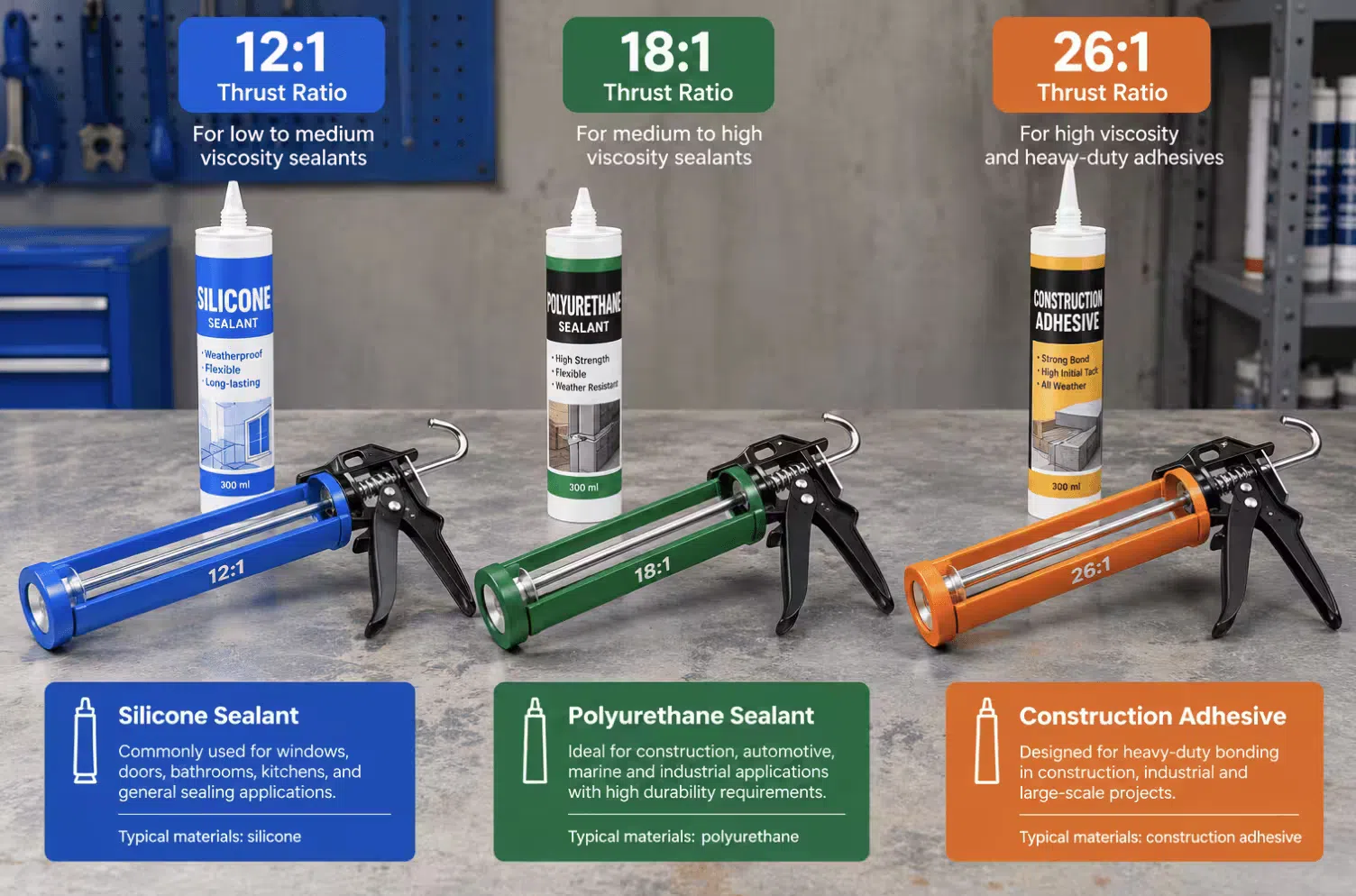
The right caulking gun for a silicone sealant is not necessarily the right gun for a polyurethane sealant or a construction adhesive. Material viscosity, dispensed volume, and working conditions all affect which thrust ratio, frame material, and dripless mechanism make sense. For B2B buyers stocking cartridge caulking guns for distributor or hardware channels, understanding caulking gun material selection helps avoid ordering guns that do not match what the end user is dispensing.
This guide maps common sealant and adhesive types to the cartridge caulking gun specs that work best with them.
Which Caulking Gun Specs Affect Material Compatibility
Three specifications determine whether a cartridge caulking gun works well with a given material: thrust ratio, frame material, and dripless mechanism.
Thrust ratio is the mechanical advantage between the trigger pull and the force applied to the plunger rod. A 7:1 ratio means 7 units of force at the rod for every 1 unit of force at the trigger. Higher ratios push harder against thick materials but can over-pressurize thin sealants.
Frame material affects how much force the gun can sustain without bending. Aluminum alloy frames are lighter and resist corrosion. Steel frames are heavier but more cost-effective and withstand higher cyclic loads.
Dripless mechanism retracts the plunger rod slightly when the release lever is engaged, stopping material flow. Thin sealants such as silicone will continue to ooze without this feature, while thicker materials hold pressure better on their own.
| Specification | Typical Range | What It Affects | B2B Buying Note |
|---|---|---|---|
| Thrust ratio | 7:1 to 26:1 | Dispensing force matches material viscosity | Stock lower ratios for thin sealants, higher for thick adhesives |
| Frame material | Aluminum alloy or steel | Weight, corrosion resistance, load capacity | Aluminum for general use, steel for high-thrust heavy-duty models |
| Dripless mechanism | Spring-loaded or cam-type | Stops flow on trigger release | Required for silicone/acrylic sealants; confirm with factory |
Silicone and Acrylic Sealants — Low to Medium Thrust
Silicone sealants and acrylic sealants are low-viscosity materials. They flow easily through the nozzle with minimal force. A thrust ratio of 7:1 to 12:1 is usually sufficient for these sealants.
The dripless mechanism matters most with thin sealants. Without it, silicone continues to ooze from the nozzle after the trigger is released, creating drips on the workpiece and wasting material. The release lever retracts the rod and relieves cartridge pressure so the flow stops when the user stops squeezing.
For wholesale buyers, standard aluminum alloy frame models with 7:1 to 12:1 thrust and a dripless mechanism cover most silicone and acrylic applications. These are the highest-volume segment for hardware store channels and represent the entry-level tier for most distributor product lines. Many cartridge caulking gun suppliers offer these models in multiple colors and packaging options for OEM branding.
Polyurethane and Hybrid Sealants — Higher Thrust, Reinforced Frame
Polyurethane (PU) sealants and hybrid sealants are thicker than silicones. They require more force to extrude, especially at lower temperatures. A thrust ratio of 18:1 to 24:1 is typical for these materials.
The frame must handle the higher force. Steel frame models or reinforced aluminum alloy frames resist bending under repeated PU dispensing. The dripless mechanism is still useful but less critical than with silicones — thicker sealants hold less pressure after release.
OEM buyers ordering for construction and industrial channels should consider steel frame models in the 18:1 to 24:1 range as the primary stock option for PU and hybrid sealants. These models also benefit from a reinforced trigger assembly and thicker rod construction to handle the sustained load. Buyers should confirm with the caulking gun supplier whether the frame and rod are rated for continuous PU sealant dispensing.
Construction Adhesives — High Thrust, Steel Frame
Panel adhesives, floor adhesives, and other construction-grade adhesives are the most viscous materials dispensed from cartridge caulking guns. They need a thrust ratio of 24:1 to 26:1.
Steel frames are preferred for construction adhesive work. The frame must support sustained high thrust without bending or cracking at the weld joints. Pre-shipment inspection should verify weld quality and frame thickness, especially for guns specified for adhesive dispensing.
Not all cartridge caulking gun models with a high thrust ratio include a dripless mechanism, because construction adhesives hold pressure and do not drip significantly. Buyers should confirm whether the dripless feature is included or excluded based on their target market. For stocking purposes, many distributors find that offering one dripless and one non-dripless high-thrust model covers both adhesive and sealant segments.
| Application | Recommended Thrust Ratio | Key Specs to Check |
|---|---|---|
| Silicone sealant, acrylic sealant | 7:1 to 12:1 | Standard dripless, aluminum frame |
| Polyurethane sealant, hybrid sealant | 18:1 to 24:1 | Higher thrust, steel or reinforced aluminum frame, dripless preferred |
| Construction adhesives (panel, trim, floor) | 24:1 to 26:1 | High thrust, steel frame, dripless optional |
| General construction sealing | 12:1 to 18:1 | Medium thrust, metal frame, dripless |
FAQ
What thrust ratio should I use for silicone sealant? A thrust ratio of 7:1 to 12:1 works well for silicone and acrylic sealants. These are low-viscosity materials that do not need high mechanical force. A dripless mechanism is more important for silicone than for thicker materials.
What caulk gun works best for polyurethane sealant? Polyurethane sealant needs a cartridge caulking gun with an 18:1 to 24:1 thrust ratio and a steel or reinforced aluminum frame. The higher mechanical advantage reduces hand fatigue during continuous PU dispensing.
What frame material is best for construction adhesives? Steel frames are preferred for construction adhesive dispensing because the sustained high thrust can bend lighter aluminum or composite frames over time. Check weld quality and frame thickness before ordering bulk quantities for adhesive use.
Does a dripless caulk gun matter for thin sealants? Yes. Thin sealants such as silicone and acrylic continue to ooze after the trigger is released unless the gun has a dripless mechanism that retracts the rod and relieves cartridge pressure. Without it, you get messy drips and wasted material.
Can the same caulking gun handle every sealant type? A single mid-range gun with 12:1 to 18:1 thrust can handle many common sealants, but the best results come from matching the gun to the material. Distributors should consider stocking at least two tiers: a standard dripless model for silicones and a higher-thrust model for PU and adhesives.
What happens if the thrust ratio is too high for thin sealant? Too much force can over-pressurize the cartridge, causing the tube to burst or the sealant to shoot out uncontrollably. Users accustomed to low-thrust guns may break cartridges when switching to a high-thrust model without adjusting their technique.
Request a Quote
To discuss cartridge caulking gun models suited to your target materials and market, contact CaulkMFG with your sealant types, expected order volumes, and any OEM or packaging requirements.
Browse cartridge caulking gun models →
Related: What Thrust Ratio Means for Caulking Gun Selection · Polyurethane Sealant Gun Specs · Commercial Grade Caulking Gun Guide · Manual Caulking Gun Model Guide