Pneumatic Caulking Guns for Continuous Industrial Use
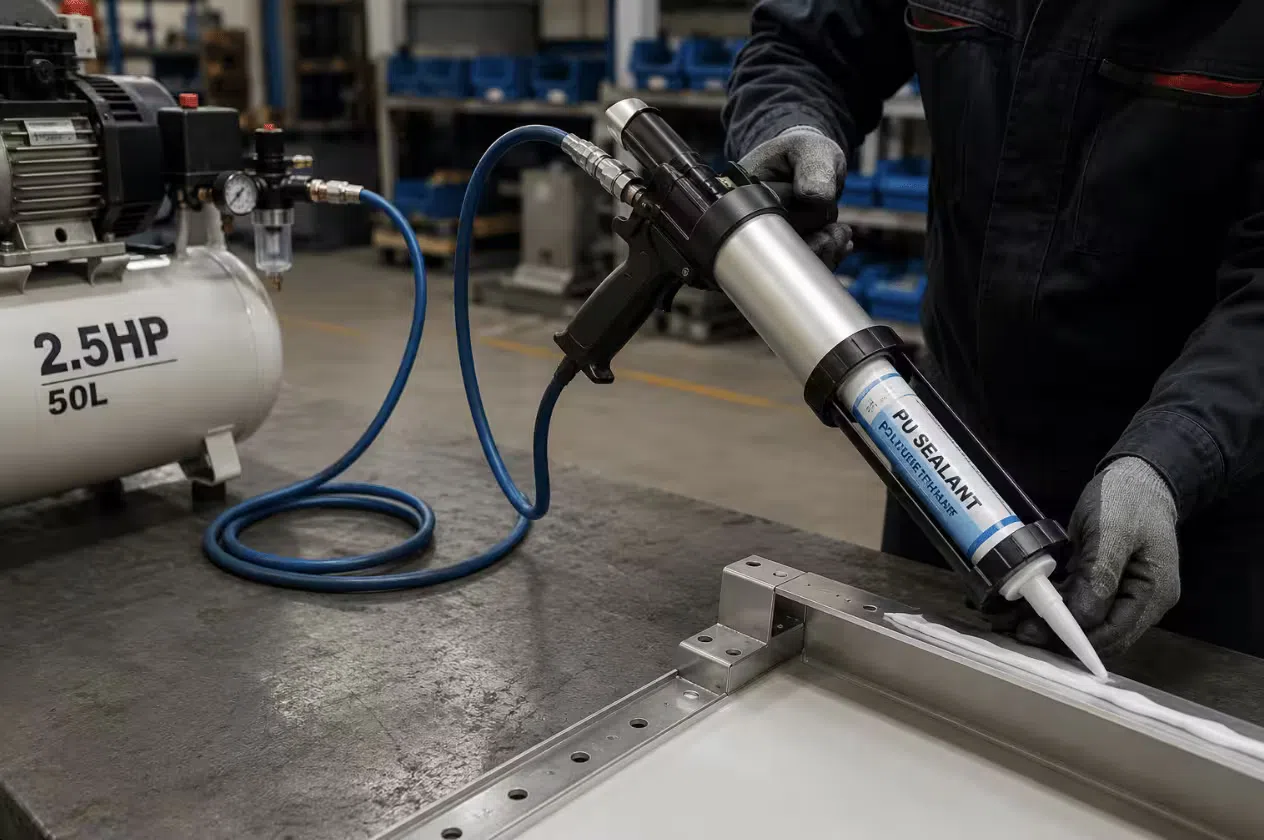
A pneumatic sealant gun uses compressed air to push sealant, adhesive, or similar material from a cartridge or sausage pack through a nozzle. Instead of relying on hand pressure or a battery-powered motor, a pneumatic caulking gun runs on standard shop air — the same supply that powers impact wrenches, nailers, and other air tools on a factory floor or construction site. For B2B buyers who stock dispensing tools for continuous industrial use, the choice between pneumatic, manual, and cordless guns comes down to duty cycle, material type, and the operating environment.
This guide covers where pneumatic caulking guns fit in continuous industrial dispensing — which applications suit them best, how they compare with other dispensing methods, and what to check when sourcing for wholesale or OEM supply.
How Pneumatic Guns Work for Continuous Use
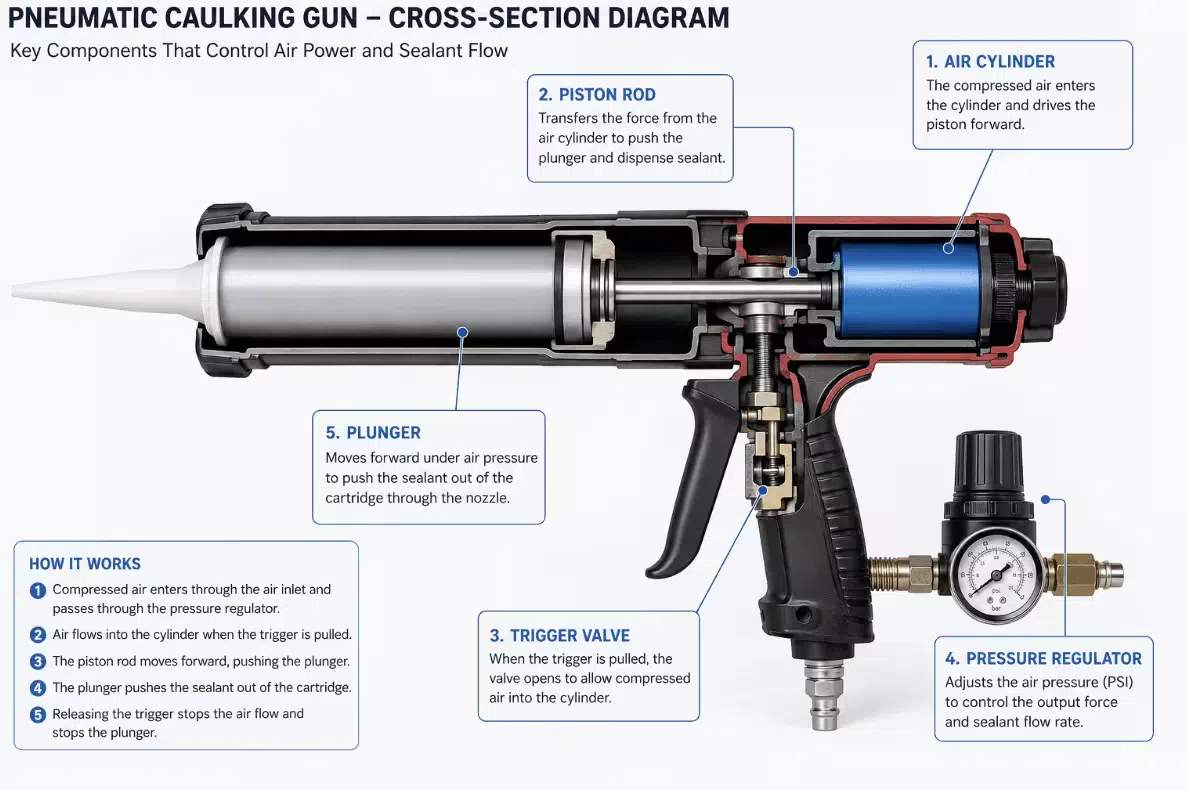
A pneumatic caulking gun contains an air cylinder, a piston, a trigger valve, and a pressure regulator. When the gun is connected to a compressed air line, pulling the trigger opens the valve and lets air push the piston forward. The piston rod drives the plunger into the cartridge or sausage pack, forcing material out through the nozzle.
The main advantage for continuous work is that pneumatic guns eliminate operator fatigue. A manual gun requires the user to squeeze repeatedly — over hundreds of cartridges per day, hand and forearm fatigue slows output and reduces bead consistency. A cordless gun depends on battery charge and motor torque, which can drop off with thick materials or cold weather. A pneumatic gun delivers the same plunger force on every trigger pull as long as the compressor maintains pressure. Trade forum users describe using pneumatic guns on long baseboard and window sealing runs where one person lays the bead and a second follows to smooth — a pattern that would exhaust a manual operator within a few cartridges.
The pressure regulator lets the operator adjust dispensing speed. For thin materials like silicone or acrylic, lower pressure prevents splattering. For thick materials like polyurethane or construction adhesive, higher pressure maintains steady flow. Users report that cheap pneumatic units lack fine regulation and consume more air than needed, while better-made guns — particularly Italian-manufactured models — provide noticeably better control. For B2B buyers, the quality of the regulator and piston seal directly affects end-user satisfaction.
Key Application Areas for Pneumatic Sealant Guns
Pneumatic caulking guns work best where compressed air is already available, the work volume justifies the setup, and the material viscosity or duty cycle would strain manual or cordless alternatives.
Construction and Window or Door Installation
Sealing windows, doors, and curtain walls requires running beads across long perimeters with consistent coverage. Pneumatic guns let the installer maintain a steady bead width without stopping to rest. On commercial glazing jobs where hundreds of linear feet of sealant go down per day, a pneumatic setup paired with a 1/4-inch lightweight air hose keeps the gun maneuverable while eliminating hand fatigue.
Industrial Assembly
Assembly lines that apply adhesive beads to panels, frames, or components benefit from the repeatable output of a pneumatic applicator gun. Because air pressure stays constant, the bead volume per trigger pull remains consistent across hundreds of cycles. This matters for quality control — uneven adhesive application leads to rejects or rework. For buyers supplying manufacturing customers, specifying a pneumatic gun with a reliable regulator and piston seal reduces downstream complaints.
Automotive Repair and Manufacturing
Body shops and automotive assembly stations already use compressed air throughout the facility, which makes adding a pneumatic dispensing gun straightforward. Materials commonly applied include seam sealers, polyurethane bonding adhesives, and anti-corrosion coatings. The ability to adjust pressure on the gun — rather than swapping battery tools or dealing with stalled cordless motors — keeps the workflow moving during long production runs.
Marine Sealing
Marine environments require watertight seals on deck fittings, hatches, hull joints, and bulkheads. The sealants used — often polysulfide or high-viscosity polyurethane — are thick enough to challenge manual and cordless guns. A pneumatic caulking gun connected to a workshop compressor handles these materials without hesitation. For boat builders and repair yards that work through multiple tubes per shift, the fatigue-free operation is a practical advantage.
Pneumatic vs Manual vs Cordless Comparison
| Specification | Unit | What It Affects | B2B Buying Note |
|---|---|---|---|
| Operating pressure | PSI (typically 70–100 PSI) | Dispensing speed and material compatibility | Verify the gun's rated pressure range against the buyer's compressor output. Typical shop compressors supply 90 PSI. |
| Air consumption | CFM (typically 3–8 CFM) | Whether the compressor keeps up during continuous use | Check the gun's CFM rating at the operating pressure. A larger compressor tank reduces cycling on heavy-use days. |
| Thrust ratio | Ratio (e.g., 12:1, 18:1) | Mechanical advantage driving the plunger | Higher ratios generate more force for thick materials. For standard silicone or acrylic sealants, a moderate ratio usually suffices. |
| Cartridge or pack compatibility | Size (e.g., 600ml, 28 oz, 1/10 gal) | Fits standard sealant packaging | Pneumatic guns come in versions for single-component cartridges, sausage packs, and dual-component configurations. Confirm barrel size matches the buyer's preferred packaging. |
| Duty cycle | Unlimited (air-powered) | How many cartridges the gun can dispense without stopping | Pneumatic guns have no battery recharge downtime. For high-volume operations, this is the main advantage over cordless. |
| Application | Recommended Gun Type | Key Specs to Check |
|---|---|---|
| Window or door sealing (high volume) | Single-component pneumatic caulking gun (cartridge or sausage) | Operating pressure, air consumption, hose fitting type |
| Industrial adhesive assembly | Single-component or dual-component pneumatic applicator gun | Thrust ratio, material viscosity range, nozzle compatibility |
| Automotive seam sealing | Single-component pneumatic sealant gun | Pressure regulation precision, trigger control for start-stop beads |
| Marine sealing (thick polyurethane) | Single-component pneumatic gun (sausage pack preferred for high volume) | Material viscosity range, pack size compatibility, thrust ratio |
| Epoxy bonding (structural) | Dual-component pneumatic dispensing gun | Ratio accuracy, mixer compatibility, cartridge size (200ml, 400ml) |
Material Compatibility
Pneumatic guns handle most materials that come in standard cartridges and sausage packs. The key variable is viscosity. Thin materials — silicone, acrylic, latex — need low pressure and fine regulator control. Thick materials — polyurethane, MS sealant, construction adhesive, epoxy — need higher thrust and often work better with a pneumatic gun than with a battery-powered alternative.
For single-component pneumatic guns, common compatible materials include silicone sealants, acrylic sealants, polyurethane adhesives and sealants, MS polymer sealants, and latex-based caulk. These guns accept standard 600ml sausage packs, 28 oz cartridges, and 1/10 gal cartridges depending on barrel design.
For dual-component pneumatic guns, compatible materials include epoxy adhesives, structural bonding adhesives, and two-part polyurethane systems. These guns use side-by-side cartridges — typically 200ml or 400ml — and require a static mixing nozzle. The pneumatic drive keeps both components dispensing at equal ratios regardless of viscosity differences.
When sourcing for wholesale or OEM supply, confirm with the supplier's specification sheet which sealant types, cartridge dimensions, and sausage pack sizes each model supports. Do not assume a gun that fits one 600ml sausage pack brand will fit all — pack length and cap design varies between manufacturers.
B2B Buyer Sourcing Checklist
Available air supply. The buyer's compressor setup determines whether a pneumatic gun will perform well. Check the gun's CFM requirement at the intended operating pressure and compare it against compressor output. A detailed reference on compressor matching is in the air powered caulking gun PSI and compressor guide.
Material viscosity. Pneumatic guns handle a wider viscosity range than most cordless models, but the gun's thrust ratio must match the material. Thick structural adhesives benefit from a higher ratio. For standard sealants, a moderate ratio with a good regulator provides sufficient control.
Packaging format. Decide whether the end user works with cartridges, sausage packs, or both. Guns with quick-release barrels make pack changes faster. For buyers supplying multiple customers, stocking a pneumatic bulk gun option alongside cartridge models covers more ground.
Duty cycle expectations. For operations running through 20 or more cartridges per shift, pneumatic eliminates the battery-swapping downtime that cordless guns require. This is the primary consideration for buyers equipping assembly lines or commercial crews.
Regional fitting compatibility. Air fittings vary by region — NPT, BSP, quick-connect standards. Confirm the gun's inlet thread matches or include an adapter.
For detailed comparisons of air pressure ratings, thrust ratio values, and cartridge dimensions, refer to the pneumatic caulking gun specs guide.
Pneumatic Caulking Gun FAQs
How does a pneumatic sealant gun work? A pneumatic sealant gun uses compressed air to push a piston. The piston rod drives the plunger into the sealant cartridge or sausage pack, forcing material out through the nozzle. The operator controls flow by adjusting the pressure regulator and trigger.
How much does a pneumatic caulking gun cost? Pneumatic caulking gun prices vary by quality tier. Entry-level pneumatic models are typically less expensive than cordless guns of similar capacity. Industrial-grade pneumatic guns with precision regulators and metal-body construction cost more up front but last longer under continuous use. For current pricing and bulk or OEM pricing, contact the supplier directly.
Can I use a pneumatic caulking gun for 2-part epoxy? Yes, but only with a dual-component pneumatic dispensing gun designed for epoxy and structural adhesive cartridges. These guns push both components through a static mixer, maintaining the correct ratio. Single-component pneumatic guns are not suitable for epoxy.
What size sausage pack fits a pneumatic caulking gun? 600ml is the most common sausage pack size for pneumatic caulking guns. Some models also accept 310ml or 400ml packs. Pack length and cap design vary between sealant brands. Confirm with the supplier's specification sheet before ordering.
Which brand of pneumatic sealant gun should I buy? Popular brands in the pneumatic dispensing category include Cox, Albion Engineering, and SEM for specialty applications. For B2B buyers sourcing for wholesale or OEM, CAULKMFG offers pneumatic caulking gun configurations with the required barrel size, fitting standard, and pressure range for the target market. Brand selection should depend on the end user's material viscosity, duty cycle, and compressor compatibility rather than brand preference alone.
Source Pneumatic Caulking Guns for Your Distribution Channel
CAULKMFG supplies pneumatic caulking guns for single-component and dual-component dispensing, with options for cartridges, sausage packs, and bulk configurations. When requesting a quote or bulk order, include your sealant or adhesive type and viscosity, cartridge or sausage pack size, target market and regional fitting standard, expected order quantity, and OEM or private label requirements. This information helps match the correct gun configuration — barrel size, thrust ratio, regulator type, and fitting — to your customers' application needs.
Browse pneumatic caulking gun models and submit your specifications