An air caulking gun uses compressed air to push sealant or adhesive from a cartridge or sausage pack. The mechanism relies on internal seals — O-rings, piston cups, and gasket rings — to maintain air pressure and control material flow. When these seals dry out or wear down, the gun loses power, leaks air, or stops working entirely.
The most common reason pneumatic guns fail on job sites is not a manufacturing defect. It is a lack of daily cleaning and lubrication.
For B2B buyers who distribute or stock air powered caulk guns, understanding maintenance requirements helps reduce after-sales complaints, lower tool replacement rates, and provide better end-user support. This guide covers the key components that need care, a practical daily cleaning routine, a lubrication schedule, moisture management, and seal replacement guidelines.
Key Components That Need Regular Maintenance
An air caulking gun is different from a manual or cordless tool in one important way: it depends on compressed air that flows through internal seals. If those seals dry out, the air bypasses the piston, and the gun cannot build enough pressure to dispense material.
The parts that wear most quickly are the trigger valve O-rings, the piston cup inside the cylinder, and the seal around the thrust rod. These are small, inexpensive components, but replacing them requires disassembly. Regular lubrication keeps them soft, clean, and functioning.
| Component | Material | Failure Mode | Maintenance Action |
|---|---|---|---|
| Trigger valve O-ring | Buna-N or polyurethane | Dries out, cracks, causes air hissing | Lubricate with pneumatic tool oil |
| Piston cup | Leather or polyurethane | Hardens, loses seal, allows air bypass | Replace when plunger feels weak |
| Cylinder wall | Steel or aluminum | Rust from moisture or dried sealant residue | Keep dry, wipe after each use |
| Thrust rod seals | Buna-N | Wear from rod movement, dried residue | Clean rod daily, re-oil |
| Air regulator diaphragm | Rubber compound | Hardens, sticks, causes pressure fluctuations | Clean periodically, check for debris |
Distributors who stock pneumatic caulking gun seals and O-ring kits can respond faster to customer maintenance requests and reduce tool downtime on job sites.
Daily Cleaning Routine
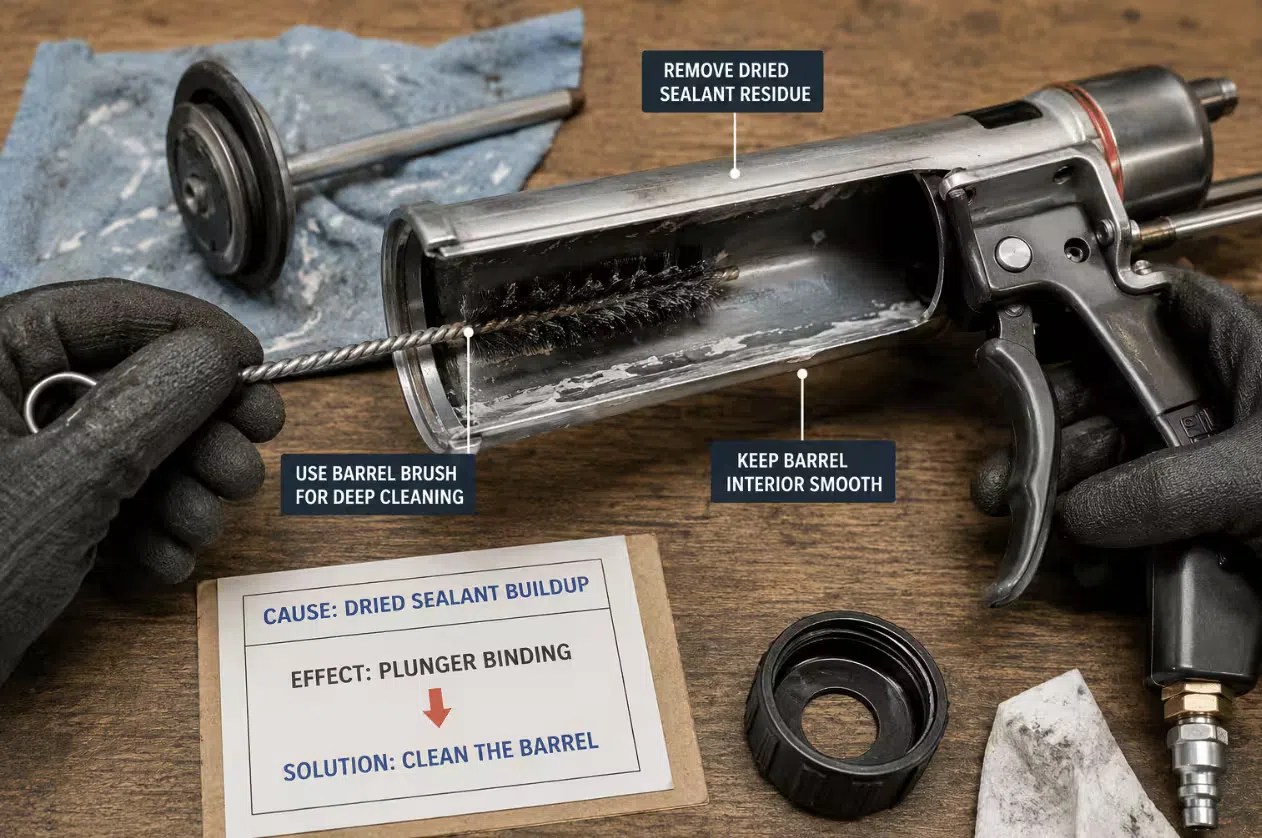
Cleaning an air caulking gun after each use is the single most effective maintenance step. Dried sealant inside the barrel creates friction that wears down the pressure plate and thrust rod. Left long enough, it can lock the plunger in place.
Step-by-step daily cleaning:
- Pneumatic caulking gun cleaning starts with safety: disconnect the air hose before touching the gun. Accidental discharge can happen if pressure remains in the line.
- Remove the empty cartridge or sausage pack. Pull the plunger rod back to its retracted position.
- Wipe the thrust rod and pressure plate with a clean rag. For wet sealant, use a rag dampened with the correct solvent:
- Water-based acrylic or latex sealant: warm water
- Silicone sealant: mineral spirits or isopropyl alcohol
- Polyurethane or MS polymer sealant: mineral spirits
- Clean the inside of the barrel if sealant has leaked into it. A barrel brush sized for the gun diameter works best.
- Wipe the air regulator and exhaust port with a dry cloth. Do not spray solvent into these parts.
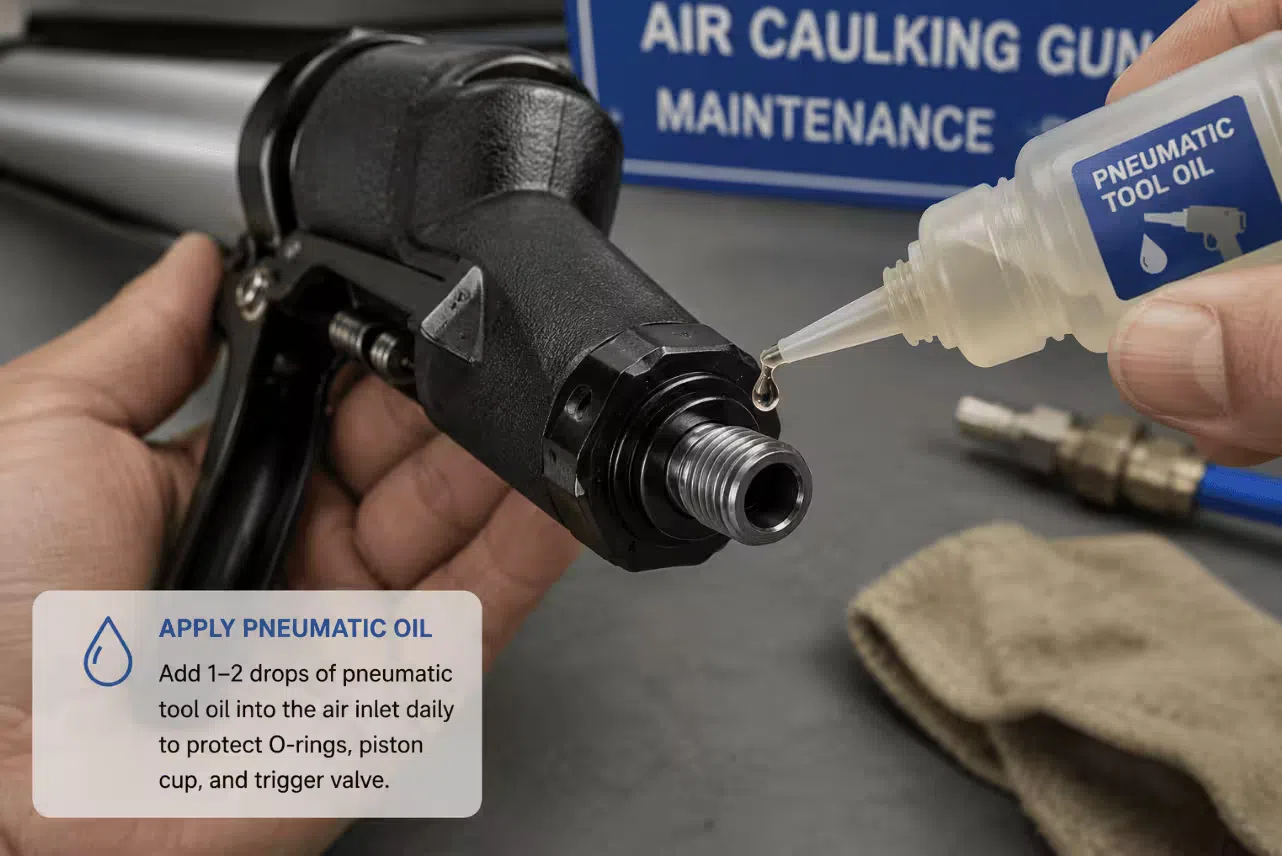
- Apply 2 to 3 drops of pneumatic tool oil into the air inlet. Cycle the trigger a few times to distribute the oil through the valve and cylinder.
- Store the gun with the plunger retracted so the pressure plate does not sit compressed against the front of the barrel.
What not to do:
- Do not submerge the entire gun in solvent or water. Liquid enters the air cylinder through gaps around the front cap and ruins internal seals.
- Do not use WD-40 as a lubricant. It is a solvent that strips existing oil from seals and accelerates drying and cracking.
- Do not leave sealant in the barrel overnight. Once cured, removal requires disassembly and mechanical scraping.
Lubrication Schedule
The air cylinder and trigger valve inside a pneumatic caulking gun need regular lubrication to keep seals soft and moving parts sliding smoothly. Without oil, the piston cup dries out and loses its seal, and the trigger valve stem sticks.
When to lubricate:
- Before first use each day
- After cleaning
- When the gun feels sluggish or the plunger moves slowly
- After storage of more than two weeks without use
What type of oil to use:
For effective pneumatic caulking gun lubrication, use a dedicated pneumatic tool oil, typically ISO 32 or SAE 10-weight non-detergent. Use a dedicated pneumatic tool oil, typically ISO 32 or SAE 10-weight non-detergent oil. These oils are designed to lubricate air tools without gumming up internal passages. Common options include Milton Pneumatic Tool Oil, Marvel Air Tool Oil, and generic ISO 32 compressor oil.
Do not use:
- WD-40 or similar solvents
- Heavy motor oil (SAE 30 or higher) — too thick for small air passages
- Grease on trigger valve seals — grease blocks air flow through the valve
- Household oils with additives that degrade O-rings
How to lubricate: Place 2 to 3 drops of pneumatic tool oil directly into the air inlet fitting on the gun handle. Connect the air hose and run the gun briefly — pull the trigger 3 to 4 times — to cycle the oil through the valve, cylinder, and piston. Wipe any excess oil that exits the exhaust port.
For B2B buyers, including a bottle of pneumatic tool oil with each gun shipment is a low-cost way to reduce maintenance complaints. Distributors can bundle oil in bulk-purchase orders or private-label it with their branding.
Moisture Management
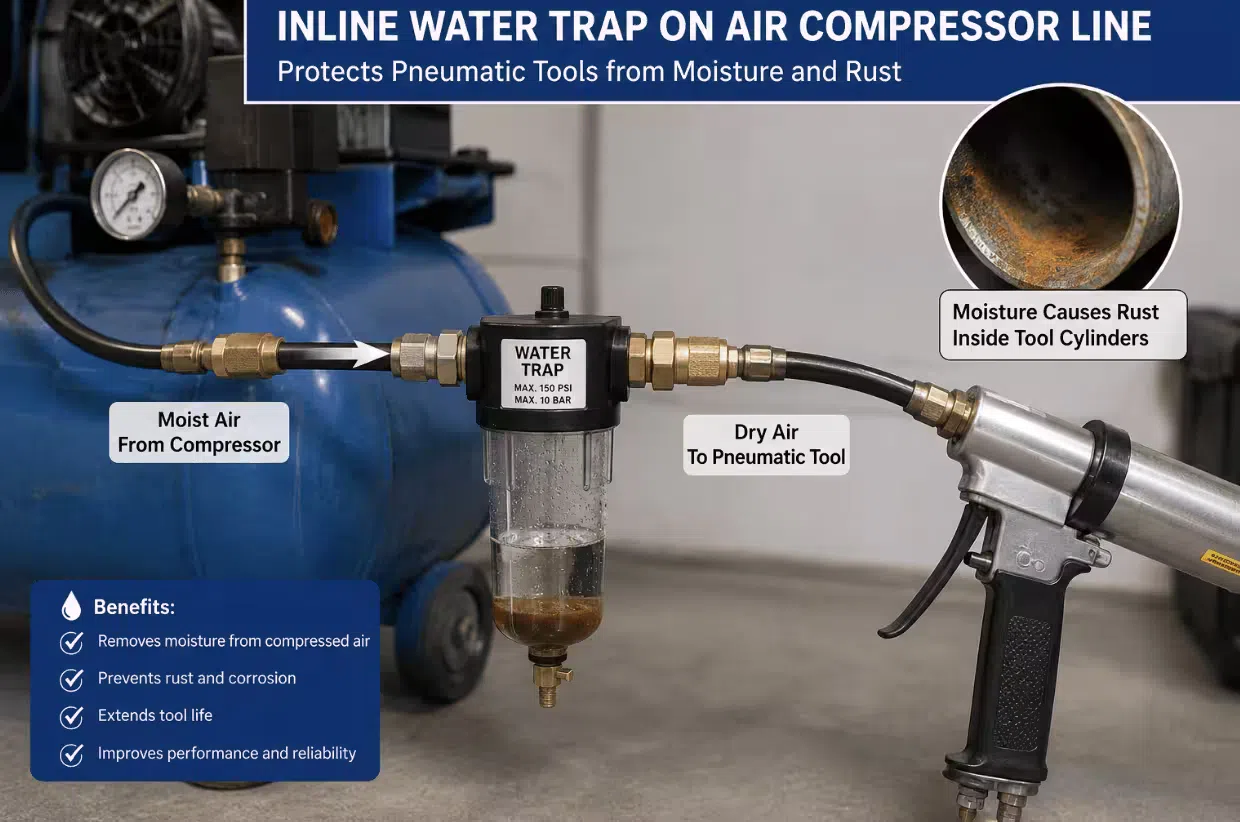
Compressed air from a shop compressor contains water vapor. When the air cools inside the gun's cylinder, moisture condenses on the metal walls and causes rust. Rust abrades the piston cup and cylinder wall, creating air bypass and loss of power.
In humid environments, this is the most common cause of premature pneumatic tool failure — not the tool itself but the air supply quality.
Practical moisture management:
- Install an inline water trap or filter at each drop point where pneumatic tools connect. A basic water separator costs roughly $20 to $40 per drop.
- For continuous use, use an air dryer at the compressor to reduce dew point.
- Drain the compressor tank daily. Accumulated water feeds moisture into every tool connected to that line.
- At the end of each day, disconnect the air hose and purge the gun by pulling the trigger with no cartridge loaded. This pushes condensed moisture out through the nozzle.
B2B buyers who sell air powered caulk guns into humid regions should inform customers about moisture management upfront. A tool that fails from internal rust within three months is usually a compressed air quality problem, not a product defect.
Seal and O-Ring Replacement
Seals and O-rings on an air caulking gun wear out eventually. Regular lubrication extends their life, but replacement is needed when these signs appear:
| Symptom | Likely Cause | Replacement Part |
|---|---|---|
| Hissing from trigger area | Trigger valve O-rings worn | Trigger valve O-ring kit |
| Weak plunger force | Piston cup hardened or cracked | Piston cup matched to cylinder diameter |
| Sealant oozing after trigger release | Exhaust port seal stuck or dirty | Clean or replace exhaust valve seal |
| Air leaking from hose connection | Air inlet O-ring damaged | Air inlet O-ring for 1/4" NPT fitting |
| Plunger moves roughly | Thrust rod seal contaminated with dried sealant | Thrust rod wiper seal |
Manufacturer rebuild kits are available for most pneumatic caulking gun models. They typically include all O-rings, the piston cup, and the exhaust valve seal needed for a full overhaul. Generic O-ring kits can work for simple replacements, but the piston cup and exhaust valve seals are usually tool-specific. Matching the manufacturer's part number is recommended.
For B2B distributors, stocking rebuild kits for the most common gun models in your product line allows customers to repair rather than replace failed tools. This reduces warranty claims and builds loyalty with end users who value serviceable products.
Practical PSI and Lubrication Reference
The air pressure required for a pneumatic caulking gun depends on sealant viscosity, nozzle opening size, and cartridge format. The following are typical starting points. Confirm with the sealant manufacturer's technical data sheet (TDS) and the gun supplier's specification sheet before setting operating pressure.
| Material or Application | Typical Starting Pressure | What Changes It | Buyer Check |
|---|---|---|---|
| Low-viscosity (acrylic, latex) | 40 – 60 PSI | Larger opening needs lower pressure; cold material needs higher | Confirm with sealant TDS; start at lower end |
| Medium-viscosity (silicone, hybrid) | 60 – 80 PSI | Material temperature, nozzle size, bead width | Test at 60 PSI before increasing |
| High-viscosity (PU, MS polymer) | 70 – 90 PSI | Thicker material needs stable supply; regulator adjustment | Check gun rating does not exceed 90 PSI continuous |
| Sausage pack 600 ml | 60 – 80 PSI | Larger diameter needs consistent pressure | Requires steady compressor output |
| Two-component epoxy 400 ml | 50 – 70 PSI | Mixing nozzle creates back pressure | Check gun is rated for dual-component use |
Not all pneumatic caulking guns include a built-in air regulator. Guns without a regulator depend on the compressor's external regulator, making pressure control less precise. Guns with an inline regulator allow the operator to adjust at the tool. This is worth checking when selecting models for a product line.
See the Air Powered Caulking Gun PSI Settings and Compressor Guide for a detailed compressor setup explanation.
B2B Maintenance Recommendations
For distributors and wholesalers, maintenance awareness directly affects your business. Customers who neglect daily cleaning and lubrication will report more tool failures and request more replacements.
What to stock:
- Pneumatic tool oil (ISO 32 / SAE 10W non-detergent) — available in bulk cases for resale or inclusion with gun orders
- O-ring rebuild kits for your most common pneumatic gun models
- Piston cups in standard cylinder diameters
- Barrel brushes for daily cleaning
- Inline water separators and air filters
What to tell customers:
- Include a printed maintenance card with each pneumatic gun shipment showing the three daily steps: disconnect, wipe, oil.
- Recommend pneumatic tool oil as a mandatory accessory, not optional.
- Remind customers in humid climates to manage moisture before blaming the tool.
- Offer rebuild kits when customers place bulk orders — this signals that the tool is serviceable and built to last.
For more on model selection, see the Pneumatic Caulking Gun Specs Guide. To understand format sizing, read the Pneumatic Caulk Gun Sizes Guide.
FAQ
What sealant types work with air caulking guns? Air caulking guns accept standard 310 ml or 400 ml cartridges and 600 ml sausage packs containing silicone, acrylic, polyurethane, MS polymer, and hybrid sealants. Two-component epoxy cartridges require a dual-component pneumatic gun with separate plungers and a static mixing nozzle. Always check the sealant manufacturer's TDS for cartridge dimensions and recommended dispensing pressure before use.
How often should I lubricate a pneumatic caulking gun? Add pneumatic tool oil to the air inlet before every day of use. If the gun sits unused for more than two weeks, oil it before the next use. A gun that starts to feel sluggish or shows reduced dispensing force needs immediate lubrication — do not wait until the end of the day.
What kind of oil is best for pneumatic caulking guns? ISO 32 or SAE 10-weight non-detergent pneumatic tool oil. These oils are formulated to lubricate air-powered tools without gumming up valves or degrading O-rings. Do not use WD-40, motor oil, grease, or general-purpose household oils.
Can I submerge a pneumatic caulking gun for cleaning? No. Submerging the gun in solvent or water allows liquid to enter the air cylinder through the front cap and around the trigger valve. Once inside, the liquid washes away internal lubrication and causes rust. Only wipe external surfaces and the barrel interior with a damp rag.
How do I know when seals need replacement? Signs include air hissing from the trigger or exhaust port, slow or weak plunger movement, the gun failing to build enough pressure for thick material, and sealant continuing to drip after releasing the trigger. A rebuild kit for your specific gun model contains all the seals needed for a full overhaul.
What is the typical OEM maintenance kit that should accompany each pneumatic caulking gun order? For B2B bulk orders, many factory-direct suppliers including CAULKMFG offer OEM-matched maintenance kits containing the piston cup, O-ring set, air inlet fitting, and a bottle of pneumatic tool oil. Requesting these kits alongside the initial gun order simplifies spare parts management for distributors and ensures end users have the correct replacement components from the start rather than guessing at generic sizes.
Can I get pneumatic caulking guns with custom branding, private-label packaging, or bundled maintenance kits? Yes. Many factory-direct manufacturers offer OEM and private-label options including custom colors, logo stamping, branded packaging, and bundled maintenance kits with tool oil and replacement seals. Minimum order quantities (MOQs) vary by model and configuration. Specifying cartridge format (310 ml, 400 ml, or 600 ml sausage) and target market during the quote helps the supplier recommend the right bundled package.
Get Bulk Quotes for Pneumatic Caulking Guns
Daily cleaning and lubrication keep air caulking guns running longer, reduce after-sales service calls, and lower total cost of ownership for end users. For B2B buyers — distributors, wholesalers, construction suppliers, and OEM programs — stocking guns with proper maintenance guidance and spare parts builds customer confidence and repeat business.
CAULKMFG supplies factory-direct pneumatic caulking guns for cartridges, sausage packs, and two-component cartridge systems. We offer OEM configuration, private-label options, bulk pricing, and flexible MOQ to match your product line.
To request a quote, provide your sealant type, cartridge or pack size, target market, expected order quantity, and any OEM or private-label requirements. Our team can recommend the right pneumatic gun model and discuss matching maintenance kits and replacement parts.