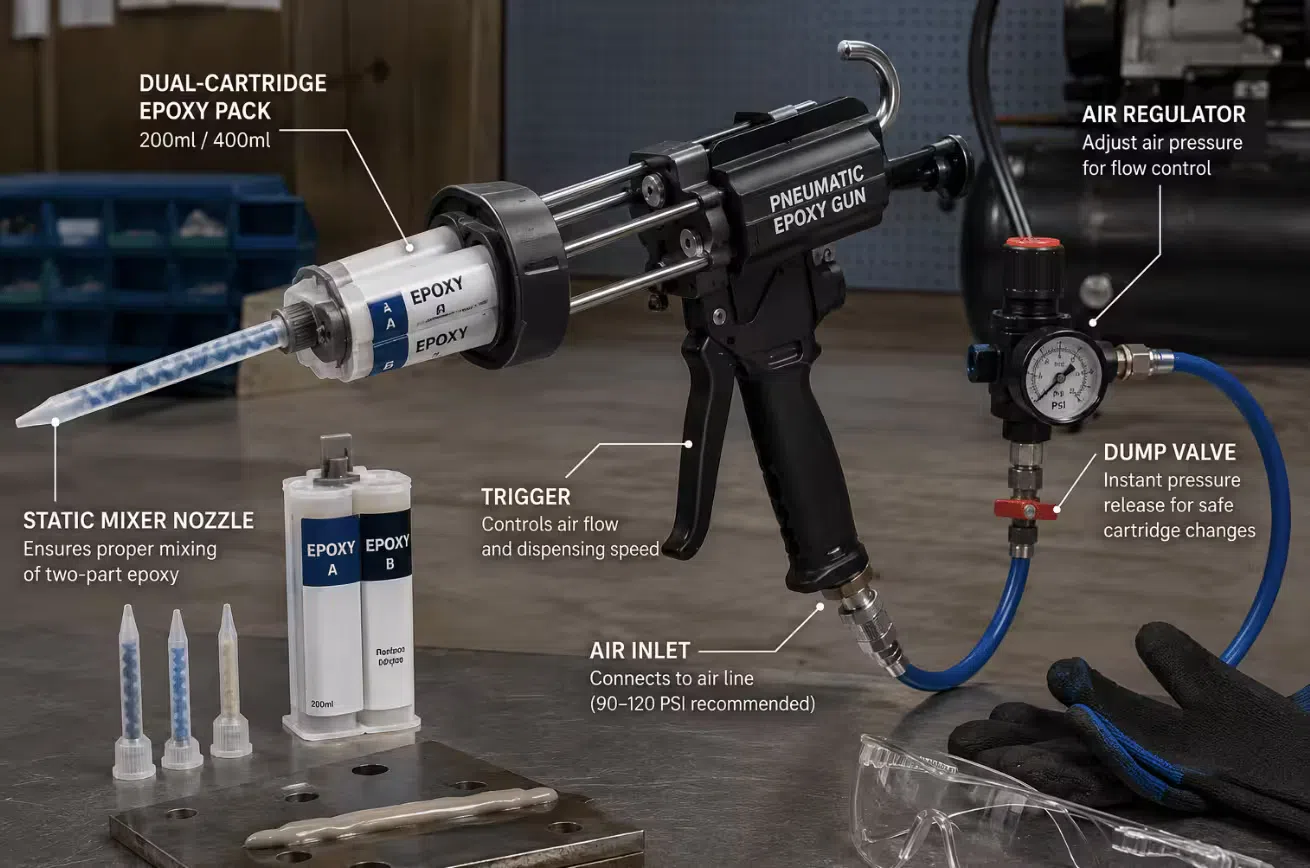
A pneumatic epoxy gun is an air-powered dispensing tool for two-component epoxy, structural adhesive, and other dual-cartridge materials. It uses compressed air to drive both plungers simultaneously, pushing resin and hardener through a static mixer nozzle where they combine before application. For B2B buyers — distributors, construction suppliers, OEM buyers, and industrial wholesalers — understanding how pneumatic epoxy guns work, what specifications to check, and which cartridge systems they support is a practical part of product line planning.
What Is a Pneumatic Epoxy Gun?
A pneumatic epoxy gun is built for two-component (2K) adhesive systems. Unlike single-component pneumatic caulking guns that dispense from one cartridge, a pneumatic epoxy gun holds a dual cartridge with resin in one chamber and hardener in the other. When the trigger is pulled, compressed air pushes both components through a static mixer nozzle, where they combine before application.
These tools are used in bonding, repair, anchoring, industrial assembly, automotive repair, marine sealing, and construction work where two-part adhesive systems are needed. The product category spans multiple sizes, mix ratios, and pressure ratings, which makes correct specification matching an important step when ordering.
For an overview of the full product range, see the pneumatic caulking guns category page, which covers both single-component and dual-component pneumatic applicator options.
How Pneumatic Two-Component Dispensing Works
The operating principle is straightforward but depends on correct air pressure, cartridge fit, and nozzle selection.
When the operator connects the gun to a compressed air supply — typically 4 to 8 bar (58 to 116 PSI) — and pulls the trigger, air pressure pushes the plunger mechanism forward. For dual-cartridge guns, the plunger drives two rods at the same time, one for each cartridge chamber. The material exits the cartridges into a static mixer nozzle, where baffles blend the two parts without introducing air bubbles.
Most pneumatic epoxy guns include an air flow regulator for adjusting dispensing speed. A dump valve or pressure release valve stops material flow when the trigger is released, which reduces dripping and waste. These control features are the main difference from manual dual-cartridge guns, where the operator relies on hand force and a mechanical ratchet.
Buyers comparing pneumatic vs. manual epoxy guns should consider that pneumatic tools provide steady, repeatable output during continuous use. Users who already have compressed air on site — common in workshops, factories, and professional job sites — can operate pneumatic guns without the hand fatigue associated with manual dispensing over long work periods. The air powered caulking gun PSI and compressor guide covers matching air supply to dispensing tools in more detail.
Mix Ratios and Cartridge Compatibility
Dual-cartridge epoxy systems come in several standard mix ratios, and the pneumatic epoxy gun must match the cartridge ratio exactly.
| Mix Ratio | Typical Use Case | Common Cartridge Sizes |
|---|---|---|
| 1:1 | General-purpose epoxies, acrylic adhesives | 50ml, 200ml, 400ml |
| 2:1 | Structural adhesives, polyurethane | 200ml, 400ml, 600ml |
| 4:1 | High-strength epoxies, marine adhesives | 200ml, 400ml |
| 10:1 | Low-viscosity epoxies, injection resins | 250ml, 400ml, 1500ml |
B2B buyers should confirm the mix ratio of the adhesive system their customers use before selecting a pneumatic epoxy gun. A gun designed for 1:1 cartridges will not correctly dispense a 10:1 system. Cartridge sizes range from 50ml dual cartridges for precision bonding to 1500ml bulk cartridges for high-volume industrial dispensing.
Material viscosity also affects selection. Higher-viscosity adhesives need more dispensing force and may require a pneumatic gun with a higher thrust ratio or larger air cylinder. Lower-viscosity materials need finer pressure control to avoid waste. Buyers should verify compatibility with the adhesive manufacturer's technical data sheet rather than assuming one gun works for all materials. The pneumatic caulking gun specifications guide provides more detail on specification matching for both single and dual-component pneumatic tools.
Pneumatic Epoxy Gun Specification Table
| Specification | Unit | What It Affects | B2B Buying Note |
|---|---|---|---|
| Air pressure range | bar or PSI | Dispensing force and speed | Typically 4–8 bar (58–116 PSI); confirm with the supplier spec sheet |
| Air consumption | CFM or L/min | Compressor sizing | Typical range 10–40 L/min; depends on material viscosity and duty cycle |
| Thrust ratio | ratio (e.g., 26:1) | Force applied to the plunger | Higher ratios suit thicker materials; confirm with sealant TDS |
| Cartridge ratio | volume ratio | Mix ratio compatibility | Must match the epoxy system: 1:1, 2:1, 4:1, or 10:1 |
| Cartridge capacity | ml or oz | Maximum material volume | Common sizes: 50ml–400ml dual, up to 1500ml for bulk systems |
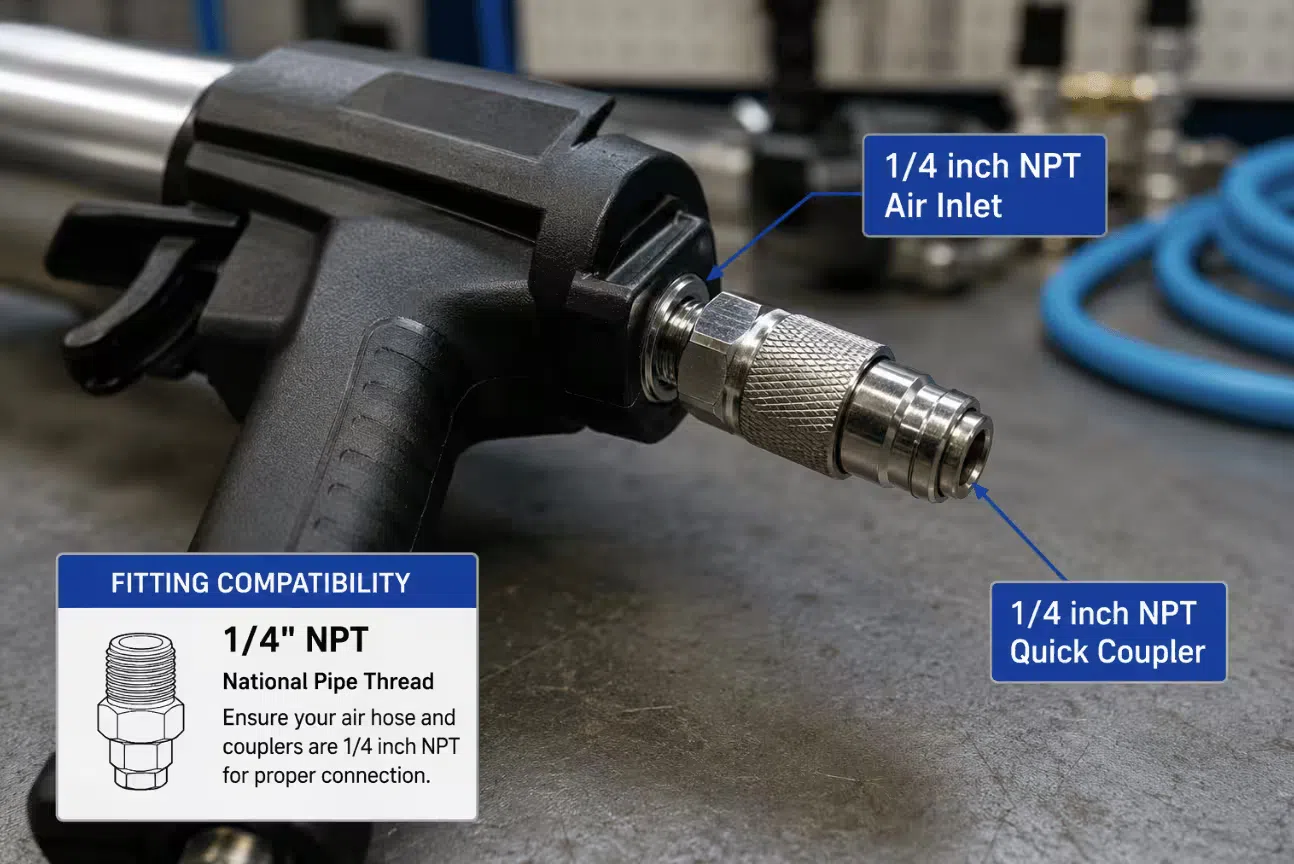
| Air inlet thread | NPT or BSP | Regional fitting compatibility | 1/4 inch NPT is common in North America; BSP in other regions |
| Dump valve | yes/no | Drip control after trigger release | Preferred feature for clean operation and material savings |
Application Matching Table
| Application | Recommended Gun Type | Key Specs to Check |
|---|---|---|
| Structural bonding (steel, aluminum) | Pneumatic 1:1 or 2:1, 400ml | Thrust ratio 26:1+, air pressure range, static mixer size |
| Automotive panel bonding | Pneumatic 1:1 or 2:1, 200–400ml | Cartridge ratio accuracy, nozzle compatibility, air consumption |
| Marine sealing and repair | Pneumatic 2:1 or 4:1, 200–400ml | Build material (metal or composite), dump valve availability |
| Industrial assembly | Pneumatic 1:1 or 10:1, 50–400ml | Cartridge size flexibility, air regulator precision |
| Construction anchoring | Pneumatic 1:1 or 4:1, 400ml+ | Cartridge capacity, air pressure range, spare parts support |
What B2B Buyers Should Check When Sourcing Pneumatic Epoxy Guns
When sourcing pneumatic epoxy guns for wholesale, OEM programs, or distributor stock, several specification and supply factors need attention.
Air pressure and consumption. Pneumatic epoxy guns typically operate in the 4 to 8 bar range. Buyers should confirm the operating pressure range and air consumption so that end users can select a compatible compressor. Models with low air consumption suit intermittent use with small compressors, while high-volume dispensing may need a larger compressor tank. The pneumatic caulking guns product page lists available models and their specifications.
Cartridge ratio and capacity. Each pneumatic dual-component gun is built for specific mix ratios. Buyers should stock models that match the adhesive systems most common in their target market. Checking whether the gun accepts adapter kits for different cartridge sizes increases flexibility for distributors serving multiple customer segments.
Regional fitting standards. Air inlet threads differ by region. North American buyers typically need 1/4 inch NPT fittings, while European and Asian markets often use BSP threads. OEM buyers should confirm that the supplier provides the correct inlet fitting for the destination market or includes an adapter.
Spare parts and service life. Pneumatic epoxy guns have moving parts, seals, and valves that wear over time. B2B buyers should ask about the availability of replacement pistons, regulator knobs, dump valve seals, and plunger rods. A gun with easily sourced spare parts reduces end-user downtime and makes the product easier to support through distribution channels.
OEM and private label options. Factory-direct suppliers can offer custom color, private label packaging, carton design, and user manual options. Buyers placing bulk orders should confirm MOQ, lead time, packaging format, and quality inspection procedures before committing.
Practical User Experience Insights
These observations from field use of pneumatic epoxy dispensing tools can help B2B buyers advise their own customers.
Pressure regulation prevents cartridge failure. Operators report that exceeding 75–80 PSI can blow out the back of a dual cartridge or push material past the mixer elements, causing incomplete cure. Guns with built-in air regulators give users better control. Buyers sourcing for customers who rely on shop air should prioritize models with adjustable regulators.
Priming prevents wasted material. When starting a new static mixer nozzle, the first 1 to 2 ml of epoxy is often incompletely mixed. Experienced users discard a bead equal to the nozzle length before applying material to the workpiece.
Consistent trigger technique improves bond quality. Operators who maintain steady pressure produce even bead application with fewer air bubbles. Stops and starts during dispensing create uneven layers and may affect bond quality.
Cleaning discipline extends tool life. Epoxy hardens quickly inside nozzles and gun components. Users who flush the gun with solvent immediately after use avoid permanent blockages. Buyers should check that replacement static mixer nozzles, plunger seals, and air regulator parts are available.
Pneumatic Epoxy Gun FAQ
What is a pneumatic epoxy gun used for? A pneumatic epoxy gun dispenses two-component epoxy, structural adhesives, and other dual-cartridge materials. It is used in bonding, repair, industrial assembly, automotive work, marine sealing, and construction anchoring applications where a consistent mix ratio is needed.
What PSI does a pneumatic epoxy gun need? Most pneumatic epoxy guns operate within 58 to 116 PSI (4 to 8 bar). The exact pressure depends on material viscosity, nozzle size, and bead width. A recommended starting point is 70 to 80 PSI, with adjustments based on the adhesive supplier's recommendation.
What is a pneumatic 2 part epoxy gun? A pneumatic 2 part epoxy gun dispenses two-component adhesives where resin and hardener are stored in separate cartridge chambers. The gun pushes both components through a static mixer nozzle where they combine before application. This type is preferred when consistent mix ratio and higher dispensing volume are required.
How much does a pneumatic sealant gun cost? Pneumatic epoxy gun pricing depends on build quality, cartridge capacity, and included features. Wholesale pricing varies with MOQ. B2B buyers should request a quote with their target model specification, expected order quantity, and any OEM or private label requirements for accurate pricing.
Can a pneumatic epoxy gun be used for single-component sealant? Some pneumatic applicator models accept single-component cartridges or sausage packs after changing the plunger adapter. However, most dual-component pneumatic guns are purpose-built for two-part cartridges. Buyers should confirm compatibility with the supplier before assuming multi-purpose use.
What spare parts should be stocked for pneumatic epoxy guns? Common wear items include plunger rod seals, air regulator knobs, dump valve seals, and front cap gaskets. Distributors stocking pneumatic epoxy guns should ask their supplier for a recommended spare parts list that covers the models in their product line. Having spares available reduces end-user downtime.
What should B2B buyers confirm before ordering pneumatic epoxy guns in bulk? Buyers should confirm the gun model, supported mix ratios and cartridge sizes, air pressure range, air inlet thread type, spare parts availability, packaging format, MOQ, lead time, and OEM or private label options. For dual-component models, verify that the thrust ratio and plunger design match the adhesive systems common in the target market.
What is the difference between a pneumatic epoxy gun and a manual epoxy gun? A manual epoxy gun uses hand force through a ratchet mechanism to push both plungers. A pneumatic epoxy gun uses compressed air, which provides more consistent force and reduces operator fatigue during repeated or long-duration dispensing. Manual guns are lower-cost and suitable for occasional use, while pneumatic guns are better for continuous production work.
Sourcing Pneumatic Epoxy Guns from a Factory Supplier
CAULKMFG supplies pneumatic epoxy guns for dual-component dispensing applications. Available models cover mix ratios from 1:1 to 10:1, cartridge sizes from 50ml to 1500ml dual systems, and both single-component and dual-component pneumatic applicator configurations. OEM and private label programs support custom color, branded packaging, and flexible product configuration.
To discuss your requirements, send your sealant or adhesive type, cartridge or pack size, target market, expected order quantity, and OEM or private label needs. A factory representative can recommend suitable models and provide pricing based on your application and volume.