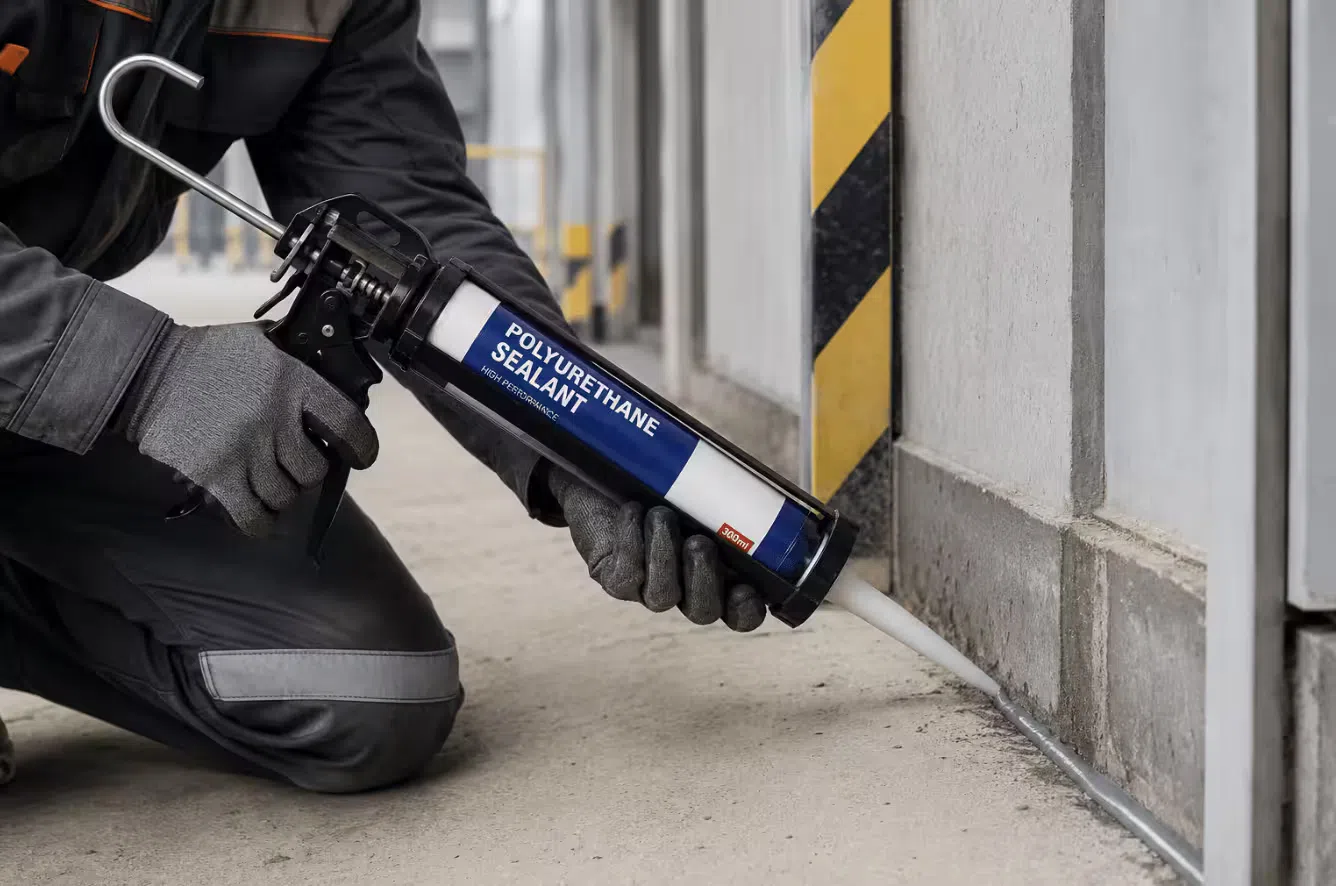
A high thrust caulk gun delivers significantly more dispensing force per trigger squeeze than a standard model. The thrust ratio measures this mechanical advantage: a 26:1 ratio means each pound of pressure on the trigger produces 26 pounds of push on the sealant inside the cartridge. A basic consumer gun with a 3:1 ratio requires roughly eight times more hand force to dispense the same material.
This difference becomes critical when the sealant or adhesive is thick. Polyurethane sealants, construction adhesives, hybrid polymers, and cold-weather materials all need more dispensing force than standard silicone or acrylic. When the gun cannot deliver enough thrust, the operator feels resistance in every squeeze and the bead quality suffers.
This article explains what thrust ratio means in practical terms, which materials require a high thrust caulking gun, how to match models to applications, and what B2B buyers should check when ordering manual caulking guns for thick-material work.
What Thrust Ratio Means for Dispensing Performance
A manual caulking gun converts trigger force into rod pressure through a lever mechanism. The thrust ratio is the multiplier. A gun rated at 12:1 delivers 12 units of force at the plunger for every unit applied at the trigger. Higher numbers mean less hand effort per squeeze, but the rod also advances in smaller increments with each trigger pull.
| Specification | Unit | What It Affects | B2B Buying Note |
|---|---|---|---|
| Thrust ratio | Ratio (e.g., 7:1 to 26:1) | Dispensing force vs. hand effort required | Higher ratio means easier squeeze; 18:1 and above recommended for polyurethane and adhesives |
| Frame material | Aluminum alloy or steel/metal | Tool durability under sustained high-thrust use | Metal frames hold up better over years of daily high-thrust work |
| Dripless mechanism | Yes or no | Whether pressure releases after trigger release | More important at high thrust where residual pressure is greater |
| Cartridge format | 300 ml standard | Which sealant packs fit the frame | All four models use 300ml cartridges; confirm for bulk or specialty packs |
| Rod type | Smooth rod or ratchet | Trigger feel and plunger return speed | Smooth rod preferred for continuous bead control at higher thrust ratios |
For distributors and OEM buyers stocking manual caulking guns, the thrust ratio is the primary specification that determines which model fits which end-user application. Stocking multiple thrust ratios rather than one general-purpose model typically serves a broader customer base.
When a High Thrust Caulking Gun Is Necessary
Not every sealing job needs a high-thrust gun. Standard silicone and acrylic sealants dispense well at 7:1 to 12:1. The need for higher thrust arises in specific conditions.
Thick and High-Viscosity Materials
Polyurethane sealants, hybrid MS polymers, construction adhesives, and butyl-based products require noticeably more force to push through a nozzle than silicone does. The force needed increases with material viscosity. At 18:1 and above, these materials flow steadily with normal hand pressure. At lower ratios, the operator feels resistance on every pull, which slows application and reduces bead consistency.
Cold-Weather Dispensing
Temperature directly affects sealant viscosity. Below about 5°C, materials that flow easily in summer become noticeably stiffer. A gun that works well at room temperature may demand significantly more force in winter conditions. A high thrust ratio caulking gun — 24:1 or 26:1 — compensates for this change without requiring the operator to switch tools or warm cartridges before each use.
Large-Volume or Daily Use
For operators who dispense multiple cartridges per day, cumulative hand fatigue is a real limitation. A contractor using a 6:1 gun on polyurethane sealant applies roughly four times the hand force per squeeze compared with an 18:1 gun. Over hundreds of squeezes per shift, the difference shows up as wrist strain, forearm fatigue, and slower work. High-thrust guns are a practical choice for shops, factories, and crews where caulking is a daily task.
Long Nozzle Extensions or Overhead Work
Using a nozzle extension or working overhead increases the effective resistance the gun must overcome. A high thrust ratio provides the extra margin needed to maintain a steady flow in these positions without requiring excessive trigger force.
Material-to-Thrust-Ratio Matching
The following table maps common construction sealants and adhesives to the thrust ratio range that typically handles them well. Check specific sealant viscosity with the manufacturer's technical data sheet before ordering.
| Application | Recommended Gun Type | Key Specs to Check |
|---|---|---|
| Silicone sealant, acrylic latex for doors and windows | Standard manual gun, 7:1–12:1 | Light frame, basic dripless mechanism |
| Polyurethane sealant for construction joints, roofing, siding | Medium-high thrust gun, 12:1–18:1 | Metal or reinforced frame, smooth rod preferred |
| Hybrid MS polymer sealant for outdoor expansion joints and glazing | High thrust gun, 18:1–24:1 | Durable frame, reliable dripless release |
| Construction adhesive for panel bonding, subfloor, and trim | High thrust gun, 24:1–26:1 | Heavy-duty metal frame, high-ratio smooth rod |
| Butyl rubber, thick epoxy, cold-weather sealants | Ultra-high thrust gun, 26:1 | Full metal construction, professional driveline |
The CaulkMFG manual caulking gun range covers every tier in this table.
- Model 03 — 7:1 or 12:1, aluminum alloy frame. Suited for silicone and light-duty acrylic. An economical choice for general sealing.
- Model 01 — 18:1, metal frame. Suited for polyurethane sealants and medium-viscosity hybrid materials. A solid mid-range option for general construction use.
- Model 04 — 12:1 or 24:1 via a dual-ratio mechanism that lets the operator switch between standard and high thrust without changing guns. A flexible SKU for distributors serving mixed applications.
- Model 02 — 26:1, metal frame. The highest thrust ratio in the range. Designed for construction adhesives, butyl, cold-weather dispensing, and high-volume daily use.
All four models use standard 300ml cartridges. OEM options include custom colors, laser-etched logos, branded packaging, and private-label carton design. Spare rods, drive plates, and nozzle cutters are available for models 01, 02, and 04 to support after-sales service.
Selecting the Right Model for B2B Orders
When ordering manual caulking guns for distribution, the right choice depends on the sealant types your customers use most.
For distributors who stock silicone and acrylic sealants primarily, an 18:1 gun such as Model 01 covers most contractor needs while keeping costs manageable for bulk ordering. For distributors whose customers work with polyurethane, hybrid, and construction adhesives, stocking both an 18:1 model and a 26:1 model covers the full viscosity range.
The dual-ratio Model 04 is worth considering for accounts where end-users switch between silicone and construction adhesives regularly. A single SKU offering both 12:1 and 24:1 simplifies inventory and lets the user choose the right ratio per job.
For high-volume wholesale orders, CaulkMFG can arrange sample testing to confirm fit and function before production. The manual component guns product page has full specifications for each model.
FAQ
What thrust ratio is considered high thrust for a caulk gun?
Thrust ratios of 18:1 and above are generally considered high thrust. At this level, the gun delivers enough mechanical advantage to handle polyurethane, hybrid polymers, construction adhesives, and cold-weather materials with reasonable hand effort. Models at 24:1 and 26:1 are ultra-high thrust, suited for the heaviest materials and highest daily volumes.
Is a high thrust caulk gun harder to use with thin silicone sealant?
No. A high thrust gun still works with thin materials — the operator simply applies lighter trigger pressure. The rod advances in smaller increments per squeeze, so the bead flow is actually easier to control. The same 26:1 gun that handles construction adhesive can also dispense silicone smoothly.
Can a high thrust caulk gun help with cold-weather sealing?
Yes. Below about 10°C, most sealants become noticeably stiffer. A 24:1 or 26:1 gun compensates for this viscosity increase. Operators working in unheated spaces or during winter months benefit from having a high thrust model available.
What is the difference between a high thrust caulk gun and a heavy duty caulk gun?
"High thrust" refers specifically to the mechanical advantage ratio. "Heavy duty" typically describes a combination of features: high thrust ratio, reinforced frame, dripless mechanism, and commercial build quality. A gun can be high thrust without being heavy duty, and vice versa. The heavy duty caulking gun guide explains these thresholds in more detail.
Is a high thrust caulk gun dripless?
Not necessarily. Dripless release is a separate feature that relieves cartridge pressure when the trigger is released. Some high-thrust models include it; some do not. At higher thrust ratios, residual pressure after a squeeze is greater, so a dripless mechanism is especially useful. Check the model specification rather than assuming the feature is included.
What thrust ratio should a wholesale buyer stock for general distribution?
Many distributors carry both an 18:1 model for polyurethane and general construction work and a 26:1 model for adhesives and cold-weather use. If stocking only one manual model, a dual-ratio gun such as the Model 04 (12:1/24:1) provides the widest material compatibility in a single SKU.
Why does my caulk gun keep dripping even with a high thrust model?
Dripping after trigger release can be caused by a damaged cartridge nozzle, a worn plunger disc, air trapped in the sealant, or a dripless mechanism that needs cleaning — not necessarily by the thrust ratio. The caulking gun troubleshooting guide covers common causes and fixes for dripping, stuck rods, and inconsistent flow.
Request a Quote
If your distribution or OEM order requires manual caulking guns for specific sealant types, contact CaulkMFG with your requirements. Include the sealant material and estimated viscosity, target market, expected quarterly quantity, preferred thrust ratio range, and any custom branding or packaging needs. The product team can recommend a suitable model and arrange sample units for testing before production.