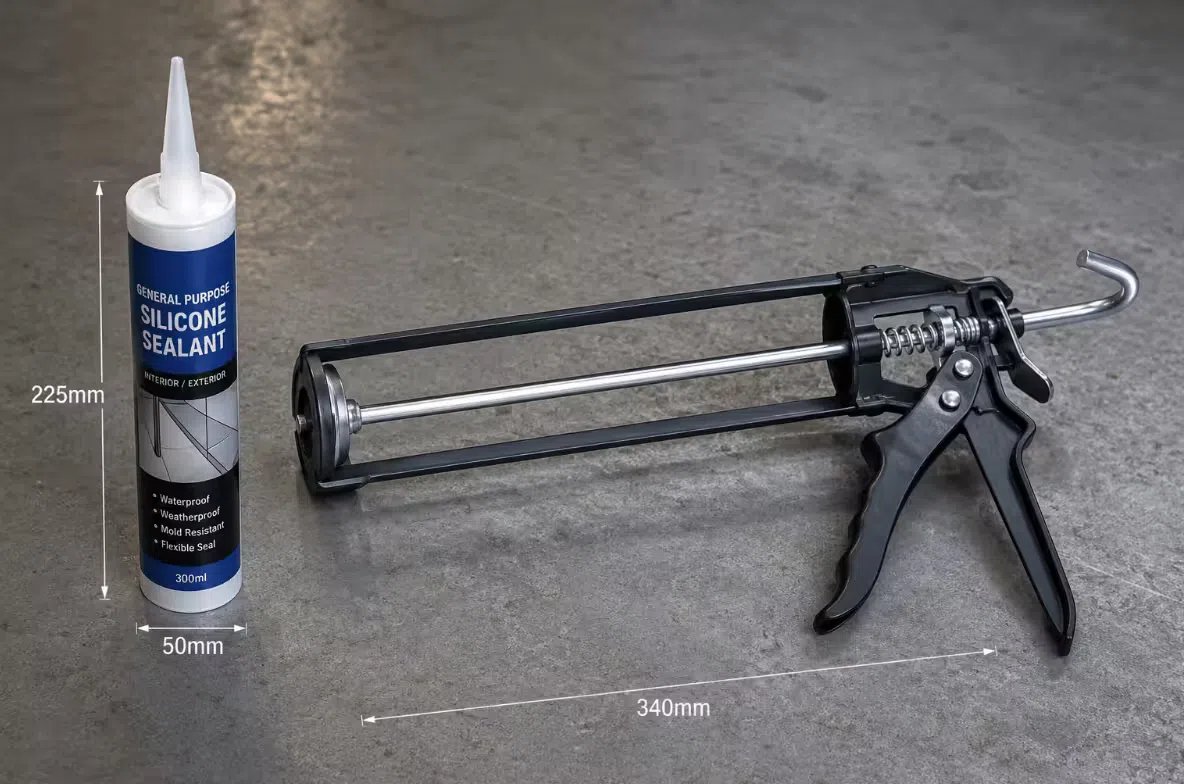
When you search for an industrial caulking gun, you find products priced from $15 to $60 and labeled "heavy duty," "contractor grade," or "professional." No single standard defines what industrial means for a manual caulking gun. For B2B buyers ordering for factory use, construction sealing, or OEM supply, the difference between a standard gun and an industrial gun comes down to thrust ratio, frame material, dripless mechanism, and intended duty cycle.
This guide explains the specifications that separate an industrial caulking gun from commercial and heavy-duty grades, and how to match the right manual gun to your operation.
What Does "Industrial Grade" Mean for a Manual Caulking Gun?
An industrial caulking gun is a hand-operated dispensing tool designed for repeated use with thick, high-viscosity sealants and adhesives in manufacturing, factory, or heavy construction environments. Industrial-grade manual guns meet three specification thresholds:
- Thrust ratio of 18:1 or higher, with 24:1 to 26:1 preferred for polyurethane and construction adhesives
- All-metal or reinforced aluminum alloy frame that withstands repeated loading, drops, and sustained rod pressure
- Integrated dripless mechanism that releases cartridge pressure when the trigger is released
A hand caulking gun that meets these criteria can dispense polyurethane, high-modulus silicone, and thick construction adhesives without the frame flexing, the rod bending, or sealant dripping between applications.
Key Specifications That Define an Industrial Caulking Gun
| Specification | Unit | What It Affects | B2B Buying Note |
|---|---|---|---|
| Thrust ratio | Ratio (e.g., 18:1, 24:1, 26:1) | Mechanical advantage — higher ratio delivers more force to the plunger rod per trigger squeeze | 18:1 is the industrial entry point; choose 24:1 or 26:1 for thick adhesives and cold-weather dispensing |
| Frame material | Steel, aluminum alloy, composite | How long the gun lasts under daily industrial use and how much the operator tires | Steel is most durable; aluminum alloy saves weight; composite may flex at high thrust over time |
| Dripless mechanism | Pressure release (yes/no) | Whether sealant stops flowing when the operator releases the trigger | Standard on industrial guns; models without it waste material and add cleanup time |
| Rod type | Smooth rod or ratchet rod | How the rod travels and whether the operator can pause mid-stroke | Smooth rod gives fine control for precision beads; ratchet rod holds position automatically between squeezes |
| Cartridge capacity | 300ml / 10 oz | How much sealant the gun holds per load | All manual industrial guns use standard 300mm cartridges; verify barrel width if sourcing non-standard sizes |
Thrust ratio is the single most important spec. A 7:1 or 12:1 gun, adequate for acrylic caulk or lightweight silicone, becomes hard to squeeze and produces an uneven bead when used with thick polyurethane or structural adhesive. An 18:1 mechanical caulking gun multiplies hand force 18 times, making thick-material dispensing practical for a full work shift.
Frame Material and Durability
The frame material determines how long a mechanical caulking gun holds up under continuous industrial use. All-metal steel frames are the traditional standard — strong, resistant to bending, but heavy at 2.5 to 3.5 pounds. Steel guns cause more hand and wrist fatigue during overhead or extended horizontal dispensing.
Aluminum alloy frames offer a practical middle ground. They weigh about 30 to 40 percent less than steel while keeping enough strength for 18:1 to 24:1 thrust. For B2B buyers, aluminum alloy guns balance industrial durability with operator comfort — important for distributors supplying construction crews who run guns for hours daily.
Manufacturers typically offer OEM configuration options for aluminum alloy models — custom frame colors, branding, and packaging for wholesale orders — and the lighter frame reduces shipping weight for bulk container orders.
Composite frames are common in consumer-grade models. At 24:1 or higher thrust, they may flex under repeated heavy loads, reducing service life. For industrial applications, metal or metal-alloy frames are the safer choice.
Dripless Mechanism: Standard for Industrial Guns
Most industrial and contractor-grade caulking guns include a dripless mechanism that releases cartridge pressure when the trigger is released. Without it, compressed sealant continues to flow, creating drips and uneven bead starts.
An industrial dripless caulking gun uses a thumb latch or trigger-release rod that pulls the plunger back slightly when pressure is released, decompressing the cartridge and stopping flow almost immediately. The mechanism has few moving parts, and replacement latches are typically available as spare parts.
For B2B buyers, dripless is a baseline expectation for any gun destined for industrial or continuous use. When ordering, confirm the model includes a pressure-release mechanism and that replacement latches or rod springs are available through the supplier's after-sales channel.
Industrial Caulking Gun Applications
| Application | Recommended Gun Type | Key Specs to Check |
|---|---|---|
| Factory sealing and production assembly | Industrial manual gun | 24:1 or higher thrust; steel or aluminum alloy frame; dripless |
| Construction site sealing (window, door, waterproofing) | Industrial or heavy-duty manual gun | 18:1 to 24:1 thrust; aluminum alloy or steel frame; dripless |
| Polyurethane and adhesive dispensing | High-thrust industrial manual gun | 24:1 to 26:1 thrust; steel or reinforced aluminum frame; dripless |
| Manufacturing maintenance and facility repair | Industrial manual gun | 18:1 to 24:1 thrust; aluminum alloy frame for balance |
| Mixed-material shops (silicone, acrylic, polyurethane) | Switchable dual-thrust manual gun | 12:1/24:1 switchable; dripless; aluminum alloy or steel frame |
Common industrial applications include window installation sealing, structural glazing, waterproofing membrane work, HVAC duct sealing, prefabricated panel assembly, and marine container sealing. These applications all involve continuous bead runs, thick or high-modulus sealants, and operators who need consistent dispensing without fatigue across a full shift. Distributors should carry models at each thrust tier so buyers can match the gun to their specific material.
How to Select the Right Industrial Caulking Gun for Your Operation
When ordering industrial caulking guns for resale or internal use, match these specifications to the materials and conditions the gun will face.
Match thrust ratio to sealant viscosity. For silicone, acrylic, and medium-viscosity sealants at room temperature, 18:1 is adequate. For polyurethane, construction adhesive, or sealants used below 50°F (10°C), choose 24:1 or higher.
Choose frame material by duty cycle. For daily industrial use with occasional drops or rough handling, steel or reinforced aluminum frames last longer. For guns used overhead or by multiple operators, aluminum alloy balances durability with less fatigue.
Verify dripless mechanism and spare parts availability. Every industrial gun should include a pressure-release dripless mechanism. Confirm that replacement latches, rod springs, and barrels are available through the supplier's after-sales channel.
Confirm cartridge compatibility and request sample testing. Standard 300ml (10 oz) cartridges fit most manual industrial guns. For non-standard cartridges or foil packs, request a sample gun to test fit before placing a bulk order.
How Industrial Caulking Guns Compare to Other Grades
An industrial caulking gun differs from commercial or heavy-duty grades mainly by its specification floor. Commercial-grade guns typically offer 12:1 to 18:1 thrust with a mix of composite and metal frames. Heavy-duty guns overlap with industrial at the lower end (18:1, metal frame) but may use lighter materials. True industrial guns start at 18:1 with all-metal or reinforced aluminum construction and dripless as standard.
For B2B buyers, the practical difference is service life. A commercial gun may last six months in a factory setting. An industrial gun with the same maintenance can last years.
Readers who want a closer look at related grade levels can read our articles on what makes a caulking gun commercial grade and heavy-duty caulking gun specs and applications. For a focused overview of thrust ratio, see what is a high thrust caulk gun.
FAQ
What is an industrial caulking gun? An industrial caulking gun is a manual dispensing tool with an 18:1 or higher thrust ratio, a metal or reinforced aluminum alloy frame, and a dripless mechanism. It is designed for continuous use with thick sealants in factory, manufacturing, and heavy construction environments.
What thrust ratio do I need for an industrial caulking gun? For most industrial applications, 18:1 is the minimum. For polyurethane adhesives, high-modulus silicone, or cold-weather dispensing, 24:1 or 26:1 provides better bead control and reduces fatigue. Confirm the right ratio with your sealant supplier's technical data sheet, since viscosity varies between brands and formulations.
What is the difference between an industrial and a commercial caulking gun? Industrial caulking guns have higher specification floors — 18:1 thrust minimum, all-metal or metal-alloy frames, and dripless mechanisms as standard. Commercial-grade guns may start at 12:1 thrust and use composite or mixed materials. Industrial guns are designed for continuous-duty cycles while commercial guns suit job-site work with moderate material volumes.
Does an industrial caulking gun need a dripless mechanism? Yes. Dripless is a baseline expectation for any gun used in industrial or contractor applications. It releases cartridge pressure when the trigger is released, preventing sealant from continuing to flow. Without it, operators waste material and spend time cleaning drips between applications.
Can a manual caulking gun be used for industrial applications? Yes. Manual industrial caulking guns are the most common dispensing tool in facilities without compressed air. They are reliable, require no power source, and are straightforward to maintain. The key is choosing a model with thrust ratio, frame material, and dripless mechanism matched to the materials and duty cycle.
Can I order OEM-branded industrial caulking guns for my distribution? Yes. CaulkMFG offers OEM and private-label options including custom frame colors, barrel branding, packaging design, and bulk pallet shipping. MOQ depends on the model and customization level.
What is the minimum order quantity for industrial caulking guns? MOQ varies by model and whether the order includes OEM customization. Standard bulk orders for stock models typically require lower minimums than branded runs. Contact the supplier with your expected annual volume.
What spare parts are available for industrial caulking guns? Common spare parts include replacement plunger rods, dripless latch assemblies, rod springs, and barrel sleeves. Confirm with the supplier that these parts are stocked and lead times match your after-sales support requirements.
Ready to Order Industrial Caulking Guns?
To get a quote or request samples, tell us what sealant types and viscosities you need to dispense, the cartridge size or pack format you use, your target market or application, expected order quantity, and whether you need OEM branding or private-label packaging. This information helps us match the right thrust ratio, frame material, and dripless configuration to your operation.