Manual caulking guns are the standard tool for construction sealing. But the gun body alone is only part of the dispensing system. The attachments you stock alongside it — nozzles, cutters, holders, and conversion kits — determine how well the gun performs on site and how much value your customers get from each tube of sealant.
For B2B buyers, knowing which caulk gun attachments to offer with manual caulking guns affects customer satisfaction, repeat orders, and the completeness of your product line. This guide covers the main attachment types, what they are used for, and what to check when ordering.
Nozzles and Tips
The nozzle is the most frequently replaced part on any caulking gun. It controls bead size, shape, and placement. Offering a range of nozzle options helps your customers match the tool to the job.
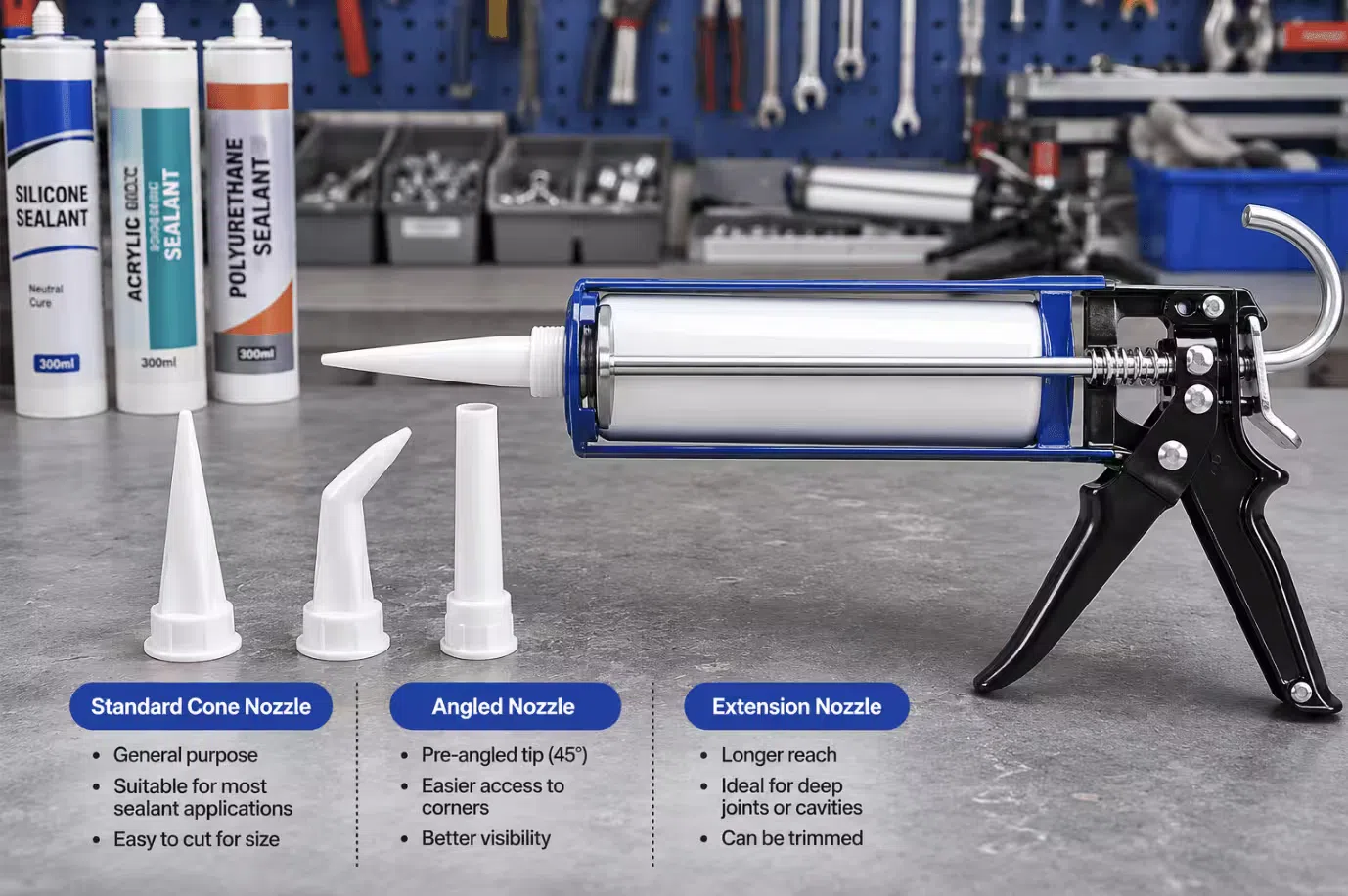
Standard cone nozzles. These come pre-attached to most sealant cartridges. The user cuts the tip at a 45-degree angle to produce the bead width they need. Standard cone nozzles work for general sealing around windows, doors, and trim.
Angled and extension tips. Trade users working in tight spaces find standard nozzles too short. Angled tips improve access without bending the nozzle body, which can crack the plastic. Extension nozzles (150 mm to 300 mm) let the user reach deep gaps while keeping the gun body at a comfortable angle.
Precision tips. For narrow joints, precision tips with a fine opening produce a thinner bead. These work for sealant application around trim and fixtures where a standard nozzle would overfill.
When selecting nozzles for distribution, check that the thread pattern matches the cartridge necks used in your target market. Most standard cartridges use a fine UNC thread common in North America. Regional variations exist, so confirm fit before bulk ordering.
Caulk Gun Nozzle Cutters
A clean nozzle cut affects bead consistency more than any other operator action. Cut too much off the tip, and the bead becomes too large for the joint. Once cut, the opening cannot be reduced — only a cap or tip converter can fix it.
Built-in cutters. Many manual caulking guns include a slot cutter on the frame or handle. These cut at a fixed angle and are convenient for quick setup. Higher-quality guns use hardened steel cutter inserts that produce cleaner cuts than stamped steel.
Separate cutters and knives. Professional users often prefer a sharp utility knife over a built-in cutter for better control over cut angle and depth. Including a basic nozzle cutter or multi-tool with each gun adds perceived value and reduces questions about cut quality.
A dull blade crushes rather than slices the plastic, leaving a jagged opening that disturbs bead flow. Blade changes after 2 000 to 3 000 cuts are a typical maintenance interval depending on nozzle material hardness. See our caulk gun nozzle guide for more on cut angle and bead sizing.
Caulking Gun Holders and Storage
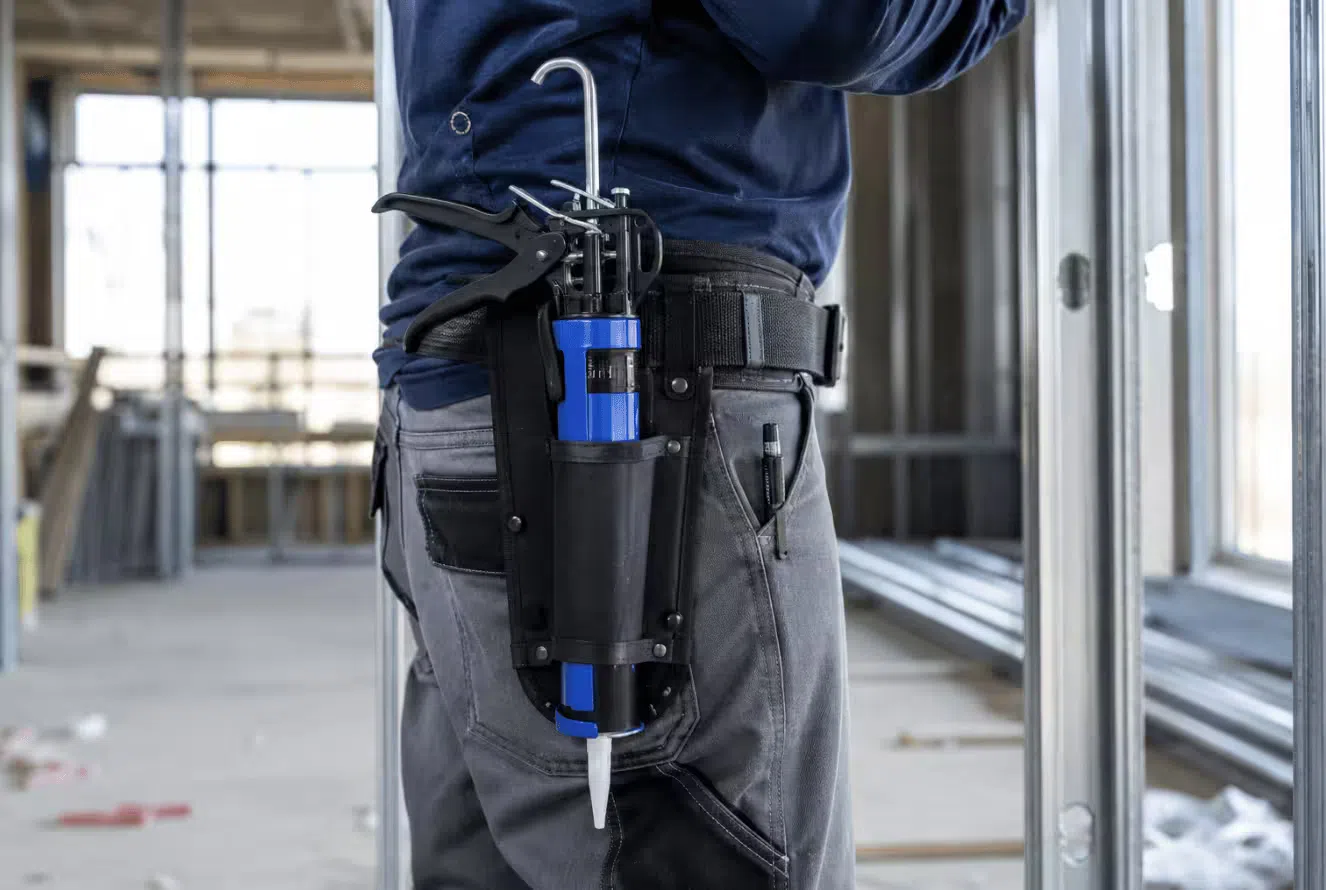
A caulking gun holder (320/mo search volume) is a practical accessory that many buyers overlook. A holder keeps the gun accessible, prevents the nozzle from touching dirty surfaces, and reduces the chance of the trigger being bumped during transport.
Belt holders. A leather or nylon loop that clips onto a tool belt or waistband. The gun sits handle-up or barrel-up depending on design. Belt holders are popular with window installers and painters who move frequently and need both hands free between applications.
Bucket holders. Clips that attach to a 5-gallon bucket rim and hold the gun barrel-down. These are common on larger job sites where the bucket serves as a mobile workstation.
Wall racks and storage blocks. For workshops and warehouse storage, wall-mounted racks keep multiple guns organized. A caulk block design stores several tubes upright so the user can select by sealant type without sorting through a toolbox.
From a distributor perspective, offering holders compatible with standard tool belts (up to 75 mm width) increases the chance of cross-sell with manual guns. Customers who buy a gun and holder as a bundle tend to return for sealant and nozzle refills at higher rates. See our caulk gun cleaning guide for storage and maintenance recommendations.
Conversion Kits and Adapters
Not all sealants come in the same package format. A customer who buys a 300 ml cartridge gun may later need to dispense from a 400 ml sausage pack or a different thread standard.
Cartridge-to-sausage converters. These replace the pressure plate and barrel cradle with a cylindrical adapter that holds a foil sausage pack. The conversion lets one gun frame handle two pack formats. Verify that the adapter barrel inner diameter matches the sausage pack width — typically 43 mm for 400 ml and 48 mm for 600 ml packs. Our how to load a caulk gun guide covers the different loading steps for cartridge and sausage formats.
Thread adapters. Cartridge neck threads vary between markets. A thread adapter lets a North American nozzle fit an imported cartridge or vice versa. Stocking thread adapters reduces returns when end users buy sealant from a different supplier than the gun.
Barrel extensions. For bulk-pack dispensing, a barrel extension increases the gun's capacity without requiring a dedicated bulk gun. These are less common for manual guns than for pneumatic models, but some manual frames accept extended barrel kits.
Application Matching Guide
The right attachment depends on the sealing task. This table matches common applications to the recommended accessory type and the key specification to verify before ordering.
| Application | Recommended Attachment | Key Specs to Check |
|---|---|---|
| Window and door sealing | Standard cone nozzle, 45° cut | Nozzle opening 3–5 mm; cut at second thread from tip |
| Corner and tight-space work | 90° angled tip or 200 mm extension tube | Tube inner diameter matches cartridge neck; secure locking ring |
| Large joint filling (6 mm+) | Wide-opening nozzle or sausage pack adapter | Adapter barrel width: 43 mm (400 ml) or 48 mm (600 ml) |
| Mobile job-site work | Belt holder or bucket clip | Belt width compatibility (typically up to 75 mm) |
| Multi-sealant storage | Wall rack or caulk block holder | Tube slot width fits standard 300 ml cartridges |
| Precision bead on trim | Fine-tip nozzle or precision applicator | Opening 1–2 mm; smooth inner bore for even flow |
Replacement Parts as Attachments
| Attachment / Part | Common Specifications | What to Check When Ordering |
|---|---|---|
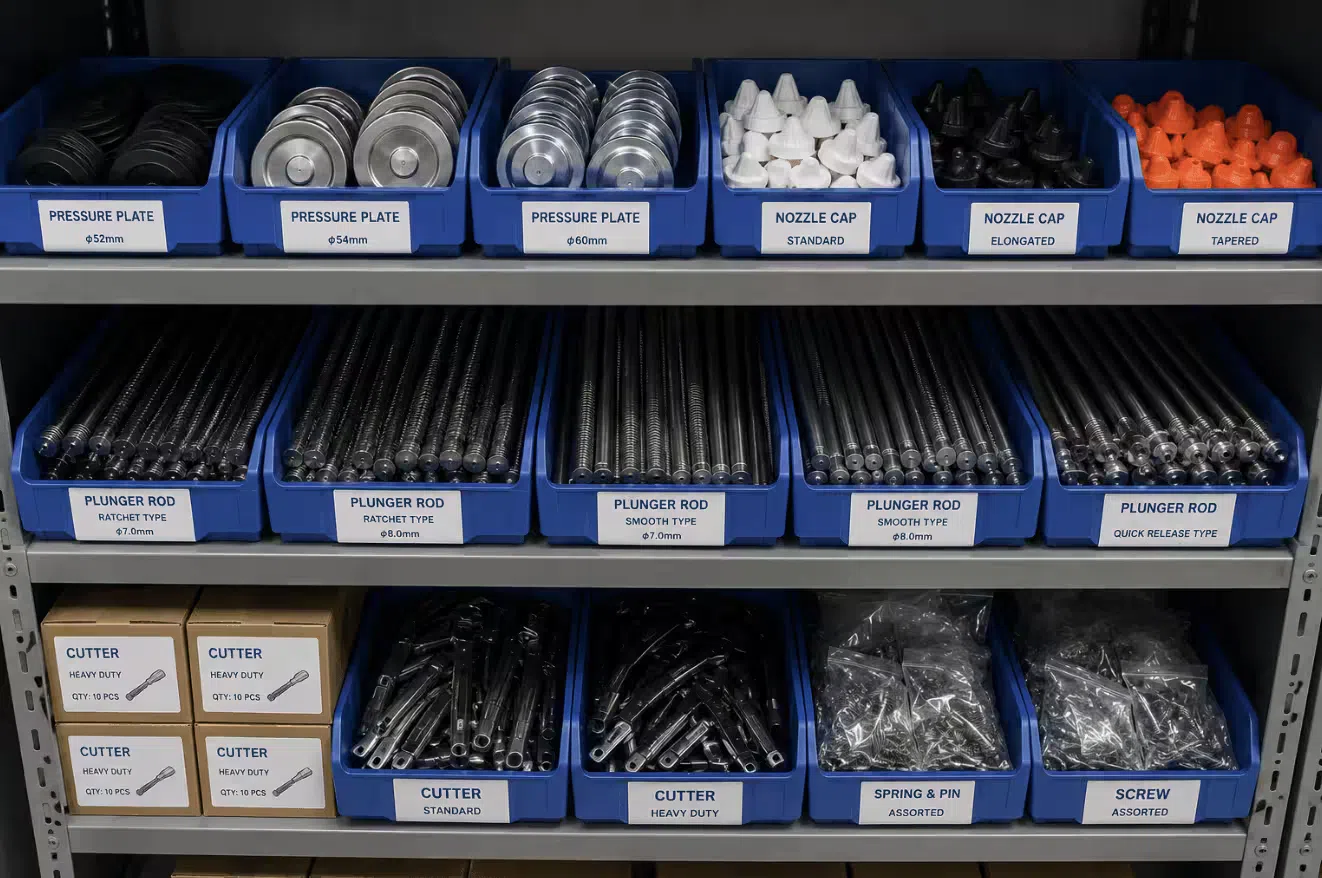
| Pressure plate | Diameter: 42–45 mm for 300 ml cartridges | Plate must seat flat against cartridge base without rocking |
| Plunger rod | Length: 200–300 mm; hardened or zinc-plated steel | Rod must be straight; bent rods cause uneven dispensing |
| Trigger and release lever | Cast or stamped steel; spring-tensioned | Smooth movement with no lateral play |
| Nozzle cap / seal cap | Universal fit for 1/10-gallon cartridge threads | Confirm thread match with cartridges in target market |
Stocking replacement parts alongside complete guns lets customers extend tool life instead of replacing the entire tool. For B2B buyers, offering a basic spare-parts kit (pressure plate, rod, and cap) with every bulk gun order reduces post-sale support requests.
B2B Buyer Checklist for Caulk Gun Attachments
When placing your next bulk order, consider these questions. Our manual caulking gun price guide covers bulk pricing factors for the base guns:
- Nozzle variety — Are you stocking standard cone nozzles only, or do you offer angled and extension tips for tight-space work?
- Cutter quality — Does the gun include a built-in cutter, or do you need a separate cutter with the order?
- Holder options — Would a belt or bucket holder bundle increase average order value for contractor customers?
- Conversion readiness — Do your customers use one cartridge size or multiple pack formats? A simple adapter may prevent lost sales.
- Spare parts — Can customers order replacement rods, pressure plates, and caps through your catalog?
- Packaging — Are attachments packaged separately or bundled? Bundled kits simplify ordering and increase per-unit revenue.
FAQ
Can you use a drill attachment on a manual caulk gun? Drill attachments are designed for cordless caulking guns, not standard manual frames. Manual guns use a mechanical thrust mechanism that requires hand operation. A drill adapter exists for some bulk manual models but is not common for standard cartridge guns.
What size nozzle should I use for a 6 mm bead? Cut the cone nozzle at the 6 mm mark from the tip. Start smaller than the joint width — you can always enlarge the opening if needed. A 45-degree cut angle is the typical starting point for most construction silicone and acrylic sealants.
How do I store a caulking gun on a job site? Use a belt holder to keep the gun accessible and the nozzle off the ground. For short breaks, release the thumb latch to relieve cartridge pressure, then set the gun nozzle-up in a bucket holder. For overnight storage, remove the cartridge and clean the pressure plate.
Does a higher-quality nozzle cutter make a difference? Yes. A sharp blade produces a clean angled cut that helps the bead flow evenly. Dull blades crush the plastic, creating an irregular opening that causes sealant to curl or split as it exits. Hardened steel cutters maintain their edge longer than stamped steel cutters.
How many spare pressure plates should I order per 100 guns? A common distributor ratio is 10–15 replacement plates per 100 guns. Pressure plates are the first component to wear under repeated use, especially with high-thrust frames applying greater force to the cartridge base.
What thread standard do most cartridge nozzles use? The most common standard for 1/10-gallon (300 ml) cartridges sold in North America is a fine UNC thread approximately 15 mm in diameter. European cartridges sometimes use a different pitch. Verify compatibility before ordering nozzle caps or adapters in bulk.
Where can I source caulk gun attachments for wholesale or OEM orders? Contact the manufacturer directly with your target market, expected order quantity, and preferred attachment types. Many factories offer attachments as add-on items that can be packaged with guns or ordered separately. Provide your sealant type, cartridge or pack size, target market, expected order quantity, and OEM or private-label requirements to get a matched recommendation.