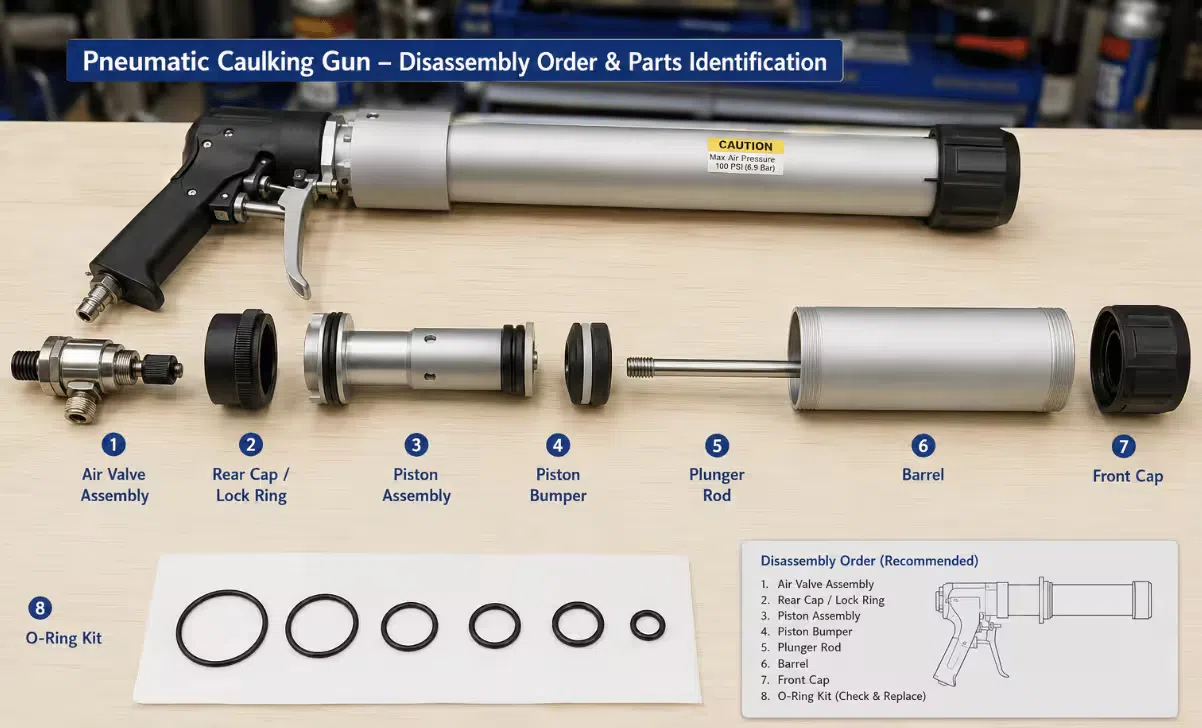
Pneumatic caulking gun parts such as trigger valve o-rings, piston seals, and air fittings wear over time and need replacement to keep the tool dispensing consistently. For B2B buyers who distribute or stock pneumatic dispensing equipment, understanding which parts commonly fail, what to stock, and how to support end-user repair requests helps reduce customer downtime and improves after-sales service. This guide covers the main replacement components for pneumatic caulking guns, what they do, when they wear, and what accessories support reliable daily operation.
Why Pneumatic Caulking Gun Parts Matter for B2B Stocking Decisions
Distributors and wholesale buyers who supply pneumatic caulking guns to contractors, installers, and industrial maintenance teams need more than the tools themselves. End users expect replacement parts to be available when a gun loses air pressure or starts leaking. A distributor who stocks common parts along with the guns can offer faster support than one who does not.
Carrying replacement parts also helps buyers retain customers. A user who finds piston seals, o-ring kits, and air fittings at the same source where they bought the gun is less likely to switch suppliers. For B2B buyers, parts availability is a differentiator.
| Specification | Unit | What It Affects | B2B Buying Note |
|---|---|---|---|
| Trigger valve o-ring size | mm (ID) | Seals the air valve; worn o-ring causes air leak at trigger | Most common replacement; stock multi-size kits |
| Barrel diameter | mm or inches | Determines which piston seal and barrel cap fit | Match to gun model series; cartridge vs sausage models differ |
| Air inlet thread | NPT or BSP | Determines hose fitting compatibility in each market region | NPT common in North America; BSP common in Europe and Asia |
| Working pressure range | PSI (typical 60–120) | Affects seal wear and dispensing consistency | Confirm with manufacturer spec sheet; do not exceed rated maximum |
| Plunger rod length | mm | Determines full-stroke capacity for different cartridge sizes | Rod length varies by barrel size and gun model |
Main Replaceable Parts on Pneumatic Caulking Guns
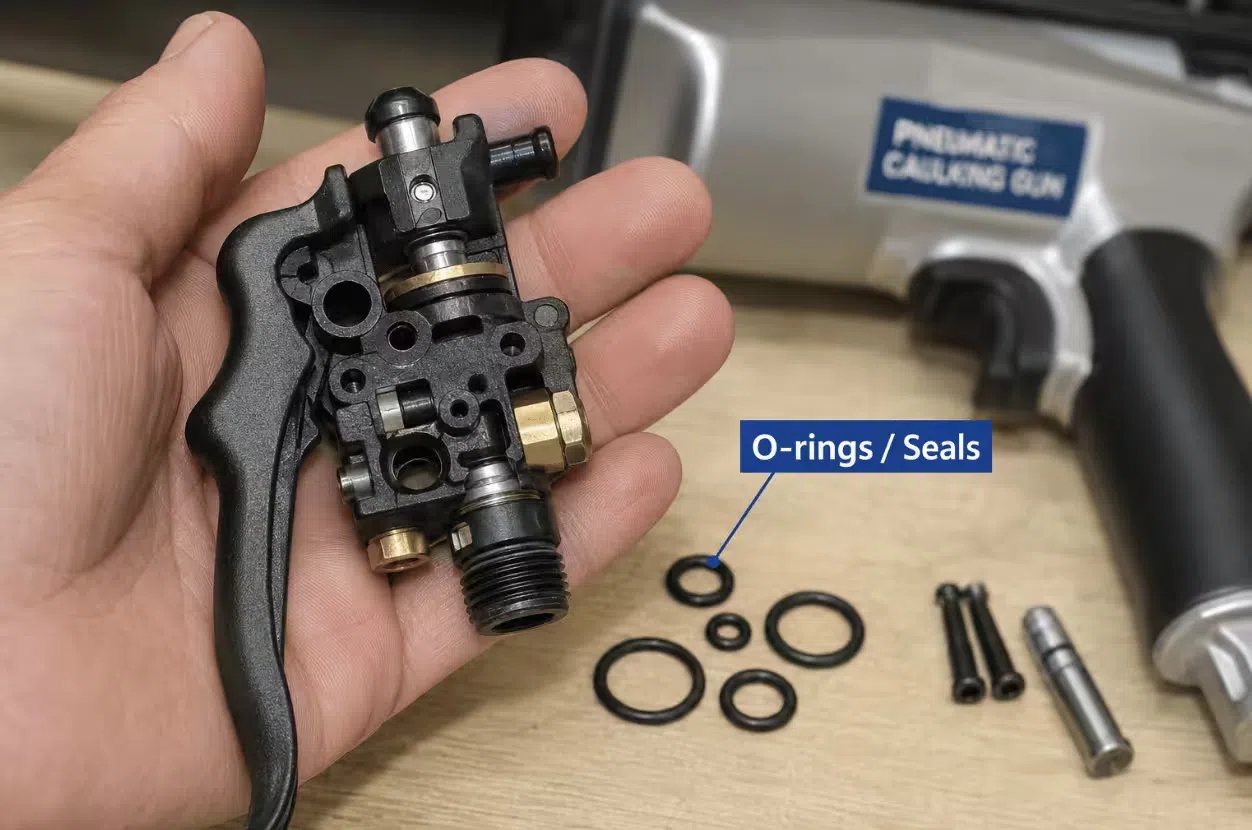
A pneumatic caulking gun contains several serviceable components. Knowing which parts wear and how to identify the correct replacement helps B2B buyers stock the right items without carrying every possible part number.
Trigger valve o-rings. These small rubber seals regulate the airflow when the trigger is pressed. They cycle with every use and are the most frequently replaced part. Users typically notice an air hissing sound from the trigger area, or the gun fails to hold air pressure when connected. Stocking multi-size o-ring kits that cover several common models provides more flexibility than single-part inventory.
Piston seal or plunger cup. This seal prevents compressed air from bypassing the plunger. When it wears, the gun loses consistent output pressure. The user may hear air escaping from the rear of the barrel while the plunger moves weakly. Piston seal kits are specific to barrel diameter, so buyers should confirm barrel size when ordering.
Barrel cap gasket. This gasket seals the rear opening where the plunger enters the barrel. A worn gasket causes air loss and reduces dispensing efficiency. Check thread type and barrel material when sourcing replacements.
Air inlet fitting and coupler. The fitting connects the air hose to the gun. Leaks at this point are often mistaken for internal gun failure. Confirm thread standard — NPT in North America, BSP in other regions — and stock adapters for cross-standard connections.
Trigger valve assembly. On some models the complete valve assembly can be replaced rather than rebuilding individual seals. Complete assemblies save labor time for end users who need fast repairs.
Barrel or cylinder tube. Cartridge barrels and sausage pack tubes can dent or accumulate material buildup over time. Replacement barrels by size allow users to switch between cartridge and sausage formats without buying a new gun.
Nozzles and adapters. Pre-cut nozzles and multi-size kits help users control bead width and reduce material waste. These are low-cost items that improve the dispensing experience.
| Application | Recommended Gun Type | Key Specs to Check |
|---|---|---|
| General construction sealing with silicone or acrylic | Single-component pneumatic cartridge gun | Barrel size (10 oz or 300 ml typical), working pressure 60–90 PSI |
| High-volume curtain wall or window sealing with sausage packs | Single-component pneumatic sausage gun | Sausage tube size (300 ml, 400 ml, or 600 ml common), quick-release barrel |
| Industrial assembly with polyurethane or MS polymer | Single-component pneumatic cartridge or sausage gun | Thrust ratio and air pressure range for thicker material |
| Epoxy or two-part adhesive bonding | Dual-component pneumatic applicator gun | Cartridge ratio (1:1, 2:1, 4:1 or 10:1 common), mixer nozzle compatibility |
| Automotive body seam sealing | Single-component pneumatic seam sealer gun | Nozzle type for bead profile, air pressure range for material viscosity |
O-Rings and Seals: The Most Common Parts Replacement
The three most common points where pneumatic caulking guns develop air leaks involve o-rings and seals.
Trigger valve o-rings. These are exposed to every trigger cycle. Over time the rubber dries out or develops cracks. Users notice air hissing from the trigger or gradual loss of dispensing force.
Piston or barrel o-rings. When the o-ring around the piston fails, compressed air bypasses the plunger. The gun loses consistent pressure and the plunger may stall mid-stroke.
Barrel cap and valve stem seals. These smaller seals wear less often but should be checked when pressure loss persists and the main seals appear intact.
When replacing any o-ring, use silicone-based grease designed for pneumatic tools. Petroleum-based lubricants can swell the rubber and accelerate failure. Most pneumatic caulking gun seals use Buna-N (Nitrile) rubber. Viton is a common upgrade when the gun dispenses materials containing solvents.
For daily care procedures that help extend seal life, see the pneumatic caulking gun seals and lubrication guide.
Pneumatic Caulking Gun Accessories for Reliable Operation
Replacement parts are not the only items B2B buyers need to consider. Several accessories help end users get better performance and reduce the frequency of repairs.
Air line moisture filters and regulators. Compressed air often contains moisture that accelerates seal wear inside the gun. An inline filter-regulator installed between the compressor and the gun delivers clean, dry air at a consistent pressure. This is one of the most effective ways to extend seal life.
Swivel air connectors. A swivel fitting at the air inlet reduces hose twisting during use, which prevents strain on the fitting and makes the gun easier to handle during continuous dispensing.
Replacement barrels and sausage tubes. Barrels wear from regular use, especially with abrasive materials. Stocking replacement barrels by size lets users switch cartridge and sausage formats or replace a worn barrel without replacing the entire gun.
Nozzle kits and cutters. Pre-cut nozzle tips and multi-size kits help users control bead width and reduce material waste. These inexpensive accessories improve daily dispensing quality without requiring technical support.
Air Pressure and Seal Performance
Pneumatic caulking gun seals are designed to operate within a typical pressure range. Most single-component pneumatic models are rated for 60 to 120 PSI. The actual pressure needed depends on material viscosity, nozzle size, temperature, and gun design.
| Material or Application | Typical Starting Pressure | What Changes It | Buyer Check |
|---|---|---|---|
| Low-viscosity sealant (acrylic, thin silicone) | 60–80 PSI | Higher nozzle restriction may need slightly more pressure | Confirm with sealant TDS and gun model spec sheet |
| Medium-viscosity sealant (polyurethane, MS polymer) | 80–100 PSI | Cold weather thickens material; higher pressure may be needed | Match gun to common material viscosity in target market |
| Thick sealant or construction adhesive | 90–120 PSI | Large nozzle or fast output rate requires higher pressure | Verify gun thrust ratio handles thick materials at available pressure |
| Two-component epoxy via dual-cartridge | 80–100 PSI | Mixing nozzle restriction and ratio affect required pressure | Confirm cartridge ratio and air pressure rating on pneumatic epoxy gun |
Using pressure above the rated maximum damages seals and shortens the service life of internal parts. For more detail on compressor and pressure setup, see the air powered caulking gun PSI and compressor guide.
How to Identify the Correct Parts for Ordering
When a customer needs a replacement part, three pieces of information help identify the correct component.
Model and barrel size. The gun model number, usually printed on the body or barrel, determines which o-rings, seals, and plunger components fit. Barrel diameter varies between cartridge and sausage models.
Air fitting type. Confirm whether the gun uses NPT (North America), BSP (Europe and Asia), or a proprietary quick-connect fitting. Adapters are available for cross-standard connections.
Sealant compatibility. If the gun has been used with solvent-based sealants, existing o-rings may be degraded. Check whether the replacement seal material is compatible with the customer's sealant type.
For detailed ordering specifications, refer to the pneumatic caulking gun specs guide. For guidance on matching gun format to packaging size, the pneumatic caulk gun sizes guide covers cartridge, sausage, and bulk format options.
FAQ
What are the parts of a pneumatic caulking gun? The main components are the air valve and trigger assembly, piston with seal, plunger rod and pressure plate, barrel or cylinder tube, barrel cap gasket, air inlet fitting, and dispensing nozzles. Dual-component pneumatic applicator guns also include a dual-piston assembly and static mixer nozzle.
What size o-rings do pneumatic caulk guns use? O-ring size depends on the gun model and the seal location. Trigger valve o-rings on common models typically range from 6 mm to 12 mm inner diameter. Piston seals depend on barrel diameter. Buyers should confirm dimensions with the gun manufacturer's spec sheet. Stocking multi-size o-ring kits provides coverage across several models.
How often should pneumatic caulking gun seals be replaced? For professional daily use, trigger valve o-rings typically need inspection every 3 to 6 months. Piston seals last longer but should be checked if the gun loses output pressure. Distributors who stock common o-ring sizes can serve end users who need fast replacements.
Can you repair a pneumatic caulking gun that is leaking air? Yes, in most cases. An air leak usually comes from a damaged trigger valve o-ring, a worn piston seal, or a loose air fitting — each repairable by replacing the affected seal or tightening the fitting. If the barrel or valve body is cracked, the component needs replacement.
Why does my pneumatic caulking gun not dispense evenly? Uneven dispensing can result from a worn piston seal bypassing air, a clogged nozzle, pressure too low for the material viscosity, or a bent plunger rod. Check these in order. Distributors who stock piston seal kits can help users resolve this without returning the tool.
What replacement parts should wholesale buyers stock for pneumatic caulking guns? The most commonly needed parts are trigger valve o-ring kits, piston seal kits for common barrel sizes, barrel cap gaskets, air inlet fittings in NPT and BSP thread standards, and multi-size nozzle sets. Stocking these items lets distributors offer one-stop service for pneumatic gun users.
Can you source OEM or private label pneumatic caulking gun parts? Yes. For wholesale and OEM programs, parts can be supplied alongside complete guns. Buyers should specify their desired parts coverage, packaging format, and labeling during the ordering process so the supplier can prepare compatible components.
Sourcing Pneumatic Caulking Guns and Parts
Whether you need complete pneumatic caulking guns for your distribution line or replacement parts to support existing customers, understanding the common wear components and available accessories helps you serve your market. Contact CAULKMFG with your sealant types, target cartridge or sausage pack sizes, market region, expected order quantities, and any OEM or private label requirements. We can recommend suitable models and discuss parts support for your distribution channel.
Visit the pneumatic caulking guns product page for the full product range.