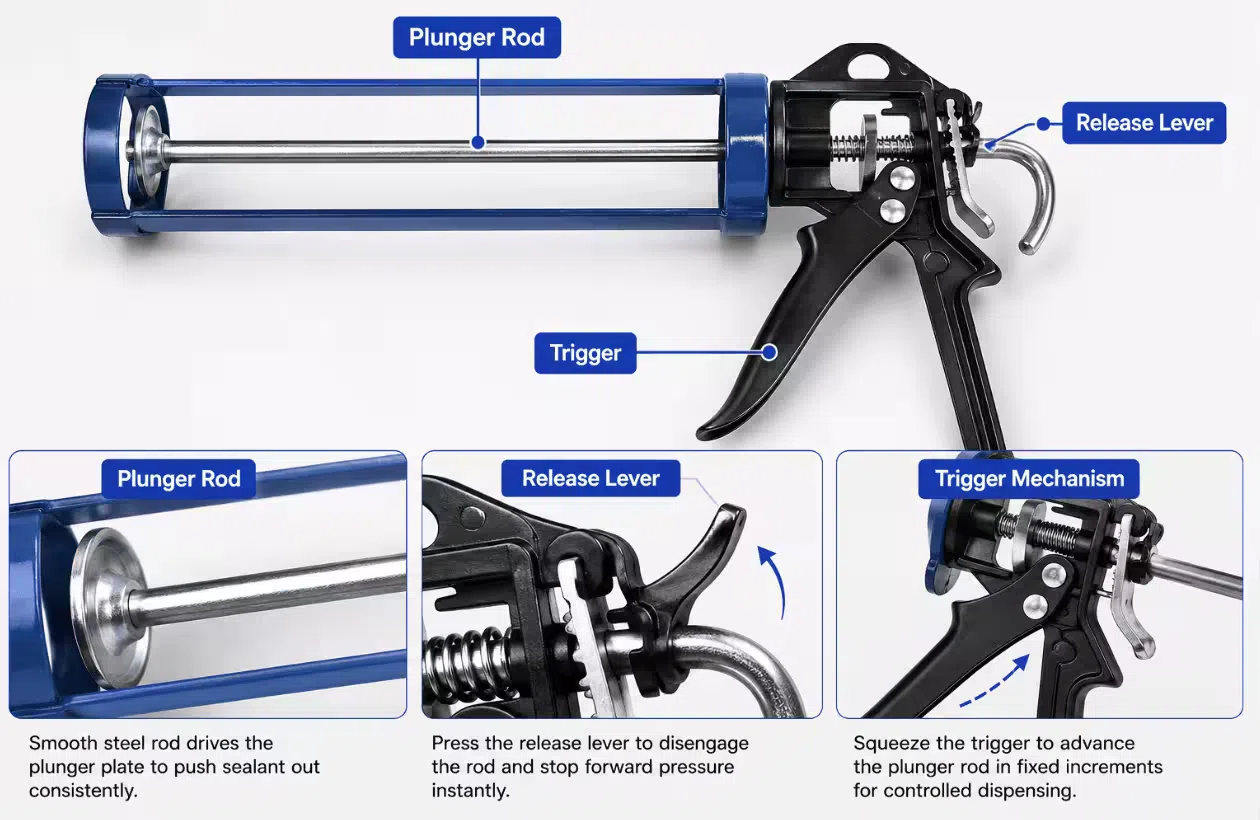
Manual caulking guns have only a few moving parts, but those parts wear out with regular use on construction sites. When a gun stops working, the problem is usually in the plunger rod, the trigger mechanism, or the release lever. This caulk gun repair guide covers how to diagnose each failure, what you can fix on site, and when replacement is the better option for your crew.
The Three Common Failure Points
A manual caulking gun for 300 ml cartridges works through a simple mechanical chain. The plunger rod pushes against the cartridge base. The trigger advances the rod through a ratchet or smooth-rod mechanism. The release lever disengages the rod so you can swap cartridges. Each component fails in predictable ways after repeated use.
| Specification | Unit | What It Affects | B2B Buying Note |
|---|---|---|---|
| Rod engagement mechanism | Ratchet teeth or smooth-rod collar | Whether the rod holds position under load | Metal internal parts last longer than plastic assemblies on ratchet guns |
| Release lever type | Thumb release or trigger release | How easily the rod disengages for cartridge changes | Thumb-release design has fewer parts to fail and is easier to service in the field |
| Rod material | Steel or aluminum alloy | Whether the rod bends under high thrust | Higher-thrust guns (18:1+) use thicker rods that resist bending better |
| Frame construction | Metal or skeleton plastic | Whether the gun can be repaired at all | Cast-metal frames may have riveted rods that cannot be replaced |
Diagnosing a Caulk Gun Trigger Not Working
When the trigger pulls but nothing comes out, the diagnosis depends on how the trigger feels. A trigger that moves with no resistance means the rod is not engaging. On ratchet guns, the pawl that catches the rod teeth may be worn or blocked with dried sealant. On smooth-rod guns, the clamping collar may have lost its grip.
A trigger that is hard to pull or stuck mid-squeeze usually points to dried sealant inside the barrel. Sealant creeps past the cartridge base when the gun is left with a partially used tube, and it hardens around the rod. This is most common with silicone and polyurethane sealants, which cure by moisture exposure.
For B2B buyers, trigger mechanism failures are a signal about gun quality. Guns with metal trigger assemblies and accessible rod guides are serviceable. Plastic trigger housings on budget guns often cannot be opened for cleaning, which means the whole gun is replaced.
Plunger Rod Repair Options
A bent plunger rod is common when a gun is used with thick adhesive or in cold conditions. The user keeps squeezing when the material resists, and the force bends the rod at its narrowest point. Guns with thrust ratios below 12:1 are more likely to have this problem because the mechanical advantage is lower.
To straighten a mildly bent rod, clamp it near the handle and bend it back carefully. If the rod is severely bent or the front pad threads are stripped, replacement is needed. Some guns use removable rod assemblies — check with your supplier whether replacement rods are available for the models you carry. Guns with riveted rod attachments cannot be repaired at the component level.
On smooth-rod guns, the rod rarely bends but the clamping collar wears out. Cleaning the rod surface with solvent usually restores grip. If the rod still slips after cleaning, the collar or the entire trigger mechanism needs replacement.
Release Lever Repair
The release lever is the component that fails most often on manual caulking guns. The lever pushes a pin or plate that disengages the rod lock. When the lever spring breaks or the mechanism gets gummed up, the rod stays locked and you cannot remove the cartridge.
To repair a caulk gun release lever that is stuck, spray penetrating lubricant into the lever slot and work the lever back and forth. If the lever moves but the rod stays locked, the internal lock plate is probably jammed. Push the lock plate with a small screwdriver while pulling the rod — this usually releases the bind.
If the lever spring is broken, the repair depends on the gun. On skeleton-frame guns the spring is often not replaceable. On higher-quality guns with accessible spring housings, you can order a replacement spring from the manufacturer.
A release lever with a snapped lever arm or cracked frame at the pivot point means the gun has reached end of life. The cost of repairing that failure exceeds the cost of a replacement gun.
Repair vs. Replace Decision Guide
| Application or Problem | Recommended Action | Key Specs to Check |
|---|---|---|
| Rod bends when dispensing thick sealant | Straighten rod if mild; replace if severe | Thrust ratio (18:1+ recommended for thick materials); rod thickness |
| Release lever jammed with dried sealant | Lubricate and free the lock plate | Whether the lever spring is accessible for replacement |
| Trigger pull has no resistance | Clean ratchet pawl or smooth-rod collar | Metal vs. plastic trigger housing (metal is serviceable) |
| Frame cracked or bent after impact | Replace the gun | Frame material (metal is more durable but still fails on impact) |
| Dripless mechanism will not release | Clean pressure-release spring | Whether the dripless spring is replaceable or sealed in the frame |
For B2B buyers managing a fleet of caulking guns, the economics of repair look different than for individual users. If a repair takes 15 minutes of a site supervisor's time and the wholesale price is $10–12 for a basic gun, repair is rarely worth it. But higher-thrust guns with metal frames may cost $25–40 wholesale, and a 10-minute parts swap becomes cost-effective.
When you stock guns for your own crew or distribute to construction suppliers, the repairability of a gun is a genuine purchasing factor. Guns with metal frames, replaceable rod assemblies, and accessible release lever springs give you more maintenance options.
How to Insert a Caulk Tube Correctly
Improper cartridge installation causes a surprising number of repair calls. When a tube is not seated correctly, the user forces the gun, which can bend the rod or jam the mechanism.
- Retract the plunger rod fully using the release lever.
- Cut the nozzle at a 45-degree angle at the desired bead width.
- Pierce the inner foil seal with the nozzle cutter or a stiff wire.
- Place the cartridge in the frame with the nozzle facing forward.
- Push the rod forward until it contacts the cartridge base.
- Squeeze the trigger once to confirm sealant flows.
Skipping step three — piercing the seal — is the most common reason users think the gun is broken. The trigger pulls, the rod advances, but nothing comes out because the foil seal is still intact. This is not a repair issue, but it shows up in repair searches frequently.
Frequently Asked Questions
How do I fix a caulk gun that will not dispense? Pull the rod back, remove the cartridge, and check whether the inner seal is pierced. If it is, check for dried sealant blocking the nozzle. If the rod does not advance when you pull the trigger, the ratchet pawl may be worn or the clamp collar needs cleaning.
Why will my caulking gun plunger not move? The most likely cause is dried sealant in the barrel. Clean the barrel interior with a solvent and pull the rod with pliers. If the rod still does not move, the frame may be bent.
How do I fix a caulking gun release lever that is stuck? Spray penetrating lubricant into the lever slot and work the lever gently. If the rod stays locked, push the internal lock plate with a screwdriver while pulling the rod.
Can I replace just the plunger rod on a manual caulking gun? On guns with removable rod assemblies, yes. Check with your supplier whether replacement rods are available for the models you stock. Guns with riveted rod attachments must be replaced as a unit.
For wholesale buyers: which manual caulking gun features make a gun easier to repair? Metal-frame models with accessible release lever springs and removable rod assemblies are easier to service. Plastic-frame guns and guns with riveted rods cannot be repaired at the component level. When sourcing for distribution, consider whether your customers maintain their own guns or prefer to swap them out.
How do I know when a caulking gun is not worth repairing? When the frame is cracked, the release lever pivot point is broken, or the dripless mechanism housing is damaged, the repair cost and labor time exceed the replacement cost. For basic guns below $15 wholesale, replacement is almost always the correct choice.
Choosing Repairable Guns for Your Business
Distributors and wholesale buyers have two main options when stocking manual caulking guns: lower-cost disposable models or higher-quality repairable models. Construction supply customers who run large crews often prefer repairable guns, because replacing a trigger assembly every six months costs less than buying new guns quarterly. Hardware retail customers may prioritize lower shelf price over serviceability.
If you are sourcing manual caulking guns for wholesale or OEM distribution, providing your sealant type, expected order volume, and target market helps suppliers match the right model to your application. CaulkMFG offers manual component guns with metal frames, multiple thrust ratio options from 7:1 to 26:1, and available replacement parts. Contact the sales team with your sealant type, cartridge size, target market, expected order quantity, and OEM or private-label requirements for a model recommendation.
Related reading: How to Fix a Caulking Gun: Troubleshooting Guide, Caulking Gun Parts Guide, Caulking Gun Trigger Mechanism Types