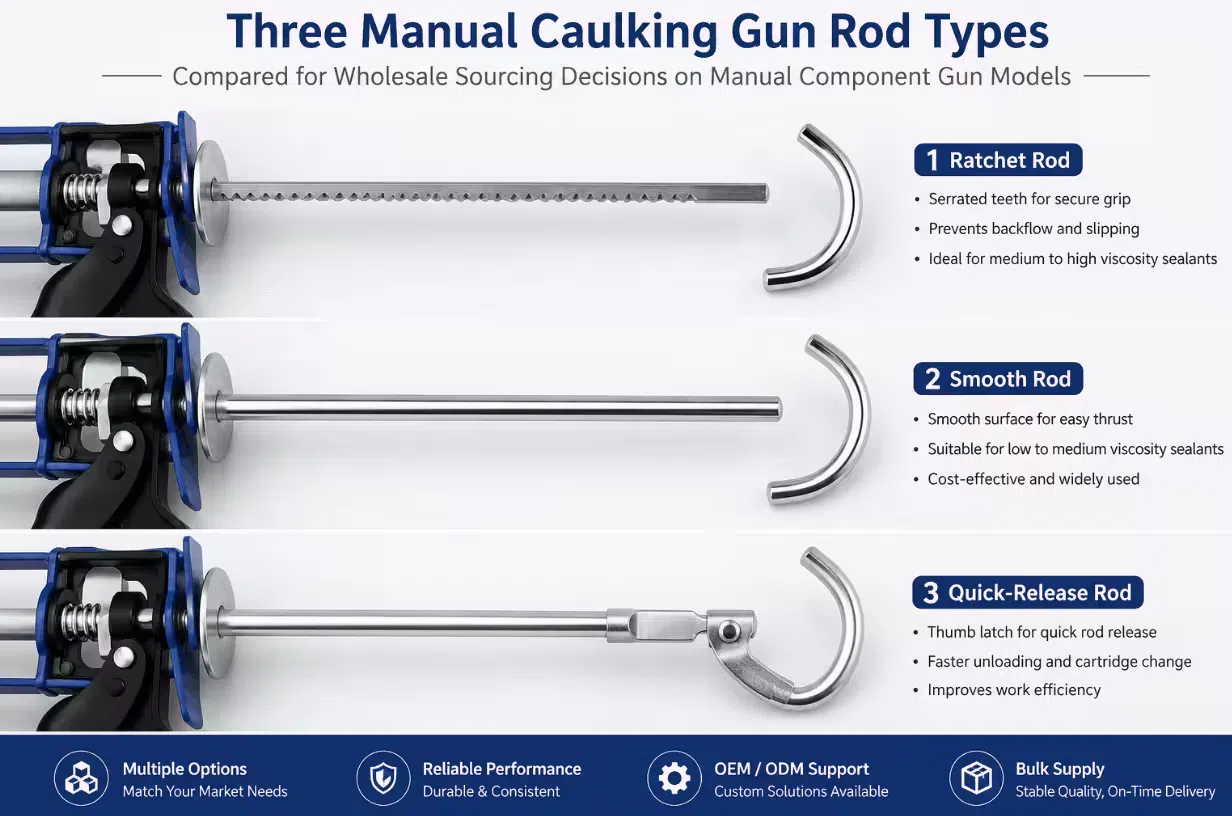
A caulking gun trigger mechanism controls how the plunger rod advances, when sealant is dispensed, and whether the flow stops cleanly after each trigger release. For B2B buyers who stock, distribute, or source manual caulking guns for resale, the difference between a ratchet rod, a smooth rod, and a quick-release mechanism directly affects bead quality, operator fatigue, dripless performance, and the range of replacement parts to support after-sale service.
This article explains how each trigger mechanism type operates, how the thrust ratio relates to mechanism selection, and what wholesale buyers should check when choosing manual caulking gun models for their product catalog.
Ratchet Rod Mechanism
The ratchet rod mechanism uses a serrated rod and a spring-loaded pawl. Each trigger squeeze advances the rod by one tooth pitch. Releasing the trigger resets the pawl without retracting the rod, so the rod stays in place and the sealant continues to hold pressure inside the cartridge.
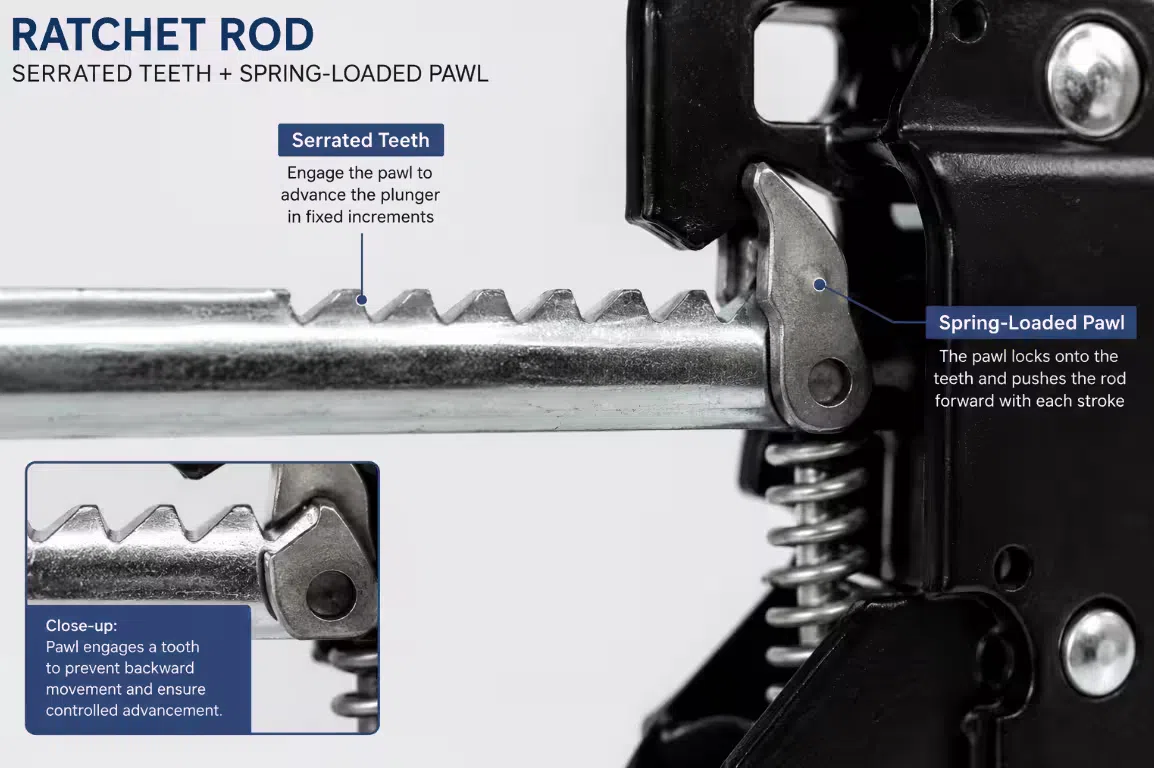
Typical thrust ratio: 5:1 to 7:1. Lower ratios require more trigger force to dispense thicker sealants.
Common applications: Rough filling, gap sealing, bedding, and heavy construction work where bead appearance is secondary to speed. The jerky flow makes ratchet guns less suited for finish-grade silicone or acrylic work.
What B2B buyers should know: Ratchet rod guns are the lowest-cost mechanism type and work as entry-level SKUs for customers who only need occasional dispensing. Distributors supplying professional trades typically carry these as economy options and recommend smooth rod or quick-release models for regular use. The pawl spring is a wear item — for bulk orders, check whether replacement pawl springs are available through the supplier's spare parts program.
| Specification | Unit | What It Affects | B2B Buying Note |
|---|---|---|---|
| Rod advance | Fixed increment | Bead smoothness | Not suited for smooth finish beads |
| Thrust ratio | 5:1 – 7:1 | Force needed per squeeze | Higher trigger force increases hand fatigue |
| Unit cost | Lowest | Wholesale price | Fits economy product lines |
| Pawl spring life | Cycles to failure | Replacement frequency | Verify spring durability for volume orders |
Smooth Rod Mechanism
The smooth rod mechanism uses a polished rod held in place by a friction plate or cam rather than teeth. The rod slides forward when the trigger is squeezed and stays in position between strokes. This design lets the user control bead width by pulling the trigger in micro-increments rather than fixed steps.
Most smooth rod guns include a dripless pressure-release mechanism — a thumb lever or push button that releases the rod tension. When activated, the rod retracts slightly and the cartridge pressure drops so sealant stops flowing immediately.
Typical thrust ratio: 10:1 to 26:1. Higher mechanical advantage reduces the trigger force needed for thick materials.
Common applications: Finish sealing with silicone, acrylic, polyurethane, and hybrid sealants. Clean bead application for windows, doors, waterproofing, and decorative sealant lines where bead appearance matters.
What B2B buyers should check: Smooth rod is the most common mechanism for commercial-grade manual guns. When ordering for wholesale distribution, verify whether the model has a dripless release button and whether the pressure plate uses a metal cam or a composite one. Metal cams maintain consistent tension longer and are worth specifying for higher-volume resale. For more detail on how thrust ratio factors into gun selection, see the caulk gun thrust ratio guide. Smooth rod guns are compatible with standard 300ml cartridges available across the manual component guns product range.
| Specification | Unit | What It Affects | B2B Buying Note |
|---|---|---|---|
| Rod advance | Micro-increment | Bead width control | Preferred for clean finish beads |
| Thrust ratio | 10:1 – 26:1 | Effort and material range | Match to customer's typical sealant viscosity |
| Dripless release | Push button or thumb lever | Material waste and cleanup | Essential for professional use |
| Cam material | Metal vs composite | Tension longevity | Metal cam lasts longer under frequent use |
Quick Release Mechanism
The quick release mechanism builds on the smooth rod design with a spring-loaded latch that releases the rod completely, letting it slide backward freely. This makes cartridge swaps faster and cuts downtime between sealant changes. Some quick release designs combine the dripless relief and the rod release into one latch.
Typical thrust ratio: 12:1 to 24:1 — comparable to smooth rod models.
Common applications: Job sites where operators switch cartridges often — multi-material projects, high-volume sealing crews, and teams that cycle through silicone, polyurethane, and hybrid sealants in the same shift.
What B2B buyers should check: The quick release latch must operate smoothly under load. Rod-collar latches are easier to use one-handed than trigger-housing latches. Metal latch components cost slightly more but reduce breakage risk for resale in contractor markets.
| Specification | Unit | What It Affects | B2B Buying Note |
|---|---|---|---|
| Rod advance | Micro-increment | Bead control | Same as smooth rod |
| Thrust ratio | 12:1 – 24:1 | Effort and material range | Mid to high range |
| Latch position | Rod collar vs trigger housing | One-hand operation ease | Rod collar preferred for field use |
| Latch material | Metal vs composite | Long-term reliability | Metal latch reduces field failures |
How Thrust Ratio Relates to Mechanism Choice
The thrust ratio of a manual caulking gun is tied to its mechanism design. Ratchet rod guns top out at lower ratios because the pawl-and-tooth linkage limits mechanical leverage. Smooth rod and quick-release designs can reach higher ratios since the continuous rod surface allows a longer trigger pivot stroke.
| Application | Recommended Mechanism | Typical Thrust Ratio | Key Specs to Check |
|---|---|---|---|
| Light silicone and acrylic sealing | Smooth rod (basic) | 10:1 – 12:1 | Dripless release, rod surface finish |
| General construction sealing | Smooth rod with dripless release | 12:1 – 18:1 | Cam material, release button durability |
| Multi-cartridge or high-volume jobs | Quick release smooth rod | 15:1 – 24:1 | Latch location, latch material |
| Thick adhesive or cold weather work | High-thrust smooth rod | 20:1 – 26:1 | Rod diameter, frame material strength |
These are typical ranges. Actual dispensing performance depends on sealant viscosity, nozzle opening size, temperature, and cartridge quality. Buyers should cross-check the recommended thrust ratio with the sealant manufacturer's TDS and test a sample lot before placing volume orders. For a more detailed comparison of how thrust ratio affects dispensing effort, see the smooth rod caulk gun guide.
Trigger Mechanism Considerations for OEM and Private Label Orders
Manufacturers and wholesalers ordering caulking guns under OEM or private label agreements should evaluate several mechanism-related specifications:
- Rod type selection: Smooth rod with dripless release is the most versatile mechanism for general distribution and covers the broadest customer base.
- Release button design: Push-button releases are the most popular for commercial-grade models. Thumb levers and pull tabs are alternatives that some buyer segments prefer.
- Latch and cam materials: Metal latch components and metal cams add to unit cost but reduce field failure reports. For warranty-sensitive markets, specifying metal wear parts is worth the cost difference.
- Thrust ratio labeling: Marking the thrust ratio on the frame or packaging helps distributors match guns to their customers' applications without opening each unit.
- Spare parts availability: Pawl springs, cam plates, release buttons, and rod assemblies should be stocked as replacement parts for buyers who rotate inventory or offer after-sales service.
If operators report trigger resistance issues not related to the mechanism type, the caulk gun hard to squeeze troubleshooting guide covers common causes.
FAQ
How do you fix a caulk gun trigger that sticks? A sticking trigger usually comes from debris between the rod and the frame channel, a worn pawl spring in ratchet models, or a bent rod. Cleaning the rod surface and applying light oil to the trigger pivot often resolves it. A bent metal rod should be replaced, not straightened.
Can you change the rod type on a manual caulking gun? No. The rod and trigger mechanism are matched to the frame and linkage. A ratchet rod gun cannot be converted to a smooth rod gun. Buyers should select the mechanism type at the time of ordering.
Which trigger mechanism works best for silicone sealant? Smooth rod with a dripless release button provides the best bead control for silicone sealant. Silicone is lower in viscosity than most construction adhesives and benefits from micro-increment trigger control and clean stops — both of which smooth rod handles better than ratchet.
What does the release lever on a caulk gun do? The release lever or button relieves tension between the rod and the frame. On smooth rod guns, pressing it retracts the rod slightly so cartridge pressure drops and the sealant stops flowing. On quick-release models, the latch also lets the rod slide back fully for a cartridge change.
What thrust ratio should a distributor order for general contractor customers? A 12:1 to 18:1 thrust ratio with smooth rod mechanism covers the widest range of common construction sealants — silicone, acrylic, polyurethane, and hybrid formulations. This keeps trigger effort low enough for daily use while handling most job-site conditions.
Are replacement trigger parts available for wholesale and OEM orders? Yes. CaulkMFG supplies replacement components for the trigger mechanisms used in its manual component guns, including pawl springs, cam plates, release buttons, and rod assemblies. OEM buyers can include spare parts as separate line items in bulk orders.
Sourcing Manual Caulking Guns from CaulkMFG
CaulkMFG manufactures manual component guns with ratchet rod, smooth rod, and quick-release mechanism options at thrust ratios from 7:1 to 26:1. Wholesale, OEM, and private label orders are supported with custom colors, packaging, and model configuration.
To discuss a specific order — including the sealant types your customers use, your preferred trigger mechanism and thrust ratio range, target market, expected annual quantity, and any OEM labeling or packaging requirements — contact the CaulkMFG sales team with your product specification sheet.