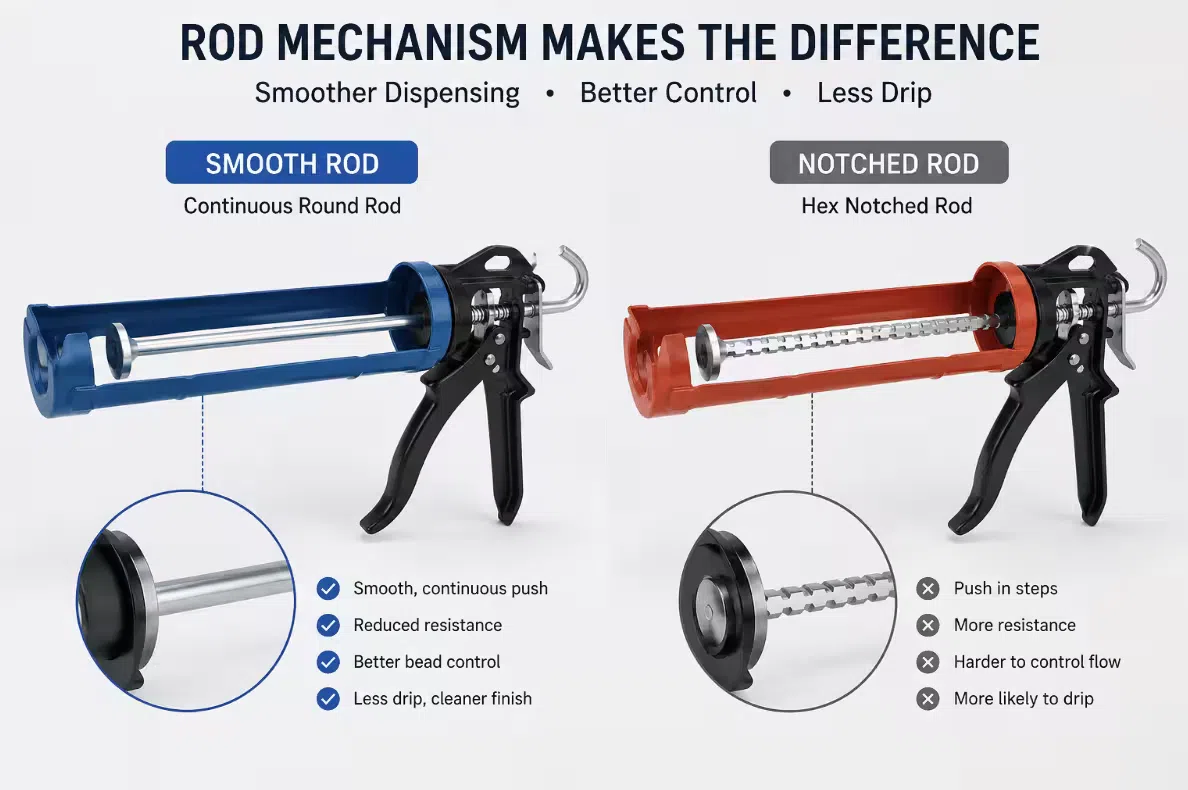
 When procurement managers and distributors evaluate caulking gun specifications, the caulking gun mechanism — specifically the rod type — is one of the first differences they see. Smooth rod, hex rod, and ratchet rod guns work differently inside. The rod type affects how evenly sealant flows, how much hand force is needed, and whether the gun drips after the trigger is released. This article explains what a smooth rod caulk gun is, how it compares with hex and ratchet rod designs, and what B2B buyers should check when sourcing manual caulking guns for wholesale, distribution, or OEM programs.
The manual caulking guns available from CaulkMFG include models with thrust ratios ranging from 7:1 to 26:1 and frame materials in aluminum alloy and metal. Understanding the rod mechanism helps match each model to the right customer application.
What Is a Smooth Rod Caulk Gun?
A smooth rod caulk gun uses a continuous metal rod without teeth, notches, or hex patterns. When the operator squeezes the trigger, the rod advances smoothly and continuously. When the trigger is released, a pressure-release mechanism — commonly called a dripless mechanism — retracts the rod slightly to relieve pressure inside the cartridge. This reduces the amount of sealant that oozes out after the trigger is released.
Two older designs work differently. A hex rod gun has a hexagonal rod with notches. Each trigger squeeze advances the rod by one fixed increment, which makes partial dispensing harder to control. A ratchet rod gun is the simplest type, with a toothed rod and a pawl that clicks forward one tooth at a time. Ratchet rod guns typically deliver the lowest thrust ratio, around 5:1, and produce the least consistent bead flow.
Most professional and mid-range manual caulking guns available today use the smooth rod design because it allows the operator to control bead width and flow rate more precisely than incremental rod mechanisms.
Rod Mechanism Key Specifications
| Specification | Unit | What It Affects | B2B Buying Note |
|---|---|---|---|
| Rod type | Design type (smooth, hex, ratchet) | Dispensing smoothness, drip control, trigger feel | Smooth rod is the practical baseline for contractor and industrial use; hex and ratchet only for budget or occasional-use tools |
| Rod material | Steel, hardened steel, composite | Wear life, corrosion resistance, rod bending risk under high thrust | Check rod hardness for high-thrust models; hardened steel rods resist bending better when dispensing thick sealant |
| Dripless mechanism | Yes / No with spring type | Post-trigger sealant drip | Dripless is standard on most smooth rod guns but does not eliminate dripping from air bubbles in the cartridge |
| Thrust ratio range | Ratio (e.g., 10:1 – 26:1) | Dispensing force multiplier for different sealant viscosities | Match thrust ratio to sealant type — higher ratios handle thicker materials and reduce hand fatigue |
Smooth Rod vs Hex Rod vs Ratchet Rod
The choice of rod mechanism affects how the gun performs on different job sites. The table below compares the three types across practical factors.
| Rod Type | Mechanism | Dispensing Smoothness | Drip Control | Typical Thrust Ratio | Best Fit for Distribution |
|---|---|---|---|---|---|
| Smooth rod | Continuous rod with pressure-release trigger | Smooth and consistent | Moderate to good — release mechanism reduces post-trigger drip | 10:1 to 26:1 | Contractor and industrial supply — most versatile range |
| Hex rod | Notched hexagonal rod, incremental advance | Stepped — can be jerky | Limited — no built-in release | 12:1 to 18:1 | Budget contractor tools, price-sensitive channels |
| Ratchet rod | Toothed rod with pawl, incremental per squeeze | Irregular — hardest to control | Poor — sealant continues flowing after trigger release | 5:1 to 7:1 | Disposable or occasional-use tools, home-center low-end |
For B2B buyers stocking tools for contractors or industrial users, smooth rod guns are the practical minimum. Experienced users on forums like r/HomeImprovement note that even inexpensive smooth rod guns outperform ratchet designs for bead control, though the cheapest models still drip because of cartridge air bubbles rather than a rod design flaw. Distributors who supply sealant contractors should prioritize smooth rod models with adequate thrust ratio for their customers' typical materials.
Thrust Ratio and Smooth Rod Performance
Thrust ratio is the multiplier between trigger force and dispensing force. A 10:1 ratio means one pound of trigger pressure produces ten pounds of force on the sealant. Higher ratios make thick material easier to push and reduce hand fatigue.
The relationship between rod type and thrust ratio is practical, not fixed. Smooth rod guns are available across a wide ratio range.
- 7:1 to 12:1 — Suitable for low-to-medium viscosity sealants such as standard silicone, acrylic latex, and general-purpose caulk. These ratios are common on entry-level smooth rod guns. Operators can use them for light sealing but may find them underpowered for thick materials.
- 18:1 — A mid-range ratio suitable for most construction sealants including standard polyurethane and hybrid sealants. This is a common specification for contractor-grade caulking guns.
- 24:1 to 26:1 — High-ratio guns designed for thick adhesives, industrial sealants, and cold-weather dispensing. The mechanical advantage reduces trigger effort noticeably. Users on construction forums report bending handles on low-thrust guns when pushing cold construction adhesive — a 24:1 or higher ratio avoids that problem.
For a complete breakdown of how thrust ratio numbers translate to real dispensing performance, see the caulk gun thrust ratio guide.
What to Look for in a Smooth Rod Caulk Gun for Wholesale
Beyond rod type and thrust ratio, several specifications affect whether a model fits a B2B distribution line.
Frame material matters for both shipping cost and durability. Aluminum alloy frames are typically 20 to 30 percent lighter than all-steel frames, which reduces per-unit shipping weight for bulk orders. All-steel frames are heavier but more resistant to bending under repeated high-force use. For distributors who ship internationally, the weight saving per container can be significant. For end users working with thick adhesives daily, reinforced metal frames offer better longevity.
The dripless mechanism is standard on most smooth rod guns but has limits. A spring-loaded retraction reduces dripping when the trigger is released. It does not prevent dripping caused by air trapped inside the sealant cartridge. As the dripless caulk gun explainer covers in detail, setting realistic expectations with customers prevents returns and support calls.
Cartridge compatibility is straightforward for 300 ml guns. All models on the CaulkMFG manual components page accept standard 300 ml cartridges, the most common size for single-component sealants. When sourcing from any new supplier, confirm frame clearance for the cartridge length and diameter your customers use.
Built-in features affect first-use satisfaction. A wire poker for piercing cartridge inner seals, a nozzle cutter, and an ergonomic non-slip handle are practical details that matter for distributor brands where end-user satisfaction drives repeat orders.
Application Matching Guide
| Application | Recommended Manual Gun | Key Specs to Check |
|---|---|---|
| General window and door sealing with silicone | Smooth rod, 10:1 – 12:1 thrust ratio | Dripless mechanism, medium frame weight, standard 300 ml cartridge fit |
| Construction joint sealing with polyurethane or hybrid sealant | Smooth rod, 18:1 thrust ratio | Steel or reinforced aluminum frame, comfortable grip for extended use |
| Heavy-duty adhesive dispensing in cold weather | Smooth rod, 24:1 – 26:1 thrust ratio | High-ratio mechanism, hardened steel rod, durable metal frame |
| Distributor general-purpose stock | Smooth rod, 18:1 thrust ratio | Mid-range covers widest sealant range; offer higher ratio as upsell for adhesive users |
FAQ
How do I know if a caulk gun has a smooth rod? Look at the exposed rod between the handle and the cartridge. A smooth rod is a continuous round or oval metal rod with no notches or hex pattern. Squeeze the trigger and watch the rod — a smooth rod advances steadily without clicking or stepping.
Can a smooth rod caulk gun be used for silicone? Yes. The smooth trigger action helps produce a cleaner, more even bead than ratchet rods. A 10:1 to 12:1 thrust ratio is usually sufficient for silicone, though higher ratios reduce hand fatigue on longer jobs.
What thrust ratio should I order for a general-purpose distributor stock? 18:1 is the most versatile single ratio for covering common sealants — silicone, acrylic, polyurethane, and hybrid materials. If your customers include adhesive users, add a 24:1 or 26:1 model to your catalog as an upsell option.
Is a smooth rod caulk gun worth extra cost compared to ratchet rod? For any distributor supplying contractors or industrial buyers, yes. The wholesale cost difference between a ratchet rod and a smooth rod gun is small, but the improvement in bead quality and user satisfaction is noticeable. Ratchet rod guns are suitable only for disposable or very occasional use.
Why does my caulk gun still drip with a smooth rod dripless design? Air trapped inside the sealant cartridge is the most common cause. As the rod pushes forward, compressed air in the cartridge expands when trigger pressure releases, forcing extra sealant out of the nozzle. This is a cartridge condition, not a defect in the gun. Releasing the trigger slowly and using a consistent technique reduces the effect.
What are typical MOQ and lead times for OEM smooth rod caulk guns? MOQ depends on the configuration — frame material, color, branding, and packaging all affect minimums. For standard models, MOQ typically starts at a few hundred units. Custom colors and private-label packaging may require higher minimums. Lead times vary by configuration and seasonal demand. Discuss specific numbers with your supplier during the quotation stage.
Are replacement parts available for smooth rod caulk guns sold through distribution? Most manufacturers offer replacement plunger rods, trigger assemblies, and pressure-release springs. When setting up a distribution agreement, confirm which spare parts your supplier stocks and the typical lead time for replacements. This affects your after-sales support capability.
Ordering from a Manufacturer
When you are ready to source smooth rod caulking guns for wholesale or OEM distribution, provide the supplier with the expected sealant types your customers use, the cartridge size required, your target market, estimated order quantity, and any private-label or custom branding needs. This information helps the manufacturer recommend the correct thrust ratio, frame material, and accessory configuration for your distribution line. Contact the CaulkMFG team through the product page or request a quote directly to start the discussion.
For reference on pricing factors that affect bulk caulking gun orders, see the manual caulking gun price guide.