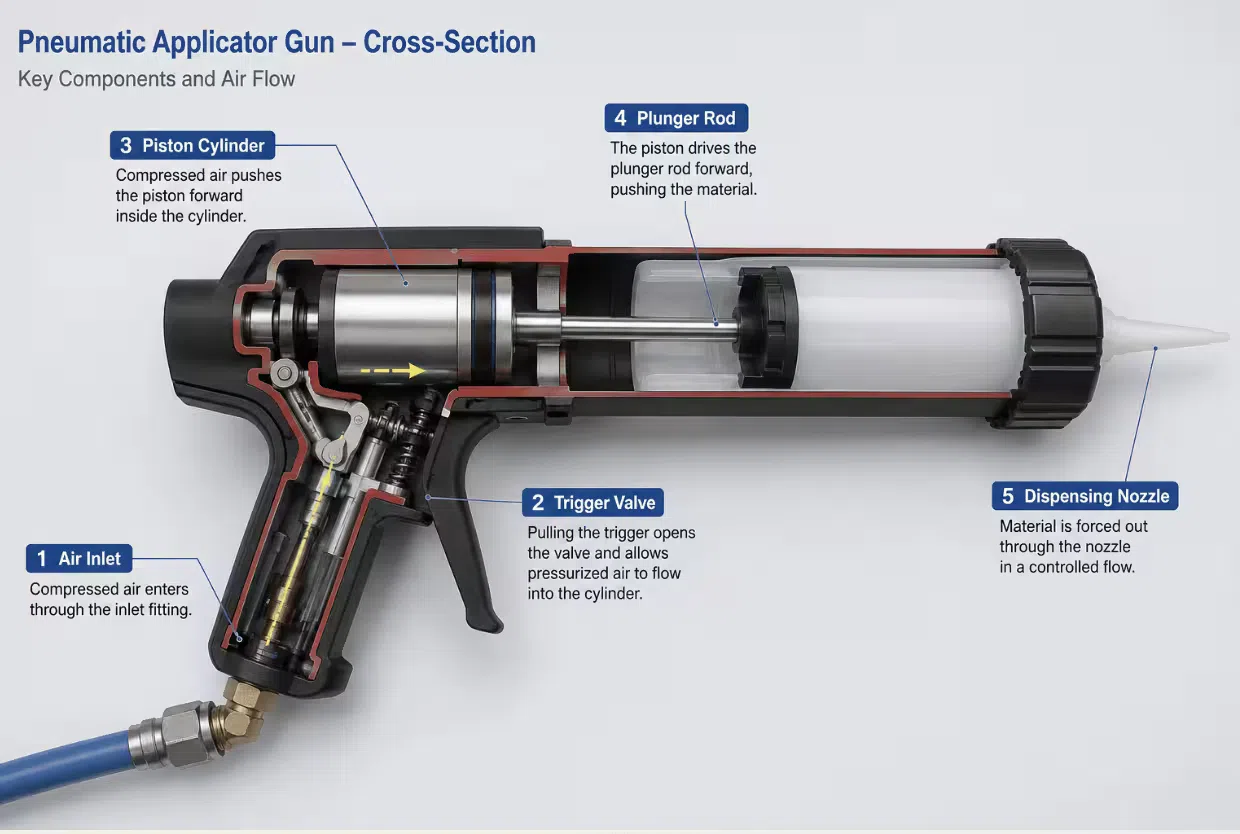
A pneumatic applicator gun uses compressed air to push sealant or adhesive out of a cartridge, sausage pack, or bulk container. Unlike manual caulking guns that depend on hand force, pneumatic applicator guns deliver steady dispensing with less user fatigue over long or repeated application sessions. For B2B buyers — distributors, construction suppliers, adhesive brands, and industrial procurement teams — understanding how a pneumatic applicator gun works, what air supply it needs, and which materials it can handle helps in making correct ordering decisions.
How a Pneumatic Applicator Gun Works
Compressed air enters the gun body through a fitting on the handle. When the operator pulls the trigger, a valve opens and pressurized air flows into a cylinder that pushes a piston. The piston drives a plunger rod forward, which pushes the sealant or adhesive out of the cartridge or sausage pack through the nozzle.
When the trigger is released, the valve closes and the air supply to the cylinder stops. Most pneumatic guns include a relief valve or exhaust port that vents residual air pressure so the material stops flowing quickly. Without this feature, the gun may continue dispensing for a short time after the trigger is released, which wastes material.
The dispensing speed depends on the air pressure entering the gun. Higher pressure pushes the plunger faster for a higher flow rate. Lower pressure slows the flow, which helps with precise bead control on thin joints or detailed work. Some pneumatic guns include an adjustable trigger or built-in regulator that gives the operator direct control over dispensing speed without needing to adjust the compressor.
Air Pressure and Compressor Requirements
Pneumatic applicator guns typically operate between 40 and 100 PSI. The exact pressure depends on the material viscosity, nozzle opening size, and bead width required. Thicker materials such as polyurethane sealant or construction adhesive need higher pressure to maintain a steady flow. Thinner materials such as acrylic latex or low-viscosity MS polymer can be dispensed at lower pressure.
The specification table below shows the factors that affect pneumatic applicator gun selection for B2B ordering.
| Specification | Unit | What It Affects | B2B Buying Note |
|---|---|---|---|
| Working pressure range | PSI | Determines which sealant viscosities the gun can handle | Confirm the gun can cover your customers' most common sealant types at their typical working temperature |
| Air consumption (CFM) | Cubic feet per minute | Affects compressor size needed per gun | Pneumatic guns typically use under 1 CFM — a small pancake compressor often works for moderate use |
| Barrel size | mm or inches | Determines cartridge or sausage pack fit | Standard barrels fit 310ml (10.5 oz) cartridges; sausage models fit 400ml to 600ml packs |
| Plunger thrust force | pounds or N | Determines ability to push thick materials through the nozzle | Higher thrust handles thicker sealants but may overshoot on thin materials |
| Air inlet thread | NPT, BSP, or metric | Determines fitting compatibility with local air hose standards | Check regional fitting standards before bulk ordering |
Compressed air volume consumption for a pneumatic applicator gun is relatively low compared to other air tools — usually under 1 CFM during continuous operation. A small 2-to-6-gallon air compressor with a regulator is sufficient for intermittent or moderate daily use. For continuous 8-hour production or high-volume sealing work, a compressor with a larger tank (10 gallons or more) or a higher duty cycle rating helps the unit keep up without overheating. Buyers supplying pneumatic applicator guns to workshop or factory customers should ask about the end user's compressor setup before finalizing model recommendations. The air powered caulking gun PSI and compressor guide covers compressor matching in more detail.
Compatible Materials and Packaging Formats
Pneumatic applicator guns are designed for a range of one-component sealants and adhesives. Common compatible materials include silicone sealant, acrylic sealant, polyurethane sealant, MS polymer sealant, and construction-grade adhesives. For two-component epoxy or structural adhesive systems, a dual-component pneumatic applicator gun with a static mixer nozzle is required. The pneumatic epoxy gun guide covers dual-component dispensing in more detail.
The application matching table below helps B2B buyers connect the gun type to the end user's working environment.
| Application | Recommended Gun Type | Key Specs to Check |
|---|---|---|
| Window and door sealing (silicone, MS sealant) | Single-component pneumatic cartridge gun | PSI range: 40–70; barrel: standard 310ml cartridge |
| Curtain wall waterproofing (polyurethane sealant) | Single-component pneumatic sausage gun | PSI range: 60–100; barrel: 600ml sausage pack |
| Assembly line adhesive bonding (construction adhesive) | Single-component pneumatic bulk gun | Thrust force rating; bulk loader compatibility |
| Automotive seam sealing (seam sealer, body panel adhesive) | Single-component pneumatic cartridge gun | PSI range: 50–80; ease of nozzle cleaning |
| Epoxy anchoring and bonding (2-part adhesive) | Dual-component pneumatic applicator gun | Cartridge ratio (1:1, 2:1, or 4:1); static mixer thread type |
Cartridge and Sausage Pack Formats
Single-component pneumatic applicator guns are available in barrel sizes that match the most common sealant packaging formats:
- 310ml (10.5 oz) standard cartridge — the most common format for general construction sealant. Use a standard barrel pneumatic gun.
- 400ml cartridge — a mid-size format used for many European and specialty sealant products. Confirm barrel length before ordering.
- 600ml sausage pack — a high-capacity format used for curtain wall, waterproofing, and high-volume sealing. Use a pneumatic sausage gun with a cradle or sling barrel.
- Bulk (5-gallon or larger) — used in manufacturing and assembly lines. A pneumatic bulk caulking gun with a loader or pump system is needed, not a standard cartridge gun.
B2B buyers who stock multiple sealant packaging formats should consider stocking pneumatic guns in different barrel configurations, or guns with adjustable barrel holders that can accept multiple pack sizes. The pneumatic caulking gun specs guide provides detailed specification comparisons.
Key Selection Criteria for B2B Buyers
Material viscosity range. A pneumatic dispensing gun that works well for silicone at 50 PSI may struggle with polyurethane at the same pressure. Confirm the gun's recommended working pressure range against the sealant types your customers typically use. Thicker materials need higher pressure and a gun with sufficient thrust force.
Packaging format match. A standard cartridge gun cannot accept a 600ml sausage pack. A sausage gun with a cradle barrel can accept both sausage packs and some cartridge sizes, which reduces the number of SKUs needed for a diverse product line. Check the barrel diameter and length against the packaging dimensions your customers order.
Air pressure control. Guns with a built-in regulator or adjustable trigger give the operator direct control over dispensing speed. Guns without these features rely entirely on the compressor regulator, which is less precise when the user is working away from the compressor. For precision work such as structural bonding or thin bead sealing, a gun with on-tool adjustment reduces material waste.
OEM and private label options. Pneumatic applicator guns can be branded, packaged, and configured for different markets. Factory-direct supply is available with custom color, logo marking, packaging design, and user manual options. Confirm minimum order quantities, lead times, and configuration flexibility with the supplier.
Spare parts availability. Pneumatic guns have seals, pistons, and valves that wear over time. Buyers who stock pneumatic guns for resale should also stock common replacement parts — primarily piston seals, trigger valves, and air inlet fittings — to support end users and reduce returns. Check whether the manufacturer offers spare parts kits and what the typical lead time is.
FAQ
What is a pneumatic applicator gun? A pneumatic applicator gun is a compressed-air-powered dispensing tool used to apply sealants, adhesives, and caulking materials from cartridges, sausage packs, or bulk containers. It uses air pressure instead of hand force to push material out.
How does a pneumatic applicator gun work? Pulling the trigger opens a valve that lets compressed air flow into an internal cylinder. The air pushes a piston, which drives a plunger rod forward, pushing the sealant out through the nozzle. Releasing the trigger closes the valve, and a relief port vents remaining pressure so material stops flowing.
What materials can a pneumatic applicator gun dispense? Single-component pneumatic guns handle silicone, acrylic, polyurethane, MS polymer sealant, and construction adhesive. Dual-component pneumatic guns handle epoxy, structural adhesive, and other two-part materials that require mixing through a static mixer nozzle. The exact model must match the material viscosity and packaging format.
How much air pressure does a pneumatic applicator gun need? Typical working pressure is between 40 and 100 PSI. Thicker sealants such as polyurethane need higher pressure. Thinner sealants such as acrylic work at lower pressure. Check the sealant manufacturer's technical data sheet for the recommended dispensing pressure range.
Can pneumatic applicator guns be used for sausage packs? Yes. Pneumatic sausage guns with cradle or sling barrels are designed for 400ml to 600ml sausage pack sealants. Sausage pack guns suit high-volume sealing work where fewer reloads and cleaner dispensing matter.
Do pneumatic applicator guns come with OEM and private label options? Yes. Pneumatic applicator guns are commonly supplied through wholesale, OEM, and private label programs. Custom branding, color, packaging, and user manual options are available from factory-direct suppliers. Confirm MOQ and lead time with the manufacturer.
Is a pneumatic applicator gun better than a cordless one? It depends on the working conditions. Pneumatic guns are lighter, cost less per unit, and work continuously as long as a compressor is running. Cordless guns are portable and quieter. For fixed workstations, workshops, or factories where compressed air is already available, pneumatic guns are practical. For mobile crews, cordless guns may be more convenient.
How much does a pneumatic applicator gun typically cost in wholesale quantities? Pricing varies by model, barrel configuration, build quality, and order volume. Factory-direct pricing is generally lower than retail. Buyers should request a quote with their expected order quantity, preferred barrel size, and any OEM requirements to get accurate pricing.
Where can I buy pneumatic applicator guns wholesale? Pneumatic applicator guns are available factory-direct from manufacturers. Wholesale, OEM, and private label supply options are common for tool distributors, construction suppliers, adhesive brands, and industrial buyers. Bulk pricing, custom branding, and packaging configuration are typically available.
What should I check before ordering pneumatic applicator guns for wholesale stock? Confirm the sealant types your customers use, the packaging formats (cartridge, sausage pack, or bulk), the required air pressure range, the air inlet thread standard in your region (NPT, BSP, or metric), and whether you need spare parts support. If you plan to offer private label options, confirm MOQ and lead time with the factory.
Ordering and Sourcing
B2B buyers evaluating pneumatic applicator guns for wholesale or OEM supply should prepare their sealant type, cartridge or sausage pack size, target market, expected order quantity, and any OEM or private label requirements before contacting a supplier. Sharing these details helps factory sourcing teams recommend the correct gun configuration, packaging format, and pricing structure for each market channel.
CAULKMFG supplies factory-direct pneumatic applicator guns for wholesale, OEM, and private label programs. Browse the pneumatic caulking guns category page to review available models. Contact the sales team with your product requirements to receive a tailored quote including pricing, MOQ, lead time, and configuration options.