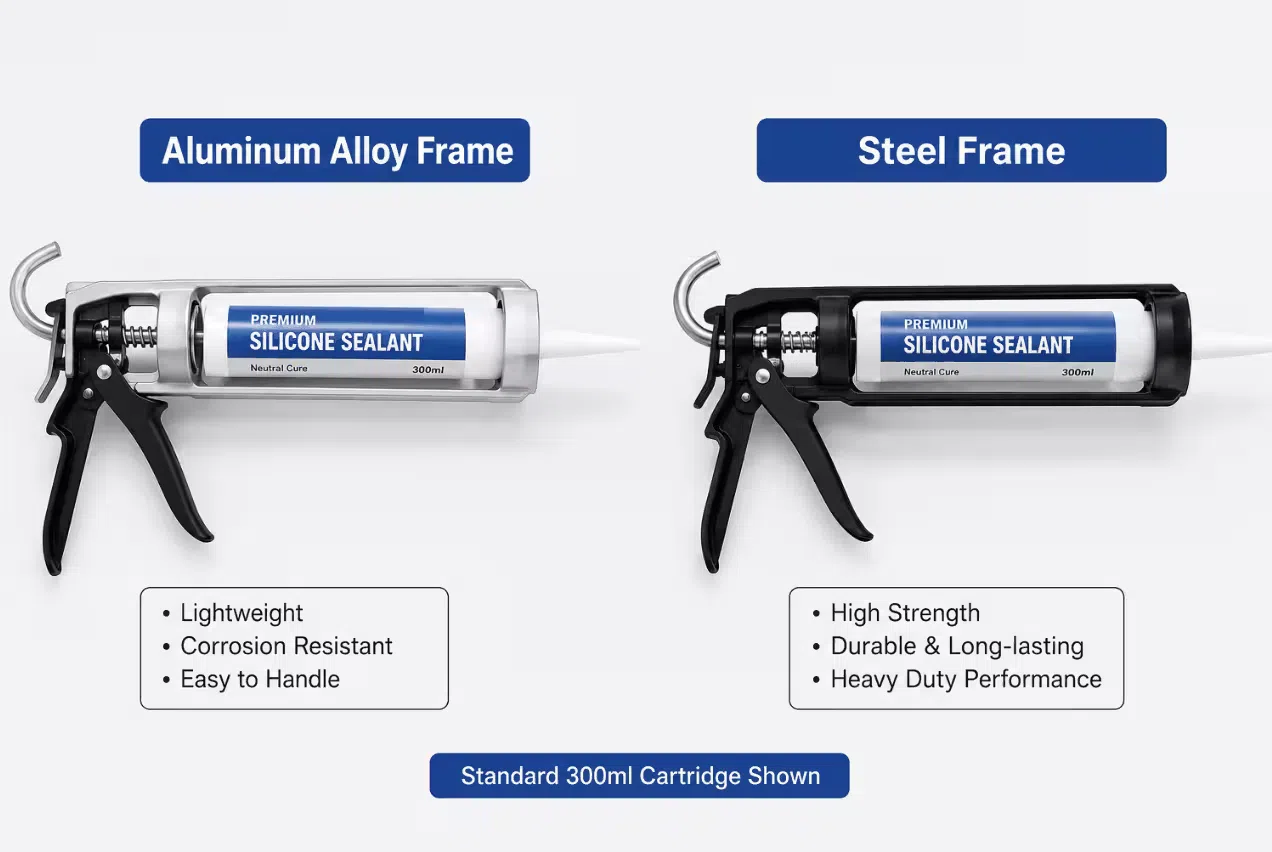
A skeleton caulk gun is a manual caulking gun with an open-frame design that exposes the sealant cartridge along its full length. Unlike closed-barrel guns that encase the cartridge in a tube, the skeleton frame holds the cartridge between two side rails with front and rear support brackets, leaving the cartridge body visible. This frame style is the most common design for 300 ml manual caulk guns and is widely used in construction, window installation, waterproofing, and general sealing.
For B2B buyers evaluating which frame type to stock or order wholesale, understanding the skeleton design — its strengths, limits, and the spec options available — helps match the right gun to the right application and end user.
Key Features of a Skeleton Caulk Gun
The skeleton frame design affects several practical aspects of how the gun performs on a job site. These features also determine which buyer segments will find it useful.
Cartridge visibility. Because the frame is open, the operator can see exactly how much sealant remains at any point. Trade users on construction forums report that this helps reduce waste — they can plan reloads instead of running out mid-bead or discarding half-full cartridges. For distributors, this is a practical selling point for contractors who apply sealant on long runs and value material efficiency.
Lighter weight. Skeleton frames use less material than closed-barrel designs. A typical 300 ml skeleton gun weighs between 0.5 kg and 1.0 kg depending on frame material and thrust ratio mechanism, while closed-barrel guns for the same cartridge size are often 20–30% heavier. Lower weight reduces shipping cost per unit for wholesale orders and lowers arm fatigue for operators who dispense sealant for hours at a time.
Easier to clean between material changes. When switching between sealant types or colors, an open frame can be wiped down directly with a rag or solvent without disassembling the gun. This matters in production environments where operators change materials between batches and cannot afford downtime for tool cleaning.
Rod and trigger compatibility. Skeleton frames accept multiple rod types — smooth rod for steady bead control, ratchet rod for incremental dispensing, and hex rod for high mechanical advantage. The trigger mechanism can be standard or dripless with a pressure-release lever that retracts the plunger when the trigger is released, preventing after-ooze. For a detailed breakdown of rod options, see the smooth rod and ratchet caulk gun guide. For trigger mechanism types including quick-release and standard designs, see the caulking gun trigger mechanism guide.
Skeleton Caulk Gun vs Closed Barrel
The choice between skeleton and closed barrel affects weight, durability, cost, and cleaning convenience. Each design suits different buyer profiles and application tiers.
| Specification | Skeleton Frame | Closed Barrel Frame | B2B Buying Note |
|---|---|---|---|
| Weight | 0.5–1.0 kg typical | 20–30% heavier | Lower weight reduces shipping cost and operator fatigue |
| Cartridge visibility | Full — cartridge visible | None — cartridge inside tube | Visibility reduces waste and speeds material checks on site |
| Frame rigidity | Moderate — depends on material and rail thickness | Higher — tubular design resists bending | Stamped steel skeleton guns may bend under thick sealants; cast or heavy-gauge frames perform better |
| Cleaning ease | Open frame accessible with rag | Requires wiping inside barrel or removing cartridge | Faster material changes for contractors who switch sealants |
| Typical cost | Lower for standard models | Higher — more material in tube | Skeleton is the cost-effective option for most 300 ml applications |
| Use cases | General sealing, silicone/acrylic, window install | Heavy-duty, thick sealants, industrial use | Closed barrel preferred when extreme frame rigidity is needed |
A common concern on trade forums is that cheap stamped-steel skeleton guns bend under the pressure of thick polyurethane or cold sealants. This is a real limitation of low-quality skeleton frames, not of skeleton guns as a category. A skeleton gun with a cast handle, reinforced side rails, or an aluminum alloy frame handles the same materials that a closed-barrel gun can. The key is matching frame quality to the application.
How to Choose a Skeleton Caulk Gun for Wholesale Sourcing
When evaluating skeleton caulk guns for distribution or OEM, focus on the specifications that determine real-world performance and end-user satisfaction.
Frame Material
Steel frames are heavier but more rigid under load. Aluminum alloy frames are lighter and resist corrosion but may flex under very high thrust. For general construction sealing with silicone, acrylic, or hybrid sealants, an aluminum alloy frame with adequate rail thickness performs well. For contractors who regularly dispense thick polyurethane or structural adhesives, a steel or reinforced aluminum frame is a safer choice.
Thrust Ratio
The thrust ratio determines how much force the trigger delivers to the plunger. General guidance from sealant manufacturers and tool makers:
| Material or Application | Recommended Thrust Ratio | Why It Matters | Buyer Check |
|---|---|---|---|
| Silicone, acrylic, common sealants | 7:1 to 12:1 | Lower ratio is adequate — smooth trigger pull with less hand effort | Confirm sealant viscosity from TDS before ordering |
| Hybrid sealants, medium adhesives | 12:1 to 18:1 | Medium ratio balances force and bead control | Test with the specific sealant brand in cold conditions |
| Polyurethane, thick adhesives | 18:1 to 26:1 | Reduces hand fatigue and prevents frame flex | Verify frame material can handle the thrust without bending |
| Cold-weather application (below 10°C) | 18:1 or higher | Cold sealants thicken — higher mechanical advantage needed | Inform buyers that cold dispensing changes thrust requirements |
Thrust ratio is a core specification to match the end user's typical sealant. Distributors should stock multiple ratios so their customers can choose by application.
Dripless Mechanism
A dripless mechanism uses a release lever on the trigger or frame to retract the plunger rod slightly when the trigger is released, relieving cartridge pressure and stopping sealant ooze. Trade users on Reddit consistently name after-ooze as a top frustration with basic skeleton guns. For wholesalers, skeleton guns with dripless mechanisms are easier to sell to contractors who value clean job sites and minimal waste.
Rod Type
Smooth rod guns provide consistent bead control with steady trigger pressure and are common for precision work. Ratchet rod guns click incrementally and are widely used because the rod does not slide back when the trigger is released — useful for operators who stop and restart frequently. The rod type affects how the gun handles bead start-stop transitions, independent of the frame design.
Common Applications
The skeleton frame is practical for any job using 300 ml cartridges of sealant or adhesive.
| Application | Recommended Frame | Key Specs to Check |
|---|---|---|
| Window and door sealing | Aluminum alloy, 12:1, smooth rod | Lightweight for overhead work; dripless to avoid mess on glass |
| General construction sealing | Steel or aluminum, 12:1–18:1, ratchet rod | Moderate thrust; ratchet rod for intermittent dispensing |
| Silicone in kitchens and bathrooms | Aluminum alloy, 7:1–12:1, smooth rod | Low thrust adequate for silicone; smooth rod for clean bead |
| Polyurethane sealant dispensing | Steel or reinforced aluminum, 18:1–26:1, ratchet rod | High thrust required; check frame rigidity |
| Waterproofing and facade sealing | Steel or heavy-gauge aluminum, 18:1, ratchet or smooth rod | Medium-high thrust; frame must support outdoor temperature conditions |
| Factory assembly and production | Lightweight aluminum, 12:1, ratchet rod | Low weight for repeated use; ratchet for start-stop patterns |
For matching skeleton gun specs to heavy-duty applications, see the heavy duty caulking gun guide for thrust ratio thresholds and frame material comparisons.
FAQ
What is the difference between a skeleton and closed barrel caulk gun?
A skeleton caulk gun uses an open frame with side rails that hold the cartridge in place, leaving it visible. A closed barrel gun encases the cartridge in a metal tube. Skeleton guns are lighter and easier to clean, while closed barrel guns offer more frame rigidity for very high thrust applications.
Are skeleton caulk guns strong enough for thick sealants?
Yes, when the frame material and thrust ratio are matched to the sealant. A steel or reinforced aluminum skeleton gun with an 18:1 or higher thrust ratio handles thick polyurethane and structural adhesives. Cheap stamped-steel skeleton guns may bend under high force, so frame quality matters more than frame type.
Which thrust ratio should I choose for a skeleton caulk gun?
For silicone and acrylic sealants, 7:1 to 12:1 is sufficient. For hybrid sealants and medium adhesives, 12:1 to 18:1. For polyurethane, structural adhesives, or cold-weather dispensing, 18:1 to 26:1. Confirm the sealant viscosity from the manufacturer's technical data sheet.
Can I get OEM branding on a skeleton caulk gun?
Yes. CaulkMFG supplies skeleton caulk guns with OEM branding, custom colors, custom packaging, and model-specific configurations. Buyers can specify frame material (aluminum alloy or steel), thrust ratio, rod type, and color. Minimum order quantities depend on the model and configuration.
How do you clean a skeleton caulk gun between uses?
Wipe the exposed frame, plunger rod, and front support bracket with a rag soaked in the solvent appropriate for the sealant used — mineral spirits for silicone and polyurethane, soap and water for acrylic. Because the frame is open, no disassembly is needed for routine cleaning.
What cartridge sizes does a skeleton caulk gun accept?
Most 300 ml skeleton caulk guns are designed for standard 300 ml (10 oz) sealant cartridges. Some also accept 310 ml cartridges common in Europe. Confirm cartridge diameter and length with the supplier before ordering to ensure frame bracket compatibility.
How can I tell if the skeleton frame quality is good for wholesale?
Look for frame side rails 1.5 mm or thicker on steel models, a cast front bracket rather than a stamped bracket, and a trigger mechanism that operates without side-to-side slop. Mild flex under heavy trigger pressure is normal on lightweight aluminum frames, but visible bending of the side rails indicates insufficient strength for the intended use.