Cartridge Caulking Gun Specs: Thrust Ratio and Frame Guide
When you search for cartridge caulking guns on a supplier site, you often see a table with model numbers, thrust ratios, frame materials, and colors — but no explanation of what those numbers mean or how they affect the gun your customer will use on the job. For a distributor or wholesaler ordering 300 ml cartridge guns for different market tiers, understanding these specifications is the difference between a product line that sells well and one that generates returns and complaints.
This guide explains the key specifications found on a typical cartridge caulking gun spec sheet and shows B2B buyers how each spec affects ordering decisions, stocking strategy, and end-user satisfaction.
What Is a Cartridge Caulking Gun
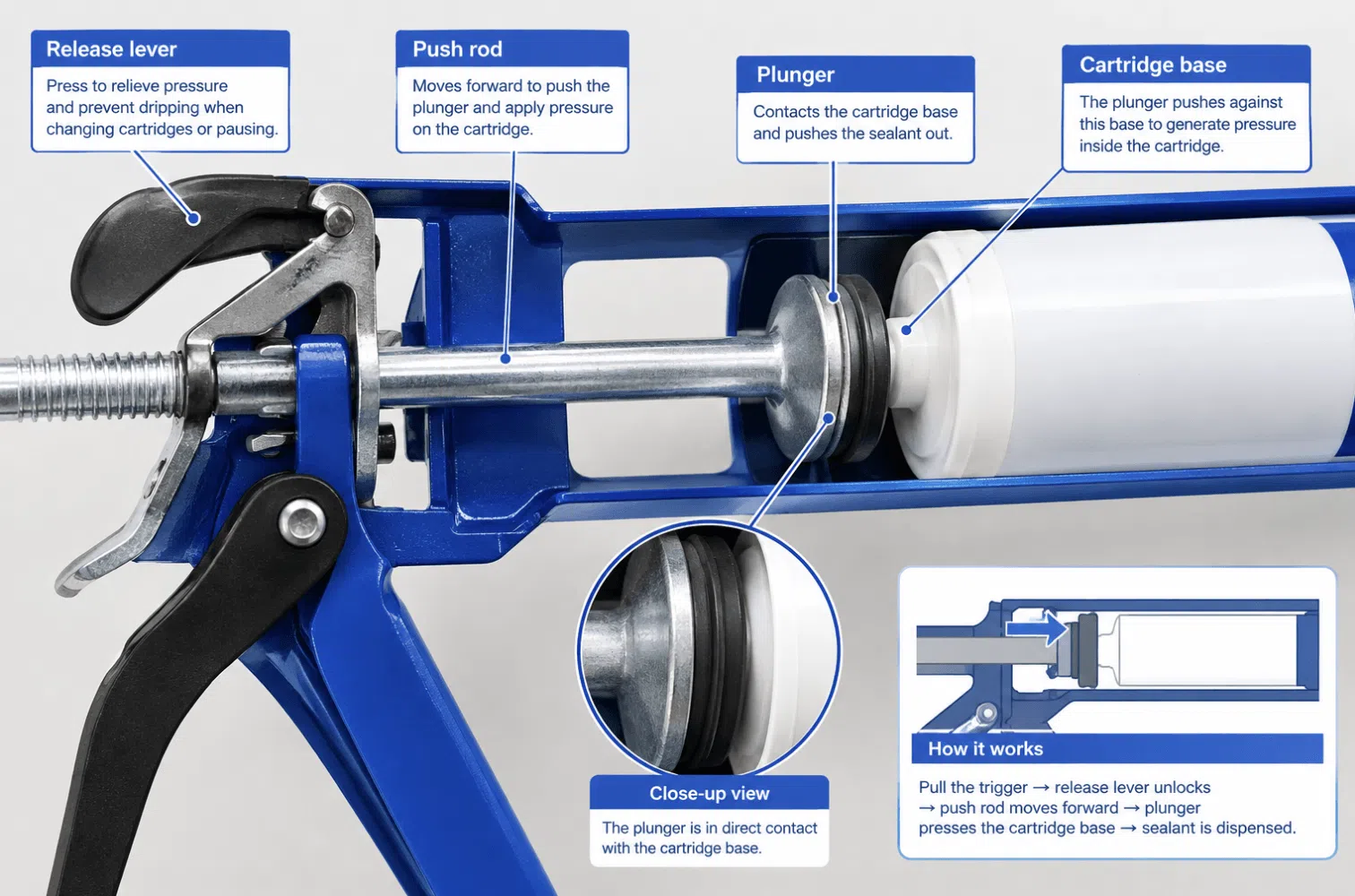
A cartridge caulking gun is a hand-operated dispensing tool designed for rigid sealant and adhesive cartridges, most commonly the 300 ml or 310 ml standard. The trigger drives a push rod forward, pressing the cartridge piston to push material out through the nozzle.
Compared with sausage caulking guns (which use foil packs) and dual-component guns (which use side-by-side cartridges for two-part materials), the single-component cartridge caulking gun serves the widest range of sealing jobs. Hardware stores, construction suppliers, and online channels across markets stock them as a core product category.
If you are an importer or distributor deciding which cartridge caulking gun models to carry, the specs you need to compare start with thrust ratio and frame material.
Thrust Ratio: How Much Dispensing Force the Gun Delivers
Thrust ratio is the mechanical advantage between your hand squeeze and the force applied to the cartridge piston. A 12:1 ratio means the trigger mechanism multiplies your hand force by 12 times.
Thrust Ratio Reference Table
| Specification | Unit | What It Affects | B2B Buying Note |
|---|---|---|---|
| Thrust ratio | X:1 (e.g., 7:1, 12:1, 18:1, 24:1, 26:1) | Dispensing force — higher ratio pushes thicker material with less hand effort | Stock multiple ratios for different market tiers; higher-ratio guns reduce complaints from users of thick sealants |
| Typical low range | 6:1 to 10:1 | Suitable for low-viscosity silicone and acrylic sealants at room temperature | Best for hardware retail and DIY channels where casual users seal with standard silicone |
| Typical medium range | 12:1 to 18:1 | Handles general construction sealants; balances effort and control | Good core stock for construction supply and contractor markets |
| Typical high range | 24:1 to 26:1 | Designed for thick PU sealants, hybrid adhesives, and cold-weather dispensing | Essential for distributors serving northern climates or construction adhesive users |
| Rod travel per stroke | Fixed distance per trigger squeeze | Higher ratio typically means more material dispensed per squeeze; lower ratio offers finer bead control | End users may prefer higher travel for faster work or lower travel for precision |
How to Match Thrust Ratio to Your Market
For general silicone and acrylic sealants at room temperature, lower thrust ratios such as 7:1 or 12:1 are usually sufficient. These models cost less and feel lighter for casual users. Caulking gun price varies noticeably across thrust ratio tiers, so stocking a lower-ratio option gives you an entry-level price point for hardware retail.
For polyurethane sealants, hybrid sealants, and construction adhesives — especially in colder working conditions — the material resists flow more. A higher thrust ratio such as 18:1, 24:1, or 26:1 delivers smoother dispensing and noticeably reduces hand fatigue over a full workday.
If you are stocking for a broad market, consider offering two tiers: a lower-ratio model for silicone and acrylic work, and a higher-ratio model for construction-grade materials. The CaulkMFG cartridge caulking gun range includes options from 7:1 to 26:1. For a detailed explanation of how thrust ratio numbers translate to real dispensing performance, see our caulk gun thrust ratio guide.
Frame Material: Aluminum Alloy vs Steel
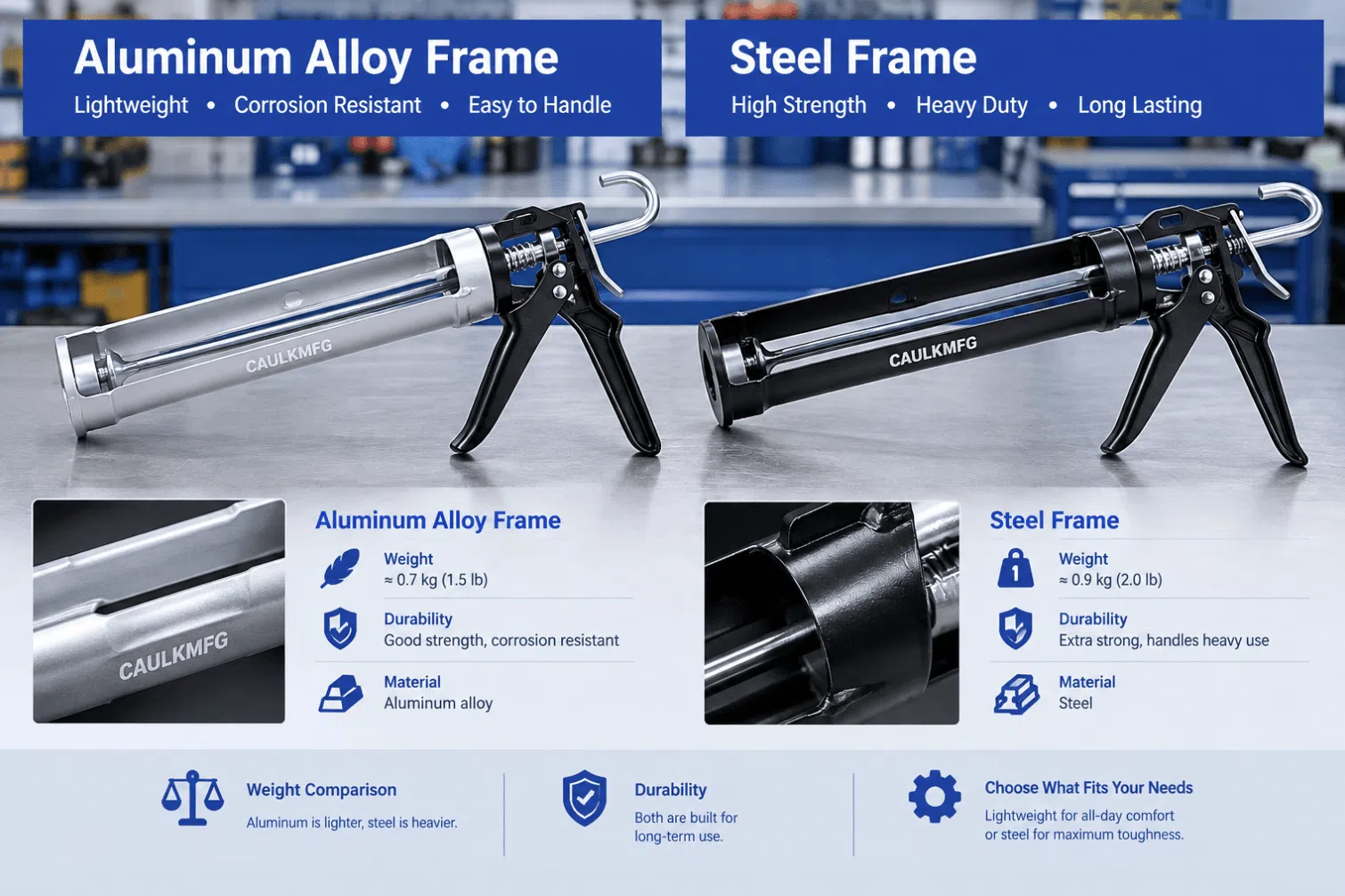
The frame is the structural body that holds the cartridge and the push rod assembly. Frame material directly affects weight, durability, corrosion resistance, and cost.
Application Matching Table
| Application | Recommended Gun Type | Key Specs to Check |
|---|---|---|
| Hardware retail, general silicone sealing | Standard cartridge caulking gun (aluminum alloy or metal frame) | Thrust ratio 7:1 to 12:1, lighter weight |
| Craft, DIY, light repair distribution | Light-duty hand caulking gun (aluminum alloy frame) | Thrust ratio 7:1 to 10:1, smooth rod mechanism |
| Professional construction supply | Reinforced cartridge sealant gun (steel or reinforced alloy frame) | Thrust ratio 12:1 to 18:1, dripless mechanism |
| Thick sealant / cold climate distribution | High-thrust cartridge caulk gun (steel or heavy metal frame) | Thrust ratio 18:1 to 26:1, durable frame |
| Industrial / multi-tier distributor | Industrial caulk gun range (multiple frame types) | Range of thrust ratios, OEM color options, various packaging |
Aluminum alloy frames are lighter and naturally corrosion-resistant. Models 03 and 04 in the CaulkMFG lineup use aluminum alloy construction with thrust ratios from 7:1 to 24:1. These suit retail channels where the buyer is a homeowner or occasional user who values a lighter tool.
Steel or metal frames are heavier but more rigid. They handle higher thrust ratios without frame flex, which improves dispensing consistency when pushing thick material. Models 01 and 02 use metal construction with 18:1 to 26:1 thrust ratios. Contractors and construction-site users typically prefer these despite the added weight, because the frame lasts longer under daily use.
For a deeper comparison of how frame design affects usability, our skeleton caulk gun guide explains the open-frame design option available on some models.
Rod Mechanism: Smooth Rod vs Ratchet Rod
The rod mechanism determines how the push rod moves forward and how it releases.
- Smooth rod guns use friction to hold position. The rod moves forward smoothly with each trigger squeeze and retracts when you press the thumb lever. These are quieter and have fewer mechanical parts.
- Ratchet rod guns use a toothed rod and a pawl mechanism. Each squeeze clicks the rod forward one tooth. The design provides positive position locking but produces more noise and drag.
For B2B ordering, smooth rod guns are more common in hardware retail because they feel more refined. Ratchet rod guns appear more often in contractor channels where users are accustomed to the mechanical feedback. Both types work with standard 300 ml cartridges.
Dripless Mechanism
A dripless (auto-reverse) mechanism lightly retracts the push rod by a few millimeters when you release the trigger. This relieves pressure on the cartridge piston, stopping the sealant flow almost immediately.
Without a dripless mechanism, the residual pressure in the cartridge keeps pushing material out after you stop squeezing. This causes the leaking and dripping that users complain about, especially on vertical surfaces and during intermittent bead work.
For B2B buyers, offering dripless models alongside standard models lets your customers choose based on their application. Professional finishers and painters will pay more for clean shutoff. General hardware customers may not need it but will appreciate it once they see the difference.
If you already stock cartridge caulking guns and are evaluating which features matter most to end users, our cartridge caulking gun OEM sourcing guide covers how to evaluate manufacturing quality across different spec configurations.
Cartridge Size and Compatibility
Most manual cartridge caulking guns are designed for 300 ml or 310 ml rigid cartridges. This format is the most common standard across hardware, construction, and industrial distribution channels.
When ordering, confirm two dimensions:
- Cartridge diameter — standard cartridges are roughly 50 mm (2 inches) in diameter
- Cartridge length — standard 300 ml cartridges are roughly 215 mm (8.5 inches) long
Most cartridge guns are matched to this standard, but some markets or specialty materials use different cartridge dimensions. If you are sourcing for a specific region where local cartridge standards differ, confirm the cartridge fit with the gun supplier before placing a bulk order. For more detail on how different sealant materials interact with gun specs, see our caulking gun material selection guide.
FAQ
How do I remove a cartridge from a caulking gun?
Press the thumb release lever at the back of the gun to disengage the rod. Pull the rod fully back, tilt the gun, and slide the cartridge out. If the cartridge is empty, the nozzle end slides out first. If partially used, seal the nozzle tip before removing.
How do I load a cartridge caulking gun?
Pull the push rod fully back. Insert the cartridge nozzle-first into the barrel. Push the rod forward until it contacts the cartridge base. Cut the nozzle tip at a 45-degree angle and puncture the inner foil seal using the built-in puncture pin on the gun frame or a stiff wire.
What thrust ratio do I need for silicone sealant?
For standard silicone sealant at room temperature, a thrust ratio of 7:1 to 12:1 is typically sufficient. If the silicone is thicker, cold, or being applied through a long nozzle, a higher ratio around 12:1 to 18:1 provides better control with less hand effort.
Is aluminum alloy or steel frame better for construction use?
Steel or metal frames are generally better for construction site use because they are more rigid and handle higher thrust ratios without flexing. Aluminum alloy frames are lighter and rust-resistant, making them a good fit for retail channels and occasional use.
Can one cartridge caulking gun handle all sealant types?
Not equally well. A gun with a low thrust ratio (7:1) handles thin silicone easily but struggles with thick PU or hybrid sealants. A high-thrust gun (26:1) handles thick materials well but may push thin silicone too fast for controlled bead work. Distributors typically stock two or three thrust ratio tiers to cover different market segments and sealant types.
Does CaulkMFG offer OEM customization for cartridge caulking guns?
Yes. Cartridge caulking guns can be customized with private-label branding, specific frame colors, custom packaging, and model configurations matched to your market. When preparing an OEM inquiry, include the target sealant types, preferred thrust ratio range, cartridge format, and estimated annual volume so the factory can recommend the right specification.
What is the minimum order quantity for wholesale cartridge caulking guns?
MOQ varies by model and configuration. CaulkMFG supports wholesale and OEM orders with options for custom colors, packaging, and private labeling. When requesting a quote, specify the target sealant types, cartridge format, estimated annual volume, and any branding or packaging requirements so the factory can match the right model configuration to your distribution plan.
Ordering the Right Cartridge Caulking Gun for Your Market
Matching cartridge caulking gun specifications to your market is a practical business decision. Stock the wrong thrust ratio and end users will complain about hand fatigue or poor bead control. Choose the wrong frame material and the guns may feel too heavy for retail or too light for construction.
Start by identifying the primary sealant types your customers use, the typical working conditions in your region, and the price points your market expects. Then select thrust ratio tiers and frame materials that match those requirements.
For wholesale or OEM orders, CaulkMFG offers cartridge caulking guns in multiple frame types, thrust ratios, colors, and packaging configurations. Submit a request with your target sealant types, cartridge size, estimated order volume, and OEM or private label requirements, and the team can recommend a model configuration that fits your distribution plan.